The Syria Conundrum

Maher Arar on the Syrian Intifada and the left’s confused response.
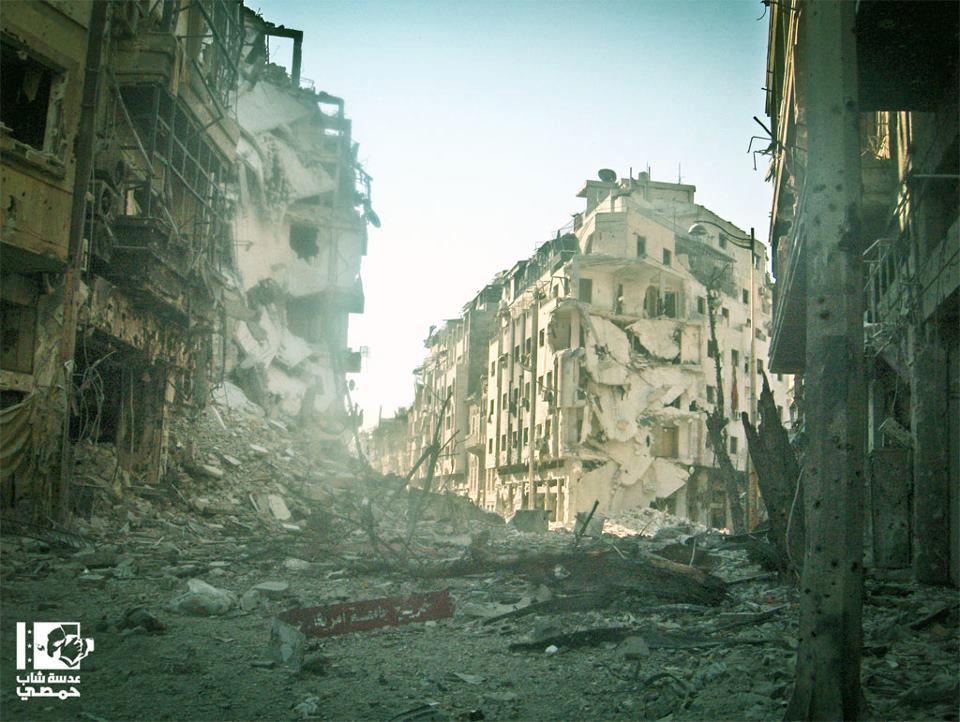
Homs after 37 days of a brutal siege

Deciding whether or not to oppose Syria’s rulers has been the recent dominant preoccupation of many anti-imperialist and left-leaning movements. This hesitant attitude towards the Syrian struggle for freedom is nurtured by many anti-regime actions that were recently taken by many Western and Middle-Eastern countries, whose main interest lies in isolating Syria from Iran. However, I believe a better question to ask with respect to Syria is whether the leftist movement should support, or not support, the struggle of the Syrian people.

What I find lacking in many of the analyses relating to the Syrian crisis, which I find oftentimes biased and politically motivated, is how well the interests of the Syrian people who are living inside are taken into account. Dry and unnecessarily sophisticated in nature, these analyses ignore simple facts about why the Syrian people rebelled against the regime in the first place.

A brief historical context is probably the best way to bring about some insight with respect to the events that are unfolding in front of our eyes today. Before doing so, it is important to highlight that, unlike many other Arab countries, Syria is not a religiously homogenous Middle-Eastern country. I am mentioning this because it is through religion that the majority of Arabs identified themselves for centuries. As it stands today, Syria’s population is composed 74 per cent of Sunnis (including Kurds and others), 12 per cent Alawites (including Arab Shia), ten per cent Christians (including Armenians) and three per cent Druze.
Continue reading “The Syria Conundrum”

Women who refuse to die

An excellent Al Jazeera documentary about the survivors of the Srebrenica massacre.

In July 1995, an estimated 8,000 Muslim men and boys – sons, husbands and brothers – were dragged away never to be seen again. The Srebrenica massacre marks a particularly inhumane and brutal act within the tragedy and bloodshed of the 1992 to 1995 Bosnian War. This film follows four survivors of the massacre as they look to the future despite the pain of their loss and the angst of trying to make sense of the past.

The Drone Morality

Here’s part three of Alternate Focus’s The Drone Wars trilogy. (Also see Part 1 and Part 2)

Who bears responsibly for lethal action when weapons are fully automated? Can a machine have a code of ethics? While their accuracy might, in theory, minimize innocent deaths, drones also enable illegal political assassinations, and by keeping US troops out of harm’s way they also make war easier. A serious debate on these topics is long overdue.

The Drone Economy

Here’s part two of Alternate Focus’s The Drone Wars trilogy. (Also see Part 1 and Part 3)

The forerunners of drones that are currently targeting people on the ground were once themselves targets. They have since evolved into reconnaissance vehicles, and more recently as weapons platforms. Predator drones are manufactured in Poway, near San Diego, where over 4,000 people are employed at General Atomics at the taxpayers’ expense. We examine the implications of this kind of warfare, and the loop of finance that rewards contractors and the politicians they support.

In praise of the 101st Airborne

They call them the ‘screaming eagles’; their courage is the stuff of legends. Men of the 101st Airborne are never daunted by impossible odds — especially if the odds are in their favour. They show a jaunty nonchalance in combat, a complete indifference to danger — especially if it’s danger that they themselves have created, to which only their enemies are exposed. As the following gun camera footage shows, they exhibit absolutely no sign of fear sitting in their AH64 Apache gunship while confronted with the real and present threat of destitute farmers armed with poppy seeds. They even sing before despatching their fearsome adversaries with a Hellfire missile. If I had the authority, I’d remove that eagle from their insignia and replace it with something more befitting–something like an image of George Zimmerman. What better avatar for men who stand their ground with such valour?

The day Hasan and Husam met their government

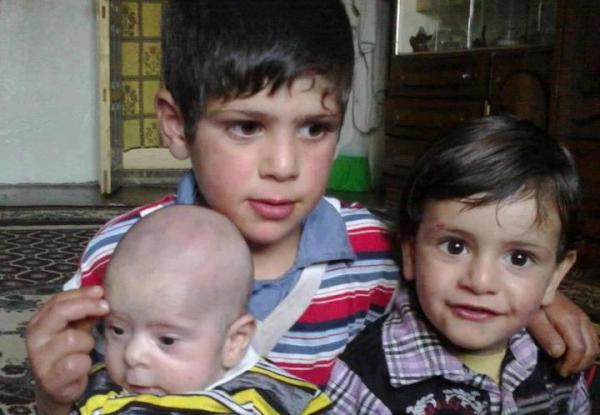
This is a photo of brothers Hasan and Husam al Zouabi from Daraa, Syria.

And this is a photo of Hasan and Husam after they met their government.

Continue reading “The day Hasan and Husam met their government”

Assad’s Downfall

It seems like the beginning of the end for the Baath regime. Its closest ally Iran is already looking to a future beyond Assad. General Manaf Tlass, a scion of the Tlass family — the keystone for four decades of the Sunni-Allawi alliance — has also had enough of the regime brutality and defected to Paris. Wikileaks has also started releasing Syria Files, a trove of documents that include 2,434,899  email exchanges between regime officials and some cronies. So far there isn’t much that’s particularly interesting, except evidence of continuing Italian support for the regime and this PR advice that the regime received from Brown Lloyd James (BLJ) to brush up its image after its bloody crackdown.

Syria’s Torture Centers Revealed

Human Rights Watch has an in-depth report on 27 torture centers run by the Syrian intelligence. You can find an interactive map of the locations and their practices here.

Former detainees and defectors have identified the locations, agencies responsible, torture methods used, and, in many cases, the commanders in charge of 27 detention facilities run by Syrian intelligence agencies. The systematic patterns of ill-treatment and torture that Human Rights Watch documented clearly point to a state policy of torture and ill-treatment and therefore constitute a crime against humanity.

Killing Arafat

Al Jazeera’s excellent investigative journalist Clayton Swisher reveals stunning new facts about Arafat’s death in ‘What Killed Arafat?’.

A nine-month investigation by Al Jazeera discovered rare, radioactive polonium on the ex-Palestinian leader’s final belongings. The finding suggests that Arafat was poisoned with polonium, a rare, highly radioactive element. The polonium was found in blood, sweat, urine and saliva stains on his personal effects, and the levels recorded by forensic pathologists in Switzerland – who studied the items – do not occur naturally.