Author: alannahpriestley
Unarmed and Courageous: Emergency Workers in Afghanistan
by Kathy Kelly and Josh Brollier
June 1, 2010

For six days in late May, 2010, Emergency, an Italian NGO providing surgery and basic health care in Afghanistan since 1999, welcomed us to visit facilities they operate in the capital city of Kabul and in Panjshir, a neighboring province. We lived with their hospital staff at both places and accompanied them in their weekly trips to various FAPs (First Aid Posts) which the hospitals maintain in small outlying villages.
One morning, accompanying a field officer from the Kabul hospital, we pulled off of the main road and traveled over unpaved lanes, then walked a short distance to a shady grove outside a small Afghan village. Villagers, eager to welcome Emergency’s staff and drivers, served ripe mulberries and a salty cucumber yogurt drink. We sat in a circle, shaded by the trees. When breezes stirred the branches, we’d enjoy a momentary rain of mulberries, much to the amusement of little children nearby.
Continue reading “Unarmed and Courageous: Emergency Workers in Afghanistan”
Artist Lowkey on Gaza flotilla in London
Israelis massacre activists on aid flotilla
Scenes from the massacre:
UPDATE I, II, III, IV and V on the BBC’s despicable coverage below.
Al Jazeera International, 30 May 2010 — A deadly attack has taken place off the coast of Gaza – as Israeli forces stormed at least one ship – attempting to break the blockade of Gaza. Commandos lowered themselves from helicopters and onto the Mavi Marmara – the lead ship in a flotilla of six vessels which are carrying aid for the Palestinian territory…Israeli radio is reporting the death toll may be as high as 16 people. Al Jazeera’s Jamal Elshayyal onboard the ship sent this report before communications were cut
According to multiple reports the death toll now stands at 16, with over 60 injured. You can follow Al Jazeera International and Press TV‘s excellent live coverage. You can also follow the flotilla’s Twitter feed.
Mustafa Barghouti on Al Jazeera rightly notes that this constitutes an act of war against multiple countries. The ship was in international waters carrying the flags of several countries. This is a flagrant violation of international law.
Continue reading “Israelis massacre activists on aid flotilla”
A Day to Remember: Resistance and Liberation Day 2010
by Brenda Heard
Anniversaries measure time. In one respect, they are an artificial concept. We decide, for instance, that twenty-five years of marriage should be celebrated, but we ignore the subsequent days as merely marking the path to twenty-six years. And reaching twenty-six years, though obviously a greater length of marriage, will not be celebrated with the same gusto as the twenty-fifth anniversary that boasts pre-printed greeting cards and foil balloons.
As the contrivance of marking anniversaries in many ways defies common sense, we might ask ourselves why we do it. Perhaps it is because the infinite, amorphous magnitude of time must be taken in bite-size pieces. It would otherwise be overwhelming. When we stop the passage of time—no matter how arbitrarily, no matter how superficially—then we are in effect looking for significance in what we accomplish with our lives.
On the 25th of May 2010, we observe the ten-year anniversary of the Lebanese Resistance and Liberation Day. A full decade has passed since the victory that baffled the Western world. A twenty-two year military occupation was virtually uprooted and expelled. The balance of global power was unhinged.
Continue reading “A Day to Remember: Resistance and Liberation Day 2010”
I Want to Live with my Family
by Kathy Kelly and Josh Brollier
May 24, 2010
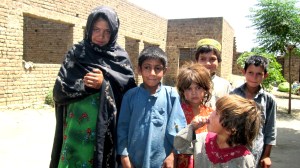
Islamabad–Abir Mohammed, a refugee from Bajaur, says that the battles which raged in his home province since 2008 have dramatically changed his life. We met him in a crowded Islamabad café where he politely approached customers, offering to shine their shoes. He isn’t accustomed to shoeshine work. But, he needs to earn as much money as possible before reuniting with family members who await him, near Peshawar, in a tent encampment for displaced people.
Formerly, he lived with his wife, his five children, his mother and four brothers in a home near the Afghanistan border. “We were very satisfied with our life,” says Abir Mohammed. “My brothers and I cultivated wheat crops and maintained orchards.” His land is full of rich soil. “But, in these days,” says Abir, “due to disasters and lack of water and electricity, there is no chance of cultivating crops.”
Norman Finkelstein v. Benny Morris
To readers I would highly recommend Norman Finkelstein’s new book, ‘This time we went too far’. It is the most systematic and thorough dismantling of the hasbara edifice erected by Israel and its apologists (including Morris). On paper, Morris is a fine historian, but in his media appearances he always dons the hat of the propagandist. In this debate from Russia Today’s CrossTalk, Benny Morris comes across as defensive and boorish. He uses the familar tools of the propagandist, derision and ridicule, to evade serious questions. Every one of his claims about Gaza — that Hamas used human shields, and that its leadership took sanctuary in basements of hospitals — is rebutted by extensive research carried out by the Goldstone Commission, Amnesty International and Human Rights Watch. (via MondoWeiss)
On this edition of Peter Lavelle’s CrossTalk, he asks his guests whether the current “indirect talks” between the Israelis and Palestinians are a waste of time.
Terror reigns on Pakistan’s Northwest Frontier
by Rustam Shah Mohmand
 The devastation could not be more heartbreaking. From one end to the other, the whole tribal area presents the spectacle of a war zone. Houses blown up, villages decimated, infrastructure no more.
Add Dir, Buner and Swat to that. Vast swaths are in ruins in Maidan, in the Dir region. Whole villages in Buner have disappeared. Matta and the adjoining areas in Swat present a picture of a powerful cyclone having devastated the whole area.
Between Khar and Nawagai, in what once was a most fertile area, villages on both sides of the road have been razed to the ground.
Many of the returning IDPs of Bajaur and Dir could not determine where their villages had once stood, to say nothing of their homes. They had to make return journeys to their camps.
In Qaudahari, in the Safi area of Mohmand, the situation is no better. The wreckage of a war is everywhere, with houses and villages having ceased to exist.
Bara, in Khyber Agency, an area once administered by an Assistant Political Agent, presents the picture of a ghost town.
Continue reading “Terror reigns on Pakistan’s Northwest Frontier”
Alleged Death Flight Pilot Fights Charges with Legal Tools Denied to Victims of Argentina’s Dirty War

by Kurt Fernández
BUENOS AIRES—Julio Alberto Poch, the former Argentine naval pilot being held on charges that he flew hundreds of “vuelos de la muerte” or death flights during the 1976-83 military dictatorship, appeared relaxed as he walked into federal court in Buenos Aires on May 20.
Poch was recently extradited from Spain in a sequence of events that began after alarmed colleagues at the Dutch airline Transavia.com testified to an Argentine federal judge that Poch, an airline employee, had bragged about such feats as having piloted planes that disposed of leftist terrorists during Argentina’s “Guerra Sucia,” or Dirty War.
In an affirmation of the rule of law—and in stark contrast to the conditions in which many victims of the Dirty War were “brought to justice”—Poch was neither hooded nor in leg irons nor naked nor drugged as he stepped from the fourth floor elevator at the federal judicial building in Buenos Aires’ Retiro neighborhood.
Politician’s Disappearance Raises Questions About Mexico’s Security Strategy
 by Kristin Bricker
A shorter version of this article appears on the Security Sector Reform Centre’s blog.
The presumed kidnapping of Diego “The Boss” Fernández de Cevallos, one of Mexico’s most powerful politicians, has put Mexico’s security crisis in the international spotlight yet again.
The Mexican government hasn’t officially classified de Cevallos’ disappearance as a kidnapping. However, the fact that his car was found abandoned on his ranch with traces of blood and signs of struggle has lead his family to plea that his “captors” make contact in order to negotiate his release. At the time of writing, it is unknown if de Cevallos is alive or dead.
The crime itself isn’t shocking—kidnappings are all-too-common in Mexico. Nor would de Cevallos be the first politician to fall victim to violent crime—several local politicians have been killed or attacked in recent weeks as the country prepares for interim elections. What sets this crime apart from others is that the victim is one of the most powerful men in Mexico.
Continue reading “Politician’s Disappearance Raises Questions About Mexico’s Security Strategy”
 P U L S E