Bees and Terrorists

David Anderson QC

David Anderson QC, a barrister who serves as the Independent Reviewer of Terrorism Legislation, claims that bee stings kill as many in the UK as terrorists. This is concerning. I didn’t know that bee stings were such a big problem in the UK. I want the government to invest more in anti-bee measures, fund more academic research into bee psychology, engage the good bees to separate them from the bad ones, and encourage communities across Britain to report any suspicious bee behavior.

In his report, Barrister Anderosn presented these alarming figures: “During the 21st century, terrorism has been an insignificant cause of mortality in the United Kingdom. The annualised average of five deaths caused by terrorism in England and Wales over this period compares with total accidental deaths in 2010 of 17,201, including 123 cyclists killed in traffic accidents, 102 personnel killed in Afghanistan, 29 people drowned in the bathtub and five killed by stings from hornets, wasps and bees.”

Life through Medialens – but not as we know it

by Martin Rowson

This week I thought I’d describe my adventures with a website called Medialens over a cartoon I recently drew for The Guardian. It featured Bashar al-Assad, in the immediate aftermath of the Houla massacre, smeared in blood and pointing an equally blood-stained finger at his own chest. Also depicted were Vladimir Putin, Wen Jiabao, Ban Ki Moon, Kofi Annan, several cowled figures of Death, Angela Merkel and Christine Lagarde lashing a pile of human bones with euro-laden cats-o’-nine-tails and the sleeping form of David Cameron, snuggled up to an enormous cat dressed in a blue pin-striped suit. The thing was captioned “Who? Me?!?”, although it’s by no means clear who’s saying these words, just as it’s not clear whose blood besmirches Assad, whether it’s his latest alleged victims’, from his earlier ones or, for that matter, whether the blood might be his own.

Anyway, I was asked by Medialens via Twitter (in 140 characters or less, even if a picture is, they say, worth a thousand words) what clear evidence I had for President Assad’s personal involvement in the Houla massacre. So far as I can tell, Medialens turn out to be a couple of blokes called David whose mission is to expose the lies, misrepresentation and manipulation in the “mainstream media”. Continue reading “Life through Medialens – but not as we know it”

Pakistan’s Unplanned Revolution Rewrites Its Future

By Pankaj Mishra

Change Returning last week from an instructive three weeks in Pakistan, I was detained briefly at Islamabad’s chaotic airport after an X-ray machine showed two highly suspicious music CDs and a USB memory stick in my check- in bag.

The music was of Mehdi Hassan, my favorite singer in South Asia, and the USB was part of a PR packet given to me by a Bangkok hotelier. It didn’t matter. For nearly three hours, two men in shalwar kameez — members of one of Pakistan’s intelligence agencies — supervised customs and immigration officials, and even the staff of my Middle Eastern airline, through an extensive scrutiny of my bags and the many visas in my passport.

These plainclothed, thuggish-looking men seemed to confirm the popular Western stereotype of Pakistan’s “deep state,” a vast subterranean network of soldiers, spies, and militants-for- hire that actually runs the country while the state fails to provide health care and education to a largely poor and illiterate population of nearly 190 million.
Continue reading “Pakistan’s Unplanned Revolution Rewrites Its Future”

60 Minutes on the Holy Land’s dwindling Christians

This is a very significant moment in American television history. Over a year back Bob Simon of CBS’s 60 Minutes had provided first glimpses to an American mainstream audience of the Palestinian lives being disrupted by Israeli occupation. He now returns to the Holy Land to debunk Israeli claims (made most recently by Israeli ambassador Michael Oren) about the thriving Christian presence in the historic lands. If you can ignore Simon’s statements about the security allegedly being provided by the wall, you’ll find the last couple of minutes, where he makes the generally composed Michael Oren squirm by confronting him over his attempts to suppress the 60 minutes investigation, quite satisfying. You can measure the significance of this segment from the fact that Israeli prime minister Benjamin Netanyahu himself got involved in attempts to pressure CBS into abandoning the investigation; it has since been described by Israeli officials as a ‘strategic terror attack‘, and ADL has issued an official condemnation.

Meanwhile, our friends at Jewish Voices for Peace have launched a campaign to thank 60 Minutes for its hard-hitting coverage. We’d encourage all readers to take a few minutes to sign their petition.

Vodpod videos no longer available.

Afghan Screams Aren’t Heard

by Kathy Kelly and Hakim

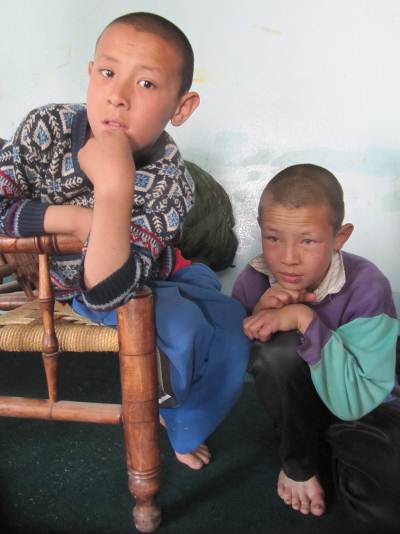
Two Afghan youth taking refuge together with the Afghan Peace Volunteers

Last weekend, in Kabul, Afghan Peace Volunteer friends huddled in the back room of their simple home. With a digital camera, glimpses and sounds of their experiences were captured, as warfare erupted three blocks away.

The fighting has subdued, but the video gives us a glimpse into chronic anxieties among civilians throughout Afghanistan. Later, we learned more: Ghulam awakens suddenly, well after midnight, and begins to pace through a room of sleeping people, screaming.  Ali suddenly tears up, after an evening meal, and leaves the room to sit outside. Staring at the sky and the moon, he finds solace.  Yet another puzzles over what brings people to the point of loaning themselves to possibly kill or be killed, over issues so easily manipulated by politicians.

I asked our friend, Hakim, who mentors the Afghan Peace Volunteers, if ordinary Afghans are aware that the U.S. has an estimated 400 or more Forward Operating Bases across Afghanistan and that it is planning to construct what will become the world’s largest U.S. Embassy, in Kabul.  Hakim thinks young people across Kabul are well aware of this. “Do they know,” I asked, “that the U.S. Air Force has hired 60,000 – 70,000 analysts to study information collected through drone surveillance?  The film footage amounts to the equivalent of 58,000 full length feature films. The Rand Corporation says that 100,000 analysts are needed to understand ‘patterns of life’ in Afghanistan.”

Hakim’s response was quick and cutting: “Ghulam would ask the analysts a question they can’t answer with their drone surveillance, a question that has much to do with their business, ‘terror’: “You mean, you don’t understand why I screamed?”

Continue reading “Afghan Screams Aren’t Heard”

Adam Shatz on Claude Lanzmann

Adam Shatz has a superb piece in the latest issue of the LRB on Claude Lanzmann, the maker of Shoah. I highly recommend it to readers. (It requires a subscription, which I highly recommend since LRB is by far the world’s best political-literary publication).  Here’s an excerpt:

‘Everybody is somebody’s Jew, and today the Palestinians are the Jews of the Israelis,’ Primo Levi said after the massacres in Sabra and Shatila. The bitter ironies of Israel’s treatment of the Palestinians – all too evident to Levi, who had seen men and women in Auschwitz reduced to ghosts ‘who march and labour in silence’, known in the camps as ‘Muslims’ – are invisible to Lanzmann. He is fond of quoting Emil Fackenheim’s remark that the murdered Jews of Europe are ‘the presence of an absence’, but refuses to see that the Jewish state was also created ‘in the presence of absence’, as Mahmoud Darwish wrote. Only a few years after the war, Holocaust survivors found themselves living in the homes of another people who had been driven into exile, and on the ruins of destroyed villages. The Ben Shemen forest, where Lanzmann spoke with survivors of the Sonderkommando in Shoah, is only four kilometres east of Lod, where tens of thousands of Arabs were forcibly expelled in 1948. The Nakba – Arabic for ‘catastrophe’, or Shoah – has yet to end […]

Since the outbreak of the Second Intifada, the French Jewish community has been swept by a wave of communautarisme, or identity politics. Anti-semitism is one reason: clannishness is understandable in the face of incidents like last month’s killings in Toulouse. But anti-semitism alone can’t explain the Jewish community’s turn inward, or its drift to the right. A few years ago, troubled by the increasingly bellicose tenor of Jewish politics in France, Jean Daniel published a striking little book calledThe Jewish Prison. This prison, unlike anti-semitism, was self-imposed, and made up of three invisible walls: the idea of the Chosen People, Holocaust remembrance and support for the state of Israel. Having trapped themselves inside these walls, the prosperous, assimilated Jews of the West were less and less able to see themselves clearly, or to appreciate the suffering of others – particularly the Palestinians living behind the ‘separation fence’. Over the last four decades, Claude Lanzmann has played a formidable role not only in building this prison but in keeping watch over it. That a chronicler of the Holocaust could become a mystical champion of military force, an unswerving defender of Israel’s war against the Palestinian people and a skilled denier of its crimes, is a remarkable story, but you won’t find it in Lanzmann’s memoir.

Brother Arab Republic of Syria

Venezuelan president Hugo Chavez has offered his unequivocal support to the leader of the ‘Brother Arab Republic of Syria’. Those unfamiliar with the anti-imperial record of this regime might find the following report instructive:

The Iron Lady

The Iron Lady is currently in showing in British cinemas. The trailer seems to suggest that Margaret Thatcher advanced the cause of women. In a recent interview Meryl Streep confessed how much more she had come to appreciate Thatcher’s contributions to feminism. It all reminded me of this clip from The Onion.

Ralph Fiennes on Coriolanus

I watched Ralph Fiennes’s superb directorial debut Coriolanus last night. It is one of my favourite Shakespeare plays and Fiennes does it justice with a gritty adaptation, using a documentary camera technique. Like Orson Welles’s Julius Caesar, the play is transposed to modern times while retaining the Shakespearean language. The questions of power, representation, umbilical bonds, and the conflict between liberty and security are given a contemporary relevance. The adaptation is artistically bolder than Julie Taymor’s excellent Titus, even if Taymor’s adaptation was more creative and seamless in incorporating modern motifs into an ancient, rather more fantastic story. The performances, particularly Fiennes’s and Vanessa Redgrave’s, are outstanding. The only quibble I have is Coriolanus’s strutting. Shakespeare’s Coriolanus is confident of his own physical and moral superiority, he has nothing to prove. Whereas Fiennes’s Coriolanus is often stiff and affected, as if he feels the need to keep reminding others of his strength. The tattoo on the neck was just out of place. Gerard Butler is far more relaxed in his role, even if his performance is somewhat lacking in conviction. Lubna Azabal, last seen in the Canadian film Incendies, is convincing as the intense and rebellious Tamora.

Continue reading “Ralph Fiennes on Coriolanus”