Freedom of the press is guaranteed only to those who own one
Author: Idrees Ahmad
I am a Lecturer in Digital Journalism at the University of Stirling and a former research fellow at the University of Denver’s Center for Middle East Studies. I am the author of The Road to Iraq: The Making of a Neoconservative War (Edinburgh University Press, 2014). I write for The Observer, The Nation, The Daily Beast, Los Angeles Review of Books, The Atlantic, The New Republic, Al Jazeera, Dissent, The National, VICE News, Huffington Post, In These Times, Le Monde Diplomatique, Die Tageszeitung (TAZ), Adbusters, Guernica, London Review of Books (Blog), The New Arab, Bella Caledonia, Asia Times, IPS News, Medium, Political Insight, The Drouth, Canadian Dimension, Tanqeed, Variant, etc. I have appeared as an on-air analyst on Al Jazeera, the BBC, TRT World, RAI TV, Radio Open Source with Christopher Lydon, Alternative Radio with David Barsamian and several Pacifica Radio channels.
Cultures of Resistance has released Iara Lee’s hour-long video of the attack on Mavi Marmara. You see events leading up to the attack, the attack itself (beginning at about 36:00), and its aftermath. (via Juan Cole, whose coverage of the massacre and its aftermath has been stellar)
News organizations need to be careful about their sources. They appear to report as fact claims made by any entity that calls itself an ‘institute’ or a ‘foundation’. This otherwise commendable report from Russia Today on the murderous US drone attacks is no exception. Like many other media outlets (including, oddly, Democracy Now and Al Jazeera) it reports as fact a dubious report produced by the New America Foundation (NAF), a leading cheerleader for the wars in Afghanistan and Pakistan, which has transmuted the drones 98% failure rate into a 67% success rate. None of these media outlets it appears has taken a minute to study the report’s methodology or question the motivations of the organization behind it. The conflicts of interest are serious.
The NAF report is based exclusively on English language media reports, which rely solely on official claims. The officials, both American and Pakistani, for their reasons have an interest in inflating the success rate. Two studies produced by Paksitan’s The News and Dawn (the latter a supporter of the war) show that that the actual success rate is near 2 percent. This estimate has also been endorsed by David Kilcullen, the former senior advisor on counterinsurgency to Gen. David Petraeus. (In response NAF’s ‘Afpak Channel’ published this airy assessment by Christine Fair challenging Kilcullen which relies on yet another ‘institute’, the ‘Aryana Institute’, a sectarian paper organization which actually claims that Pakistanis are thrilled by drone attacks!)
NAF’s ‘Afpak Channel’, which produced the report, discredited itself long ago with its overly rosy assessment of the situation in Afghanistan and Pakistan. And while it has been featuring commentary which is frequently at odds with reality, it has been reluctant to publish anything that might undercut its sanguine support for the war. It sat on a grim assessment of developments in Afghanistan by IPS’s excellent investigative journalist Gareth Porter before informing him that it won’t be published. Its Twitter frequenlty features juvenile commentary, breathlessly sanguine about US successes in Afghanista and Pakistan. Over all, it is a highly questionable source. I’d urge journalists to show more caution.
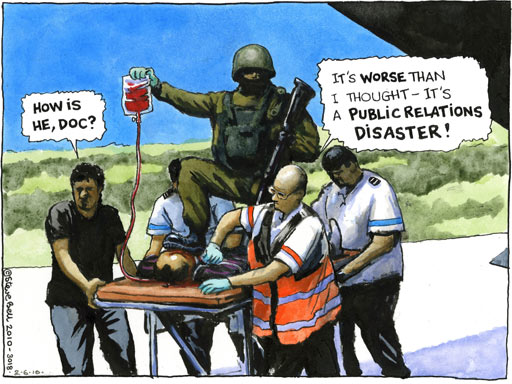
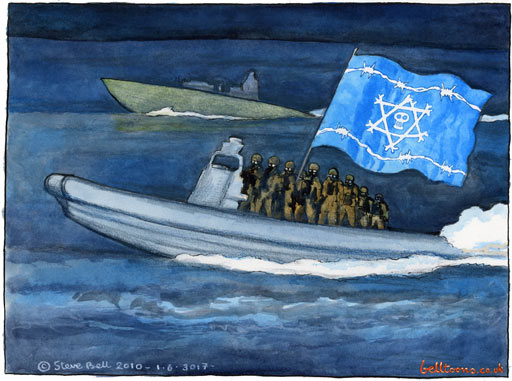
The last 72 hours have been the most harrowing in my life. Even for an experienced campaigner like myself, nothing prepared me for the barbaric onslaught by the Israeli Army on a boat of unarmed peace activists with a cargo of humanitarian aid.
There are images from Monday’s bloody attack that will haunt me for the rest of my life.
May 26, 2010 (IPS) – In 2005, ahead of the G8 summit in Gleneagles, Irish rock star and philanthropist Bono dedicated a concert to Harvard economist Jeffrey Sachs for his services to global poverty alleviation. Time magazine twice named Sachs one of its 100 Most Influential People. His 2005 book “The End of Poverty” was a New York Times bestseller. He has served as a special advisor to U.N. Secretary-General Ban Ki-moon on the Millennium Development Goals. In 2007 Vanity Fair was moved to declare him the “savior of Bolivia”.
From the fawning sobriquets it would be hard to tell that Sachs was the architect of the “economic shock therapy” which in Russia during the transition years (1991-1994) contributed to a 42 percent rise in male deaths, and 56 percent in unemployment. His Bolivian “reforms” brought inflation under control but unemployment, inequality and the cost of living soared.Following a decade of unrest, Russia was only saved by an authoritarian nationalist leadership and Bolivia by economic populism. The neoliberal experiment was a failure.
If Sachs has today recanted his extreme free-market views, it is only because of a personal epiphany. At the peak of his power, he was constrained by neither public censure nor official accountability.He is an exemplar of a new breed of influencers who operate in the interstices of official and private power and exploit the ambiguity of their multiple overlapping roles to evade both public oversight and market competition. It is this emerging power that is the subject of social-anthropologist Janine Wedel’s indispensable “Shadow Elite: How the World’s New Power Brokers Undermine Democracy, Government, and the Free Market”.
Reporters by the thousands are being let go; newspapers and foreign bureaus are disappearing. Why is this happening, and what impact does journalism’s crisis have on democracy? At a recent event, Robert McChesney and John Nichols addressed these questions and cited early US governmental support for journalism.
Rahimullah Yusufzai, who is one of PULSE’s 20 Top Global Media Figures of 2009, interviewed by Dori Smith of the excellent Talk Nation Radio.
Pakistan’s tribal border regions and North Waziristan are dangerous, veteran journalist and editor Rahimullah Yusufzai sheds light on regional militant groups, and local reaction to Faisal Shazhad case. Was it a conspiracy, people ask?
The family of Faisal Shazhad are shocked and wondering what happened. Faisal Shazhad’s Father is a liberal, explains Yusufzai, and the family is not particularly religious. Mysteries will surely surround this case for some time to come.


 P U L S E