A Tale of Two Conferences

On his fine blog, Louis Proyect describes two very different conferences and two very different versions of the left – one statist, which finds itself backing “the neoliberal family dynasty that is bombing working-class tenements” in Syria; the other internationalist, supportive of popular revolution, concerned with the class struggle. The first is the ill-named Stop the War Coalition conference to be held in London on November 30th (it was planning to invite a nun who serves as one of Assad’s chief propagandists and genocide deniers); the second was a Syria solidarity conference held a few days ago in New York.

Louis makes this important point: In the New York conference, “it is important to note that six out of the nine featured speakers were Syrian and that of the three who weren’t, one was Lebanese (Achcar), one was Palestinian (Bodour Hassan), and the other was a graduate student whose dissertation is focused on Syrian politics and who reads and writes in Arabic. What a contrast to the London event where a number of people will essentially be giving the same speech (is there any real difference between Milne, Ali, and Steele? I couldn’t tell the difference between their columns.)” So another distinction: the statist (and orientalist) left isn’t actually interested in hearing from people from the country concerned, unless they are propagandists for fascism. Here’s Louis’s piece in full:

This is a tale of two conferences, one billed as a teach-in on Syria that occurred yesterday at New York University; the other to be held in London on November 30th on Syria as well. They could not be more unalike even though Trotskyists (loosely defined) were in the driver’s seat of both events. As is the case in my write-ups of many movies that I walk out of in disgust after 15 minutes, I will rake the London event over the coals though I will not be attending it, even if someone paid for the airfare.

The London event is organized by the Stop the War Coalition (STWC) that played a key role in opposing George W. Bush’s war on Iraq. To put it as succinctly as possible, they see Syria as a new Iraq war in the making and their mission revolves around the need to oppose Obama’s war plans—something that amounts to busting down an open door. It does not matter to them that Obama never had any intention of invading Syria and imposing “regime change”; nor does it matter that there has been a revolutionary struggle in Syria. Their analysis is based on the struggle between nations and not between classes. In the case of Syria, people like John Rees and Seamus Milne back the neoliberal family dynasty that is bombing working-class tenements simply because the USA opposes it even if that opposition is only verbal. As long as there is a single op-ed piece by Nicholas Kristof taking the Baathists to task or a single speech by Obama filled with crocodile tears about the “Syrian tragedy”, they will remain on Bashar al-Assad’s team.

With almost no interest in what is taking place inside Syria, the STWC conference naturally included only a single Syrian citizen, one Mother Agnes Mariam of the Cross, a diehard supporter of the Baathist dictatorship. When a hue and cry arose over her participation, Owen Jones and Jeremy Scahill told the organizers that they were dropping out. To the great pleasure of those who were protesting her presence, she withdrew. But they are still raising hell over the initial invitation. What would compel “peace” activists like John Rees and Lindsay German to extend an invitation to someone whose reputation as a liar and a warmonger is so well known? I invite you to look at Not George Sabra’s post on Mother Agnes that I am sure helped Scahill make up his mind.

Continue reading “A Tale of Two Conferences”

Iran’s Secret Army

As the world celebrates the deal between the West and Iran, it should be remembered that Western concerns over Iran’s nuclear programme – and the sanctions which have so damaged Iran’s economy – were provoked by Israeli concerns, and that these are not existential but strategic. Iran doesn’t need a nuclear weapon but only the ability to enrich uranium to a level where it could quickly make a nuclear weapon. At that stage, the bullying power given Israel by its own nuclear arsenal vanishes. A sensible approach to the problem would have reduced Tehran’s nuclear ambition while disarming Israel. The West, of course, did not press for this, and Iran, despite its stale ‘resistance’ rhetoric, did not hold out for it.

In general, it’s good to see tension reduced between Iran and the West. The great shame is that while a deal is done over the nuclear programme, something that was never much of a threat, Iran has not been called to account for its pernicious intervention in Syria, a far greater threat to regional and international security. Iran’s intervention is on a far greater scale than any Saudi or Qatari interference. The Islamic Republic’s ‘revolutionary’ legitimacy is of course destroyed by its siding with a tyrant against a revolutionary people, and its Shia legitimacy will also be destroyed in the eyes of any thinking human being, for it has joined Yazeed in a war against a struggling Hussain. After Assad’s employment of sectarian death squads, ‘Shia’ Iran’s deployment of racist occupation forces to direct the tyrant’s fightback has been the single biggest factor amplifying the sectarian nature of the conflict. It has already dragged Lebanon back to the brink of civil war. Some argue that peacable relations between the US and Iran will defang Iran’s hardliners. That may happen eventually, but it will be far too late for usurped and shattered Syria.

I used to argue that the West and the Arabs should work with Iran. I used to repeat the line about Iran not having attacked another country in three centuries. (I made allowances for its pernicious role in keeping Iraq divided and sectarian; Iraq had after all attacked Iran in the past.) Unfortunately this line is no longer true. The Arabs are now absolutely right to regard Iran as an aggressive, expansionist threat. This deal has by no means secured peace in the region.

A Response to Another Insult

from Nablus, Palestine, in solidarity with revolutionary Syria

Someone called Asa Winstanley has addressed (yet another) ignorant insult to the revolutionary Syrian people. In order to make his inane points, Winstanley has to ignore facts (like Russian and Iranian intervention, and the continuing activity of grass roots protestors and organisers) and invent others. Sam Charles Hamad makes the following astute comment:

When it comes to the Syrian revolution, Asa Winstanley is completely discrediting himself. It’s somewhat of a small tragedy to behold – witnessing some of these so-called ‘pro-Palestine’ activists reveal that they couldn’t actually care less about the lives of Arabs (including, most tellingly, Palestinians in Yarmouk, who have been the victim of constant bombardment by Assad’s air force and artillery, not to mention a regime-imposed blockade which pushed them to the brink of starvation). The Arab spring, and in particular the revolution in Syria, has revealed that much of those who consider themselves to be ‘pro-Palestinian’ are in actuality only ‘pro-Palestinian’ if it is Israel that is doing the killing, torturing, maiming, imprisoning and blockading – if the perpetrator is a regime such as Assad’s, which is bafflingly seen as being fundamentally antagonistic to Israel, or at least its continued existence is somehow imagined to be advantageous to the Palestinian struggle against Israeli occupation and domination, they either completely ignore it or are actively willing to apologise for it. This thoroughly inadequate and contradictory reaction of some on the left to the Syrian revolution, and, more generally, the reaction of some of those involved in causes associated with Arabs, fits almost perfectly into this latent orientalist perspective of the Arab as some sort of idealised figure of resistance against the west; or as a constant victim of the west; or, in the case of Syria, as a faceless, passive entity who has absolutely no right to resist or rise against this tyrannical regime that somehow falls into what is so inaccurately thought of as the camp of ‘anti-imperialism’.

And Nader Atassi, at his indispensable Darth Nader blog, takes on Winstanley’s assertions point by point. Nader’s piece is worth reading right to the end for its combined realism and optimism in regard to Syria.

Journalist Asa Winstanley has written an article titled “Syria: the revolution that never was,” for Middle East Monitor. The following is a critique to a few of the claims Winstanley makes in the article. I decided to respond to this article in particular because I believe it contains many erroneous assertions that are frequently used to disparage the Syrian uprising, and thus this is a response and critique of those assertions and the substance of the article in general.

“To say Syria is now a disaster is a massive understatement. This is a sectarian civil war which could continue for a decade if the regime’s enemies, led by the brutal Saudi tyranny, continue to wage their proxy war on the country.

What is being implied in this statement is that if the people engaging in armed struggle against the regime were to put down their weapons, the “sectarian civil war” would cease. I’m not sure how Winstanley concludes this, but it seems to be based on an optimistic view of the regime and to place the responsibility of the war almost totally on the “regime’s enemies.” I firmly believe that intervention by reactionary forces on the side of the opposition (Saudi Arabia, Qatar) has done great harm to Syria and the Syrian uprising in general, but nevertheless, to state that the onus is entirely on them to end this war is to imply that the regime is somewhat innocent, which I believe is ludicrous.

Continue reading “A Response to Another Insult”

Damascus: the First Days of the Revolution

For many months into the Syrian revolution the dominant narrative (outside Syria), promoted by Syria Comment and other such sources, held that the inhabitants of inner Damascus were loyal to the regime, or at least fearful of change. This perceptive and moving talk by Ella Wind takes the wind out of the sails of that myth. Unlike the Tariq Alis and David Bromwiches of the chattering West, Ella clearly knows Damascus and Damascenes very well indeed. She describes the rapid politicisation of her friends, many of whom went on to become revolutionary organisers, and also talks about revolutionary heroes from the Christian community, such as film-maker Basel Shehadeh and our beloved Pere Paolo, last seen in Raqqa, presumed kidnapped by the Islamic State of Iraq and Sham.

Beyond the Sunni/ Alawi Dichotomy

Nader Atassi (of the great Darth Nader blog) takes on the twin myths that the Syrian regime is Alawi and that the revolution is Sunni. To divide and rule, the Assad regime has cleverly exploited sectarian tensions for decades. (A great Syrian blogger of previous years, Karfan – or ‘Disgusted’ – described the regime’s repression of the Alawi community and its religion here – a must read.)

Syria: Global Designs and Local Democracy

Leftist academic Yasser Munif (who happens to be the son of the great novelist – exiled from Saudi Arabia – Abdul Rahman Munif) goes beyond binary idiocy and orientalist generalisation to explain the role of global powers in Syria, as well as the local democracy he saw at work in Menbij, a town in Aleppo province in liberated Syria.

Palestine is Not a Flag

Palestinian anarchist Budour Hassan talks about Palestine and the Syrian revolution. Read Budour’s wonderful blog here (both Arabic and English).

The Syrian Revolution in Brazil

This documentary shows the inspiring solidarity extended by Brazilian workers to revolutionaries in Syria and the wider Arab world.  It puts to shame the betrayals of the Cuban and Venezuelan states, and of course the irrelevant Stalinists, Islamophobes and blanket thinkers in the West. Here is the real left, still standing.

Qaddafi’s Harem

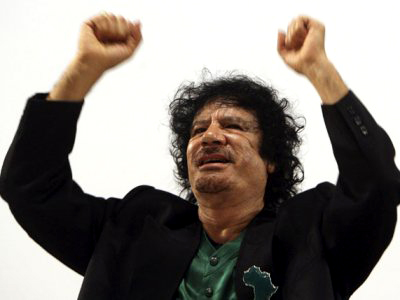
qaddafi-2This review of Annick Cojean’s book was published at NOW.

*

Today is the beginning of the end of the era of harems and slaves and the beginning of women’s liberation within the Arab nation.” Muammar Qaddafi. September 1981.

The Arab world is still crammed full of tyrannies self-labelling with terms such as ‘popular’ and ‘democratic’, sectarian regimes pretending to be secular, reactionary regimes describing themselves as progressive, and ‘resistance’ regimes which resist nothing but their subjects’ life and freedom.

The current post-revolutionary chaos in Libya provokes two orientalist responses: the crude (statist-leftist) version, that the uprising was a foreign conspiracy; and the subtler (because it’s never quite made explicit), that the Libyans made a terrible mistake by rising, because their fractious ‘tribal’ society can only be held together by a strong man of Qaddafi’s calibre. After him, goes the implicit argument, the inevitable deluge.

“Gaddafi’s Harem” by French journalist Annick Cojean provides a fact-based corrective to those fooled by Qaddafi’s illusions, specifically those impressed by the radical feminist image evoked by his once highly visible – and sexily transgressive – corps of ‘Amazon’ body guards. It will change the minds too of those who saw the dictator from a distance as a lovable buffoon.

His regime was capricious, yes, at times even darkly comedic, but it was based on undiluted sadism. The cramping stagnation it imposed for 42 years, and the fact that it refused to budge except by force of arms, are the prime causes of today’s anarchy. The means of domination it employed – psycho-social as much as physical – tell us a great deal about the universal megalomaniac personality, as well as certain cultural weaknesses in the Arab world and beyond.

Continue reading “Qaddafi’s Harem”

Tariq Ali on the Arab Revolutions

Over at Not George Sabra, Malik Little criticises Tariq Ali’s orientalist take on the Arab revolutions.

“What is a revolution?” asks Marxist Tariq Ali in a recent article. He answers, “a transfer of power from one social class (or even a layer) to another that leads to fundamental change.”

Ali never gets around to defining what exactly constitutes “fundamental change,” but he knows for sure that whatever “fundamental change” is, there has been none of it in the Arab world since 2011.

Does the end of the Ben Ali dictatorship in Tunisia and the destruction of its secret police count as “fundamental change? For Ali, no. After decades of a life of comfort and privilege in West, it seems Ali has forgotten what it is like to live under the thumb of a police state and murderous military rule. He has forgotten what a “fundamental change it is to be ruled by elected institutions and politicians rather than tyrants and generalissimos.

Since Ben Ali was ousted, there have been two general strikes called by the main union federation.

For Ali, this is no big deal. How do we know? He never mentions Tunisia or its people even once in his half-assed self-serving overview of the Arab Spring’s non-revolutionaryness, a double oversight since Tunisia is why the Arab Spring happened in the first place.

Instead, Ali goes on to ‘analyze’ events in Egypt where the counter-revolution has triumphed. He uses this triumph to deny that a revolution ever happened. Woe to V.I. Lenin who continued to write about the Russian revolution of 1905 even after it was smashed by the Tsar and Karl Marx who continually referred to the lessons he learned in the abortive German revolution of 1848-1849 for failing to match the insightful wisdom of Tariq Ali, a man who knows a revolution is only a revolution when it succeeds!

The next stop on Ali’s “nothing to see here” tour is Libya:

“In Libya, the old state was destroyed by NATO after a six-month bombing spree and armed tribal gangs of one sort or another still roam the country, demanding their share of the loot. Hardly a revolution according to any criteria.”

No mention of course of the General National Congress election of 2012 that went off without a hitch to the immense jubilation of the long-suffering Libyan people. Mentioning inconvenient facts like this might make Westerners sympathetic to the their difficult struggle to build institutions out of the ashes of 42 years of one-man rule by a deranged tyrant. No discussion of what class rules Libya today is necessary. Better to talk up “armed tribal gangs” in true Orientalist fashion. Who better than a brown man to play on the fears peddled by the white man to convince Westerners that there’s no revolution in Libya for them to solidarize with? Ali knows that if there’s anything Westerners love to hate, it’s Muslims.

In tribes.

With guns.

Throwing up gang signs.

Continue reading “Tariq Ali on the Arab Revolutions”