Arab Writers at the Book Cafe

I was on BBC Radio Scotland’s Book Cafe talking about writing from the Arab world at this revolutionary time. Here it is:

I mention novelist Manhal al-Sarraj’s immediate response to the repression in Syria, ‘Syrian Scenarios’, which can be read here.

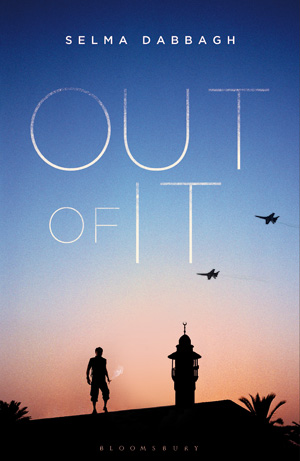
Out Of It

This review appeared in the Guardian.

The Mujaheds, if somewhat more privileged than their neighbours, are a typically itinerant Palestinian family who have learnt to attach sentimental value “only to the small things, the ones that could be thrown into suitcases and scurried away with.” Originally from Jaffa, now returned from Tunis, Beirut and Scandinavia, the novel’s opening finds them living in Gaza in the early years of the second intifada.

One of the many strengths of Selma Dabbagh’s writing is its unerringly precise sense of place. Gaza, imagined from inside with the mental aid of satellite images, is “like dried-out coral, ridged, chambered and sandy.” It contrasts with Israel, “the other side, that side, the place they came from, that had been theirs,” which, studded by solar panels, swimming pools and irrigated fields, looks from above like “an elaborate blanket of modernist design.”

Life in the Mujahed apartment, between the noise of nearby families and the louder noise of warplanes and helicopters, may be like “camping under a flyover”, but it’s better than living in tents as the neighbours – refugees from house demolitions – are forced to do.

The details of dispossession and siege are relentlessly accumulated: the rotting flowers and fruit blocked off from the market by the ‘closure’, the targetted killings, incursions and arbitrary arrests, as well as the increasingly violent internal competition between the religious parties and the corrupt Palestinian Authority whose luminaries are “yearning for cheap suits and desks with name plaques.”

Continue reading “Out Of It”
The Liberation of the Golan

Today demonstrators marched against the Syrian regime in Majdal Shams on the occupied Golan Heights. (For believers in the sectarian narrative, most of the people here happen to be Druze, not Sunnis). One of their slogans was ash-sha‘ab yureed tahreer al-jowlan – The People Want the Liberation of the Golan. The Syrian regime, which has slaughtered over 6,000 civilians since the revolution started, hasn’t fired a bullet over the Golan since 1973. In the clip below Asad loyalists confront the protestors, but are outnumbered. The demonstrators shout almowt wala almuzuleh – Death Rather Than Humiliation – and illi yiqtil sha‘abu kha’in – He Who Kills his People is a Traitor.

It’s interesting to note that the Golan was occupied by Zionists in 1967, before most of the demonstrators were born, and illegally annexed in 1982. The very Syrian drama unfolding on these ‘Israeli’ streets proves – if proof were needed – the absurdity of Zionist hopes that Arab national identity on occupied territory will gradually evaporate.

Now The Bombs

by Ali Farzat

Many Syrians have been awaiting this moment with dread. A further step down into bloody chaos and incipient civil war, a further step into the dark. This morning two car bombs exploded at security installations in Kafar Souseh, Damascus. At least thirty people were killed and over 100 injured.

Who’s to blame? There is no evidence of anyone’s guilt, and there won’t be any credible evidence while the criminal Asad regime remains in power and continues to lie and to block journalists’ access. This means that pro-regime people will follow the regime line and blame al-Qa’ida, and anti-regime people will blame the regime. I make no bones about it: I’m firmly in the anti-regime camp. Those who followed my writing before this year will know that I was once willing to give the regime the benefit of the doubt. Not any longer. This year I’ve been forced to admit that the regime is a lot less intelligent, a lot less sophisticated, than I thought. Back in February it had enough popularity to lead a genuine reform process. It’s entirely possible that Bashaar al-Asad, had he played this revolutionary year right, could have won a real election. But he didn’t play it right. From the start his regime slaughtered peaceful protestors and subjected thousands to torture, including children, even to death. Worst of all, the regime instrumentalised sectarianism in an attempt to divide and rule. After months of attacks by armed Alawi gangs on predominantly Sunni lives and property there are now instances of ‘revenge’ attacks on innocent Alawis, and tit for tat sectarian killings particularly in Homs and its surrounding countryside. All of this could have been predicted months ago. Of course, the mechanics of these killings is as obscure as that behind the bomb attacks in Damascus today. Some revolutionaries believe the regime is behind the killings of Alawis too, because it aims to spark a sectarian war which it thinks it can win. And we must not forget that sectarian war is still – to the credit of the Syrian people – not the dominant strain in the conflict. There are thousands of defected soldiers, many of whom have seen their comrades gunned down. If they had chosen to they could have attacked the minorities in a coordinated fashion. They haven’t. And the Alawi actress Fadwa Sulaiman is still leading demonstrations in the Sunni heart of Homs.

Continue reading “Now The Bombs”

Sarmada

A slightly shorter version of this review appeared in The Independent.

Places have moods, this novel reminds us. Sometimes Sarmada, a mountain village rising from the Hauran plain of southern Syria, is all “oblivion, dust and tedium”; at other times it’s a shimmering delight, each rock, tree, spring, cliff and cave owning rich meanings and histories. Sarmada is also “a Sheherazade”, a generator of tales, so many tales we can’t possibly hear them all. “I thought about telling her the joke about the overweight fortune-teller,” Azzam writes, “but..”

Like the Arabian Nights, “Sarmada” contains stories within a frame story. The frame and trigger is a meeting with Azza Tawfiq, an expert in chaos theory at the Sorbonne who (following the Druze tenet of transmigration) believes she lived in Sarmada in a past life as a murdered girl called Hela Mansour. Bemused, disbelieving, the narrator returns from “chasing dreams in Paris and delusions in Dubai” to excavate the village’s memories, at first on Azza’s behalf.

Continue reading “Sarmada”

The Other Pole

Rime Allaf has an unmissable piece in the Guardian. As a counterpoint to the sectarian war scenario we’re hearing so much about, Rime offers the other pole.

From 1946, spoiled by the US-sponsored coup of 1949 which first brought military rule to the region, Syria witnessed a shortlived parliamentary democracy, a vibrant civil society and a brief period of a free press, and it elected leaders whose names remain embedded in the national memory as examples of the Syria it can be, and it should be. While perhaps initially elitist in nature, unlike the current varied spectrum of opposition groups and revolutionary committees, it is a logical inspiration for the future.

The whole article is well worth reading. There are good observations on how the supposed fractiousness of the ‘opposition’ is not necessarily a bad thing, and important commentary on the future ramifications of Iranian miscalculations.

One major issue may change in the post-Assad era: relations with Iran and Hezbollah. The strategic alliance with Iran since the Islamic revolution flourished under Bashar al-Assad’s reign, especially following the invasion of Iraq, but Iranian support in repressing the current protests won’t easily be forgotten. Likewise, the Hezbollah leader Hassan Nasrallah’s support for the Syrian regime has incensed many, especially after his praise for every other Arab uprising; only last year, it would have been unimaginable to see Hezbollah’s flag burned in Syria, as it has been recently.

Aftermath

The first issue of Critical Muslim, a quarterly magazine in book form co-edited by Ziauddin Sardar and me, will be in the shops in January. More on that at a later date. Today I’m finishing off a long essay on Syria, Iraq and sectarian hatred for Critical Muslim’s third issue. Amongst the books I review in the essay are Fanar Haddad’s indispensable “Sectarianism in Iraq” and Nir Rosen’s “Aftermath: Following the Bloodshed of America’s Wars in the Muslim World,” which is also indispensable, in a different way. As a taster, here’s the section on “Aftermath.”

For a mix of contextual analysis and gripping reportage, the reader will find no better book than Nir Rosen’s magisterial “Aftermath: Following the Bloodshed of America’s wars in the Muslim World”.

Most Western correspondents were flown into Iraq unable to speak Arabic, largely ignorant of the context, to pass their time attending coalition press briefings or embedded with the US military. Their reports were heavy with simplistic labels (‘the Sunni triangle’, for instance) and ignored non-sectarian nationalism and class issues. Rosen’s writing on Iraq is the polar opposite of such parachute journalism. He speaks Arabic for a start, and blends in physically as a result of the “melanin advantage” bequeathed by his Iranian father. More to the point, he is courageous and energetic, going where few outsiders would dare, whatever their skin tone. He’s a reporter of the best kind, capable of locating pattern behind the copious detail. So he doesn’t merely report the mosque sermons he attended, or his encounters with militiamen and their victims, but accurately interprets and reads between the lines. His descriptions of time, place and personality are vivid, with not an ounce of orientalism added. His lack of sentimentality combined with his obvious sympathy for the people of the region make him the perfect candidate to voyage into the sectarian heart of darkness.

Continue reading “Aftermath”

Turn It Up

For Syrians it’s an exhilarating experience simply to express honest political opinions out loud in a public place. For decades anti-regime gripes have been expressed in private, in whispers. Many were frightened to speak even in the home, lest the children repeat what they’d heard at school. But now people are screaming and singing against the regime every morning, afternoon and night. The sense of solidarity amongst the revolutionaries – breaking the fear barrier together, facing possible torture and death together – is enormous. These two films demonstrate the sometimes carnivalesque quality of the revolution as well as the Syrian people’s musicality. In the first, filmed in Da’el in the Hawran, a romantic tune is turned into an  anti-Asad anthem. In the second, filmed in the Baba Amro neighbourhood of Homs, the authorities cut electricity to a protesting area; the protestors illumine their mobile phone screens and keep on going. Both films should be watched with the volume on maximum.

Continue reading “Turn It Up”

Revolutionary Alawis

Samar Yazbeck

Novelist, screenwriter and journalist Samar Yazbeck in interview: “The regime has indeed destroyed the Alawite religion, a peaceful religion, as it engaged in things foreign to the faith, leading some to become its Alawite thugs. But many of us are opponents, in jail, in exile, or banned from travel. The regime is playing with sectarianism to terrify “its” minority and get support. A game that will end, but first, I fear, there will be clashes between the communities.

In this interview an Alawite member of the Syrian Revolution General Council based in Homs argues, “We need to break down the myth that the regime is the defender of Alawites and other minorities. It is just defending itself, and using us for its own ends.”

And in this interview actress Fadwa Sulaiman explains why she’s thrown her lot in with revolutionaries in a besieged area of Homs (she’s currently on hunger strike): – “I just wanted to go just to say we Syrians are one people. I wanted to contradict the narrative of the regime.