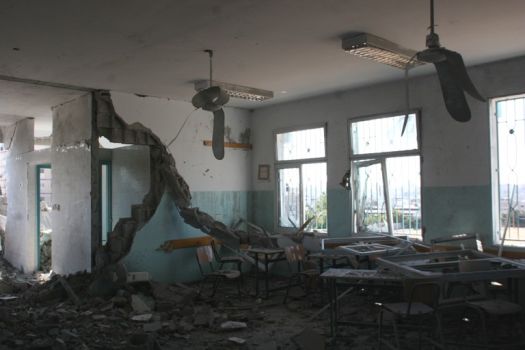
Beware of Small States

The chaos of Lebanon has thrown up an Arab horror paralleled only in post-invasion Iraq. It has also produced the Arab world’s most urgent intellectual life, and its first victory against Israel. Lebanon is the most contradictory of countries, “a more open, liberal and democratic society than any of its Arab neighbours” precisely because of “its vulnerability to domestic dissension.” So, with its seventeen sects and constantly shifting allegiances, who would dare to explain Lebanon?

No better candidate than David Hirst, whose 1977 book “The Gun and the Olive Branch” was one of the very first to sympathetically present the Palestinian plight in English. Hirst’s latest work “Beware of Small States” is a panoramic study of Lebanon’s difficult history which strikes exactly the right balance between close detail and broad interpretative sweep. The writing is precise, penetrative and elegant. For sober, logical analysis, “Beware of Small States” outstrips even Robert Fisk’s magisterial “Pity the Nation.”

Hirst explains Lebanon, and especially the fifteen-year maelstrom of the civil war, its pogroms, set battles, kidnappings and car bombs, by delineating patterns of cause and effect. The civil war is interpreted as “the intertwining of the socio-economic, the sectarian and the Palestinian, those three characteristics of the whole, ever more noxious brew.”

Continue reading “Beware of Small States”

Reel Bad Arabs Floating Overhead

One of the sillier lines deployed to take the wind out of a cultural boycott of apartheid Israel is ‘art is above politics.’ It’s not an argument, just a line. To see how far from an argument it is, just substitute Israel with something we all agree is unacceptable. Would it have been a good idea for an artist to travel to Auschwitz while the chimneys were pumping, not to witness but to entertain the Gestapo? What about singing for Stalin during collectivisation? Or dancing for Pol Pot as he filled Cambodia’s fields with corpses? O, but those were atrocities! They were criminals! Which brings us to the nub of it. Those false liberals and mercenaries who proclaim the nobility of their ‘engagement’ with Zionist colonialism believe that Zionist crimes are ok. The ethnic cleansing of Palestine, the caging of the refugees, the occupation of the West Bank and Gaza, the annexation of the Golan Heights and Jerusalem, the savage, repeated bombardments of Lebanon, the cheerleading for the destruction of Iraq – none of it matters much, because ‘art’ floats high above it.

Continue reading “Reel Bad Arabs Floating Overhead”

In the Face of Overwhelming Odds

art by Ghassan Kanafani

This is in large part an amalgam of other pieces I’ve written on the topic. It’s a response to a debate unfolding at the indispensable Mondoweiss.

In his contribution to the debate on the rights and wrongs of violent resistance to oppression, David Bromwich tells us that non-violent action is supposed to be “visible and exemplary.” In the case of Palestine, this chimes with the dominant Western narrative that the Palestinians would have achieved liberation long ago if only they had avoided mindless acts of terrorism. Much of the mainstream media goes a step further to suggest that the Palestinians are hindered by their culture and religion – which are inherently violent, hysterical and anti-Semitic – from winning their rights. If only they would grow up a little. If only they’d set a good example.

Leading liberal clown Bono has also asked where the Palestinian Gandhis are. The problem here, though, is not the absence of Gandhis but their lack of visibility – the visibility which Bromwich says is so important. For the first two decades after the original ethnic cleansing of 1947 and 48, almost all Palestinian resistance was non-violent. From 1967 until 1987 Palestinians resisted by organising tax strikes, peaceful demonstrations, petitions, sit-down protests on confiscated lands and in houses condemned to demolition. The First Intifada was almost entirely non-violent on the Palestinian side; the new tactic of throwing stones at tanks (which some liberals consider violent) was almost entirely symbolic. In every case, the Palestinians were met with fanatical violence. Midnight arrest, beatings, and torture were the lot of most. Many were shot. Nobel Peace Laureate Yitzhak Rabin ordered occupation troops to break the bones of the boys with stones. And despite all this sacrifice, Israeli Jews were not moved to recognise the injustice of occupation and dispossession, at least not enough to end it.

Continue reading “In the Face of Overwhelming Odds”

British Writers in Support of Palestine

I’m proud to be a signatory to this letter published in shortened form in the Independent on Sunday.

June 4th 2010

Dear Editor

The murder of humanitarian aid workers aboard the Mavi Marmara in international waters is the latest tragic example of Israel’s relentless attacks on human rights. But while violently preventing the free passage of medical, building and school supplies to Gaza, Israel continues to pride itself as a highly cultured, highly educated state. In solidarity with Palestinian civil society and its call for a Boycott Divestment and Sanctions campaign against Israel, we the undersigned therefore appeal to British writers and scholars to boycott all literary, cultural and academic visits to Israel that are sponsored by the Israeli government, including those organised by Israeli cultural foundations and universities. (This boycott does not include courageous independent Israeli organisations who openly oppose the occupation.) We also ask that writers, poets and British funding bodies actively support Palestinian literary events, such as the Palestinian Literary Festival and the Palestinian Writing Workshop.

Continue reading “British Writers in Support of Palestine”

When Did Resistance Become a Dirty Word?

Any Resistance There? by Ali Farzat

What the Western political class and its media demand of the Arabs and Muslims is acceptance of the unacceptable status quo in Israel-Palestine. To resist the status quo is to be troublesome, destabilising and irrationally violent. Resistance arises from the inadequacies of a culture and religion given to antisemitism and hysteria. In order to develop, these backward folk must give resistance up.

For the Lebanese, this means that they must forget the brutal 22-year occupation of their country and the 1982 siege of Beirut as well as the 2006 assault on the country’s civilian infrastructure. They must forget the endless chain of massacres perpetrated by Zionists and their allies on Lebanese territory. They must smile when Israel violates their air space on a daily basis and threatens to send them “back to the stone age” on a weekly basis. They must disarm and label as terrorist Hizbullah, the principled defender of their country.

Syria must smile at the illegal occupation and annexation of the Golan Heights and the theft of its essential water supplies. It must repress the refugees from the Golan and the half million Palestinian refugees and their political organisations. It must not buy or build weaponry that might give it minimum protection from Zionist terrorism. It must grin stupidly when Israel chooses to bomb its territory.

Continue reading “When Did Resistance Become a Dirty Word?”

Boycotting the Outlaw State

The Klaxons and Gorillaz Sound System have cancelled their shows in Israel this week. They deserve our congratulations and support. Meanwhile bestselling novelist Iain Banks has written an excellent letter to the Guardian.

Following the murderous attack on the Gaza-bound convoy, is it not time to revisit the idea of a full cultural and educational boycott of Israel (Report, 2 June)? The sports boycott of apartheid South Africa hit the Afrikaners where, arguably, they felt it most and helped them understand precisely how despicable their regime’s policies were held to be by the rest of the world.

Writers and artists refusing to visit Israel, and the cutting off of as many other cultural and educational links with Israel as possible, might help Israelis understand how morally isolated they really are. It would be a form of collective punishment (albeit a mild one), and so in a way an act of hypocrisy for those of us who have criticised Israel for its treatment of the Palestinian people in general and those in Gaza in particular, but appeals to reason, international law, UN resolutions and simple human decency mean – it is now obvious – nothing to Israel, and for those of us not prepared to turn to violence, what else can we do? For the little it’s worth, I’ve told my agent to turn down any further book translation deals with Israeli publishers. I would urge all writers, artists and others in the creative arts, as well as those academics engaging in joint educational projects with Israeli institutions, to consider doing everything they can to convince Israel of its moral degradation and ethical isolation, preferably by simply having nothing more to do with this outlaw state.

Iain Banks

North Queensferry, Fife

Henning Mankell – the Action that Proves the Word

Bestselling Swedish crime novelist Henning Mankell – the creator of commissar Kurt Wallander – was on one of the ships aiming to break the illegal siege of Gaza, and was arrested and interrogated by Israeli soldiers. In the Guardian interview below he tells of his experiences, and says, “I believe so strongly in solidarity as an instrument to change the world, and I believe in dialogue, but it’s the action that proves the word.”

I was honoured to meet Henning Mankell in Palestine in 2009 when we were participants in Palfest. Afterwards Mankell wrote a wonderful article which concluded: “The fall of this disgraceful Apartheid system is the only thing conceivable, because it must be.” The Palfest video here shows our disturbing trip to occupied Hebron. Mankell speaks very movingly at 5:39. The Guardian interview comes after the break.

Continue reading “Henning Mankell – the Action that Proves the Word”

Celebrating Murder

Not everybody is upset by the apartheid state’s murderous attack on humanitarian activists in international waters. Some are deliriously happy, and proud. Here are the celebrations outside the Turkish embassy in ethnically-cleansed Tel Aviv.

Myth and Memoricide: Shlomo Sand’s “Invention of the Jewish People”

Denise Buonanno's "Le Juif Errant"

This review essay was published at The Drouth.

A nation is “a group of persons united by a common error about their ancestry and a common dislike of their neighbours.” Karl Deutsch.

“I don’t think books can change the world, but when the world begins to change, it searches for different books.” Shlomo Sand.

Our Assumptions About Israel

Here is what we in the West, to a varying extent, whether we are religious or not, assume about the Jews and Israel:

The Jews of the world, white, black and brown, are the sons of Abraham, Isaac and Jacob. Moses, after leading the Jews out of Egyptian enslavement, gave them laws. Emerging from the desert, the Jews conquered the promised land of Canaan, which became Judea and Israel, later the mighty kingdom of David and Solomon. In 70CE the Romans destroyed the temple at Jerusalem and drove the Jews from their land. A surviving Jewish remnant was expelled when Muslim-Arab conquerors colonised the country in the 7th Century. And so the Jews wandered the earth, the very embodiment of homelessness. But throughout their long exile, against all odds, the Jews kept themselves a pure, unmixed race. Finally they returned, after the Holocaust, to Palestine, “a land without a people for a people without a land.”

This story has been told again and again in our culture. Today we find bits of it in Mark Twain and Leon Uris, in Hollywood’s output and in church pulpits, and of course in the mainstream news media. American Christian Zionists – devotees of the Scofield Bible – swear by it, and swear to support Israel with all the power of their voting block until the Risen Christ declares the apocalypse.

Continue reading “Myth and Memoricide: Shlomo Sand’s “Invention of the Jewish People””

Ghoshwood’s Mendacity

"Keeping Doors Open" (Photo: Jon Elmer)

by Robin Yassin-Kassab and Claire Chambers

Novelists Amitav Ghosh and Margaret Atwood have accepted the Dan David prize at Tel Aviv University, an institution at the heart of Israel’s military-industrial complex. By doing so they have spurned Palestinian civil society’s call for boycott, divestment and sanctions on the Zionist state. Atwood has specifically ignored this wonderful open letter from the students of Gaza. The shared prize money amounts to a million dollars, of which 10 percent will be handed back to support Tel Aviv’s graduate students.

Of course it would be a mistake to expect writers to attain to higher moral standards or to to display more political intelligence than anyone else. Two things stick in the craw in this case, however. The first is that both Ghosh and Atwood have made names as ‘progressive’ and ‘postcolonial’ writers. We aren’t surprised when an openly-declared Zionist like Martin Amis visits Israel, but when writers who sell books on the basis of their opposition to oppression visit, the resultant hypocrisy is quite nauseating.

Continue reading “Ghoshwood’s Mendacity”