A Country of Words

“We travel like other people, but we return to nowhere…

We have a country of words.”

A traditional Arab media operation, according to Abdel Bari Atwan, is “characterised by editorial interference from the owners, slavishness to social hierarchies, backstabbing and nepotism.” It goes without saying that all the Arab local-national press, TV and radio stations are controlled by their respective regimes. Only in the pan-Arab sphere, beyond the control of any single regime, is there a possibility of anything better. Yet of the pan-Arab newspapers, ash-Sharq al-Awsat and al-Hayat are owned by different branches of the Saud family dictatorship, while the smaller-circulation al-Arab is part of the Libyan regime’s propaganda apparatus. Even after the satellite revolution, pan-Arab TV remains tame and partial, fattened and diluted by Gulf money, often providing its viewers a contradictory diet of Islamic and American-consumerist bubble gum. The second most famous channel in the Arab world, al-Arabiyya, is yet another mouthpiece for the Sauds (during last winter’s Gaza massacre it became known amongst Arabs as al-Ibriyya, or ‘the Hebrew’). The most famous channel, al-Jazeera, is of course the model that broke the mould. Its challenging reporting and inclusion of all sides in open debate has had a revolutionary effect on the Arabs.

Al-Jazeera’s print equivalent is the London-based al-Quds al-Arabi, founded in 1989, seven years before al-Jazeera. It may not have the immediate impact or mass audience of al-Jazeera (it’s banned in most Arab countries) but with its cast of excellent writers, its fearless exposure of Arab regime corruption, its scoops (al-Qa’ida chooses to communicate with the world through its pages), its renowned culture section, and its refusal to bury news from Palestine behind the football results, al-Quds al-Arabi is indispensable. Rather than backstabbing, its staff have sometimes worked for no pay to keep the operation afloat. Its founder, editorialist and editor-in-chief Abdel Bari Atwan is as passionate and articulate in speech as on the page, and is admired by the Arabs for his call-a-spade-a-spade style on those TV channels which dare to host him, usually al-Jazeera Arabic and Hizbullah’s al-Manar. Atwan’s “The Secret History of al-Qa’ida” is a book-length account of his meeting with Osama bin Laden and of the development of the al-Qa’ida network. Now Atwan has written an autobiographical memoir titled with a line from a Mahmoud Darwish poem, “A Country of Words.”
Continue reading “A Country of Words”

The Cairo Declaration to End Israeli Apartheid

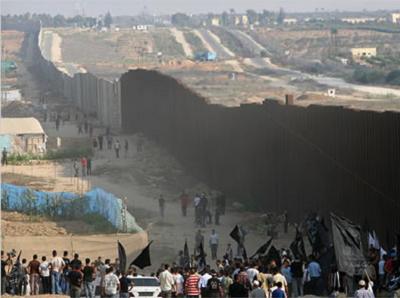
As expected, the Egyptian client regime allowed only a token number of Gaza Freedom Marchers to enter the besieged prison territory. Roughly 1400 activists from 43 countries were forced to remain in Cairo, where they managed to demonstrate outside various embassies and in the central Tahrir Square. Egyptian police turned out in huge numbers to harass the protestors and, most crucially, to stop Egyptians from coming into contact with them. (Ali Abunimah has been blogging on events in Cairo). The Freedom Marchers chanted ‘ash-sha’ab al-misri ma’ana – The Egyptian People Support Us’, a slogan which is undoubtedly true. The Egyptian regime, meanwhile, with the help of American military engineers, is building a metal wall across the frontier with Gaza which will reach deep underground and cut off the tunnels which are Gaza’s only lifeline. The corrupt Azhar Mosque authorities have declared this crime to be compatible with Islamic law.

The Gaza Freedom Marchers approved today an important declaration aimed at accelerating the global campaign for Boycott, Divestment and Sanctions (BDS) against Israeli Apartheid.  The Cairo Declaration deserves the widest possible circulation.

Cairo Declaration
January 1, 2010

We, international delegates meeting in Cairo during the Gaza Freedom March 2009 in collective response to an initiative from the South African delegation, state:

Continue reading “The Cairo Declaration to End Israeli Apartheid”

Two Stages of the Syrian Ba’ath

Stamp Commemorating the 60th Anniversary of the Ba'ath's Founding

Again inspired by Hanna Batatu’s excellent book, here are some notes on the first two of the three stages of the Ba’ath Party in Syria. I haven’t mentioned the party’s development in Iraq.

The first Ba’ath was the old Ba’ath, and it was led by ideals. The party’s founders, Michel Aflaq (a Christian) and the two Bitars (Sunnis) were the sons of grain merchants from the Damascus suburb of Maydan, and were genuinely motivated by the desire for a unified Arab state. They were of the commercial class that felt most immediately the loss of the natural Arab marketplace entailed by the Sykes-Picot partition and the actions of the French Mandate. The French had ceded Arab-majority areas north of Aleppo to Turkey, and in 1939 handed over the entire Iskenderoon governorate (which had an Arab and Alawi majority) in return for Turkish neutrality in the approaching European war. From 1925 to 26 the Druze had risen against the French under the anti-sectarian slogan ‘Religion is for God and the Homeland For All.’ The Ghuta peasant-gardeners, aflame with the nationalism of nearby Damascus, also struck, and the French bombarded the Ghuta with artillery and planes. The 1948 fall of Palestine added impetus to the pan-nationalist agenda. Sunnis from Deir ez-Zor, now cut off from their kinsmen and marketplaces in Iraq, were also attracted to Arabism.

Continue reading “Two Stages of the Syrian Ba’ath”

Five Books on Syria; Batatu on the Peasants

Inspired by the Browser interview concerning my five favourite books on Israel-Palestine, I’ve come up with a list of five on Syria. These are all books available in English, so my selection is inevitably skewed. I’ll name them, then talk at length about the first on the list, the Batatu book.

Hanna Batatu

1.  Hanna Batatu. “Syria’s Peasantry, the Descendants of its Lesser Rural Notables, and Their Politics.”

2. Patrick Seale. “Asad: The Struggle for the Middle East.”

As essential for understanding power machinations in the US, the USSR, Palestine, Israel and Lebanon as in Syria, this is a biography of Syria’s ruthless, inscrutable, masterful dictator, Hafez al-Asad. Nation builder or gangster, as you will, but surely the most important Syrian of the 20th century.

3. Samuel Lyde. “The Asian Mystery Illustrated in the History, Religion, and Present State of the Ansaireeh or Nusairis of Syria.”

Continue reading “Five Books on Syria; Batatu on the Peasants”

Five Books on Israel-Palestine

The interview below was published in the Five Books section of The Browser. I chose five books on the Israel-Palestine conflict.

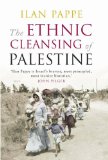
Tell me about the Ilan Pappe book, The Ethnic Cleansing of Palestine.

Pappe has written a great historical work on the ethnic cleansing of Palestine in 1947/8 and he shows that it was organised and planned, called Plan D, or plan Dalit, and he has exploded the myths that were current until his work.
What myths?

Well, for example, that the Arab leaders told the Palestinians to leave, or that the Palestinians were Bedouin people who didn’t really live there anyway, and he showed that they were ordinary people in brick and mortar homes who were intentionally forced out. This is very important because the ethnic cleansing of Palestine is the original sin of Zionism and the root of the current problem.

Continue reading “Five Books on Israel-Palestine”

The End of the Arabs?

In 2007 I read Peter W. Galbraith’s “The End of Iraq“, which suggests cutting Iraq into three mini-states, and then responded in two parts. The first part criticises Galbraith’s thesis, and the second part criticises the failures of Arabism. Both are merged below. More recently it has been revealed that Galbraith actually stood to gain financially from the dismantlement of Iraq.

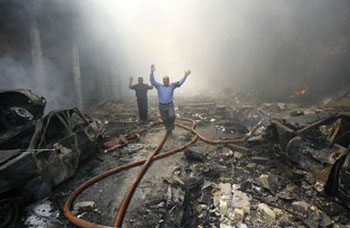
explosion at Baghdad's Mutanabi Street book market

Peter W. Galbraith’s book ‘The End of Iraq’ argues the initially persuasive thesis that Iraqis have already divided themselves into three separate countries roughly corresponding to the Ottoman provinces of Basra (the Shii Arab south), Baghdad (the Sunni Arab centre) and Mosul (the Kurdish north), and that American attempts to keep the country unified are bound to fail. I agree wholeheartedly with Galbraith’s call for America to withdraw from Iraq – America is incapable of stopping the civil war, and is in fact exacerbating it. (update: I stick by this. The civil war has to some extent calmed because of internal Iraqi dynamics, not because of the US ’surge’ – the Sunni forces turned on al-Qaida, and also realised that they had lost the battle for Baghdad and national power. Some groups then allied with the US for a variety of reasons to do with self-preservation). The rest of Galbraith’s argument is much more debatable.

Continue reading “The End of the Arabs?”

Visiting the Great Satan

Notre Dame University

I’ve never before visited the USA. Like everybody else in the world, I’ve had it come to me. Its approach has been unstoppable, for good and for ill. For good first: the incredible achievement of American prose, which leaves British writing of the last century far behind. I am astounded by Faulkner, Bellow, Updike and Roth (when they’re good), Cheever, Scott Fitzgerald, and now Joshua Ferris. Formulaic Hollywood switches me off, but I can’t get enough Spike Lee or Martin Scorcese. I love Bob Dylan, Public Enemy and Miles Davis, just for starters. Jazz and particularly hip hop are American art forms which have travelled very well indeed. These two came originally from the black poor, and it’s the heterogeneity of America, and the possibility of marginalised genres and people being heard, which is so appealing. America is a continent-sized country of mixed-up Africans, Jews, Italians, Irish, Latinos, French, Wasps, and everyone else. It should be the most globally-minded and tolerant country in the world.

It isn’t of course. A narrow hyper-nationalism, the shaping of public discourse by corporations and lobbies, and a stupifying media and public education system have seen to that. Which brings us to the ill: America’s homogenising rage, which has ravaged first its own main streets (so Naomi Klein says in No Logo) and then the high streets of the world; its humourless TV gum; its advertising culture of false smiles and sugary platitudes; its racism, wars, military bases, aircraft carriers, support for dictators and apartheid regimes. These are the reasons why the US is known in some parts as the Great Satan, standing behind most of the little satans sitting on Asian and African thrones. In Muscat, Damascus, Shiraz and London I’ve met many people who have been made refugees by the USA.

America is the empire, admittedly in decline. In one sense, therefore, I haven’t needed to visit to know it. But last week I visited nevertheless, for a conference at Notre Dame University which I enjoyed very much.

Continue reading “Visiting the Great Satan”

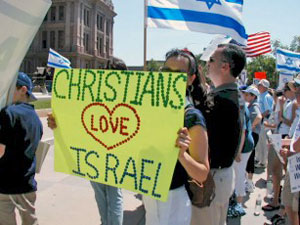
To A Christian Zionist

Update: I wrote this in 2006. If I wrote it today I would do it a little differently. Specifically, I would discuss the pernicious role of the Scofield Bible in perverting protestantism in America. I would discuss the meeting point of Christian Zionism, orientalism and racism in Western cultures. And I would point out that contemporary science has shown us that the direct descendants of the ancient Israelites are the Palestinians, not the Ashkenazi or Berber Jews who have colonised Palestine in recent years. Shlomo Sand’s excellent book The Invention of the Jewish People, reviewed here, summarises the science and undercuts the blood-and-soil aspects of Zionism which are so important to Christian Zionists and their ultimately anti-Semitic agenda.

I have recently been discussing Middle East issues with an American colleague who I would describe as a Christian Zionist. Although I like him personally I find some of his ideas (on Palestinian history, and Lebanon, and the wider Middle East) pretty offensive, and I have told him so. So as not to start an argument, I told him so in writing. He replied, saying that although he disapproves of collective punishment of the Palestinians he believes that the Bible clearly states that the Holy Land belongs to the Jews, and that the rebuilding of Israel prophesied in the Old Testament has happened since 1948. Hmm. My first response is anger. I understand Jews with memories of European anti-Semitism being attracted to Zionism, however wrong I think they are, but Americans? People who are not oppressed, who think Palestine is a Cecil B Demille set, who think real human beings (Arabs) are less important than their own narrow interpretations of scripture. Who think that ethnic cleansing, massacres, and apartheid are supported by God. It makes my blood boil. But I think responding intelligently to this kind of thing is important, because there are millions of Americans (with power) who see the Middle East through a Biblical prism. Anyway, here is my latest letter:

Continue reading “To A Christian Zionist”

Hope? – Obama, Abbas, Abunimah and Morrisons

Bell on Obama
Steve Bell

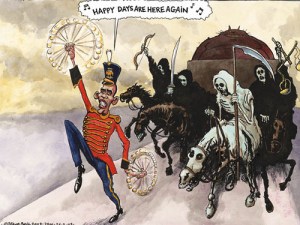
The hope invested by many in Barack Obama has dissolved. Dare I sing ‘I told you so’? I do. The audacious hope of Obamamania was always faith-based, founded on the believer’s premise that the handsome candidate didn’t mean what he actually said, that we should read his words esoterically, as code for profound radicalism. Now reality bites, and we discover that his promises to AIPAC and the military were solid and literal.

It’s certainly something that a black man has become president of a country built by African slaves, although we must place this in the context of the fierce racist backlash since his election (would those guardians of the constitution raving about the tree of liberty being watered by the blood of tyrants be quite so eager to wear their guns on their sleeves if the president were white and not a jumped-up negro? I doubt it). But that’s the achievement of Obama’s skin colour, not his policy; in fact it’s the achievement of the people who voted for him. Another achievement is that – in the company of war criminals such as Shimon Peres, Yitzhak Rabin and Henry Kissinger – Obama has already won the Nobel peace prize. Hooray!

Continue reading “Hope? – Obama, Abbas, Abunimah and Morrisons”

“Israeli Apartheid – A Beginner’s Guide”

gas arabs
settler graffitti in Hebron/al-Khalil

That there are striking parallels between white rule in apartheid South Africa and Zionist rule in Palestine – an analogy made by such mainstream figures as President Jimmy Carter and Archbishop Desmond Tutu – should no longer be controversial. But calling Israeli apartheid by its name will occasion the usual screams of anti-Semitism and ignorance from Zionist quarters, and for comprehensible reasons: the most politically inept American student knows that apartheid is a bad thing, a crime to be battled, not supported with weapons, vetoes in the Security Council and billions of dollars in ‘aid.’ Therefore the apartheid label must be vigorously resisted by Zionists and their fellow travellers.

Ben White’s “Israeli Apartheid – A Beginner’s Guide” begins by quoting Article II of the International Convention on the Suppression and Punishment of the Crime of Apartheid, UN General Assembly Resolution 3068, which defines the crime as “inhuman acts committed for the purpose of establishing and maintaining domination by one racial group of persons over any other racial group of persons and systematically oppressing them.” The rest of White’s book leaves the reader in no doubt that the Zionist instance of apartheid fits the bill even better than the erstwhile South African version.

Continue reading ““Israeli Apartheid – A Beginner’s Guide””