I’ll be voting for Scottish independence in next month’s referendum, and obviously not for ethnic-nationalist reasons – I have no Scottish blood as far as I’m aware (although the Scots may have some Syrian), and my mixed-up accent is far more English than not. Furthermore, I reject the simplistic ‘Braveheart’ narratives of uninterrupted Scottish victimhood. There’s an ex-mining town not far from here named Patna – after the Indian city – and in Sri Lanka the tea plantations bear Scottish names. Scots played an essential role in the British empire, and over the centuries Scottish as well as English landlords and industrialists have exploited the poorer Scottish classes (at some points driving them off their land en masse).
Author: Robin Yassin-Kassab
Western Activists: We Don’t Want Your Pity
First published at The Sleuth Journal, this piece is by Syrian rapper and activist Mohammad Abu Hajar. Abu Hajar’s rapping can be seen and heard here.
As new arrivals to Europe from the Middle East, we come from countries where death in war has become an almost mundane, non-urgent event; I am now in an environment where war is understood not as brutal current events but as historic ones. For us in the Middle East, by contrast, war is just another unpleasant reality we live with, like many others: occupation, poverty, dictatorship, corrupt governments, marginalization, etc…
For me, being in Europe after participating as an activist in Syria in an epic revolution showing unbelievable steadfastness by ordinary people, is important for many different reasons. Firstly, I feel like I carry a duty to tell the stories of my countrymen who I left behind, the stories of daily life full of wishes, pain and stolen moments of joy, moments stolen from between the jaws of death. Secondly, Europe means to me a platform where politics are taken to another, more advanced level, with freedom of expression and human rights – at least the basic human rights – well maintained. To me, being in Europe means acquiring new techniques and methods of analyzing political events; all this is in addition to doing my Master’s degree in Economics at a European university.
The new knowledge and culture that I’ve encountered here in Europe are extremely important to me, yet it’s still important to relate the other untold side of the experience. What I’m trying to write about here is an entirely different subject to the usual topics. While the political and social dimensions of the relationship between the locals and the new arrivals are both well covered by academic research and papers, the psychological and the personal aspects of this relationship have been largely overlooked.
The reason behind writing those words is a cumulative explosion of a feeling that many in these societies are not yet able to consider us as fully equal human beings. I don’t wish to generalize here; I’m not talking in this instance about the hostility of the far-right motivated by ultra-nationalism, but am thinking specifically about a variety of the more liberal, left wing-affiliated mind-sets or the so-called humanists.
Continue reading “Western Activists: We Don’t Want Your Pity”
Ten Things to Remember about Syria
I edited the Critical Muslim’s Syria issue, which includes excellent essays by Amal Hanano, Rasha Omran, Itab Azzam, Maysaloon, Malu Halasa, poetry by Golan Hajji, prose from Zakkariya Tamer, and much more. I contributed an essay on Syrian culture revolutionised, and I wrote the following list:
 In the old days Syrians were ready to list their ten favourite picnic spots, their ten favourite restaurants, or even ten of the sects participating in the imaginary happy mosaic. Today lists of traumatisation leap to the mind: the ten largest refugee camps, or ten major massacres, or perhaps ten of the numerous new militias.
This list tends towards the positive (only number 10 is a bad thing – it’s something that can’t be ignored). It focusses on those aspects of Syrian reality that can’t be destroyed by war, those things which will survive (with the exception, we hope, of number 10).
1. Maté
Along with Turkish Coffee, Argentinian Yerba Maté is Syria’s quintessential drink. Drink it strong and sugary in a gourd or a glass, through a silver straw from the Qalamoun region; keep the water hot for continual fill-ups; and you’ll be telling Homsi and muhashish jokes all night. Maté connotes conviviality, and sometimes more specifically the Druze, Christian and Alawi mountain communities. When the martyred Free Army commander Abu Furat appealed to the Alawi community, he did so in terms every Syrian would understand: “I know the Alawis well. I’ve visited them in their houses. We’ve drunk maté together. We lived together before and we’ll live together again, despite you, Bashaar.”
How did a South American drink become a Syrian (and Lebanese) staple? The answer is in the late 19th/ early 20th Century mass migration of Syrian-Lebanese to South and North America, the Caribbean, and west Africa. A couple of hundred drowned with the Titanic. The ‘Street of the Turks’ in Gabriel Garcia Marquez’s Macondo is so-called because the people were Ottomans when they arrived in Colombia, but they were Syrian Ottomans, Arabs. Today 20 million people describe themselves as Syrian-Brazilians. Guyana’s richest family is the Maqdeesis. Carlos Menem, former Argentinian president, is of Syrian origin too.

2. Migrants
Abdul-Qadir al-Jaza’iri led a long and heroic resistance against the French occupation of Algeria. Eventually captured and brought to Paris, he was given the choice of exile elsewhere in the Arab world. Abdul-Qadir chose Damascus, where he wrote Sufi poetry in the shrine of the mystic Ibn ‘Arabi, who was an earlier migrant, from Andalucia. In 1860, when the Christian quarter of the Old City was burnt in sectarian rioting, Abdul-Qadir protected hundreds of Christians in his house and garden.
The tomb of Ibn ‘Arabi stands between two inner-city neighbourhoods climbing the slope of Mount Qassiyoun: ‘Muhajireen’, or Migrants, is so-named because it once housed Muslim refugees from the Balkans; and ‘Akrad’ means Kurds – still a Kurdish area, it was first built for the Kurds who came with Salahudeen al-Ayyubi (Saladin’s) armies.
Who else? Armenians, descendants of those who survived the forced march from Anatolia. Half a million registered Palestinian refugees and many more Palestinian-Syrians (Yarmouk camp in Damascus, Syria’s largest Palestinian population, is nearly empty now – its population refugees for a second time, mostly in Lebanon). Over a million and a half Iraqi refugees until Damascus and Aleppo became even less secure than Baghdad and Basra. And in 2006, a million refugees from the Lebanese South (fleeing Israeli bombs), who were welcomed in mosques, schools and private homes. Syrians angrily compare the way they welcomed refugees with the way they are now (not) welcomed, in their hour of need.
Syria Speaks on Tour
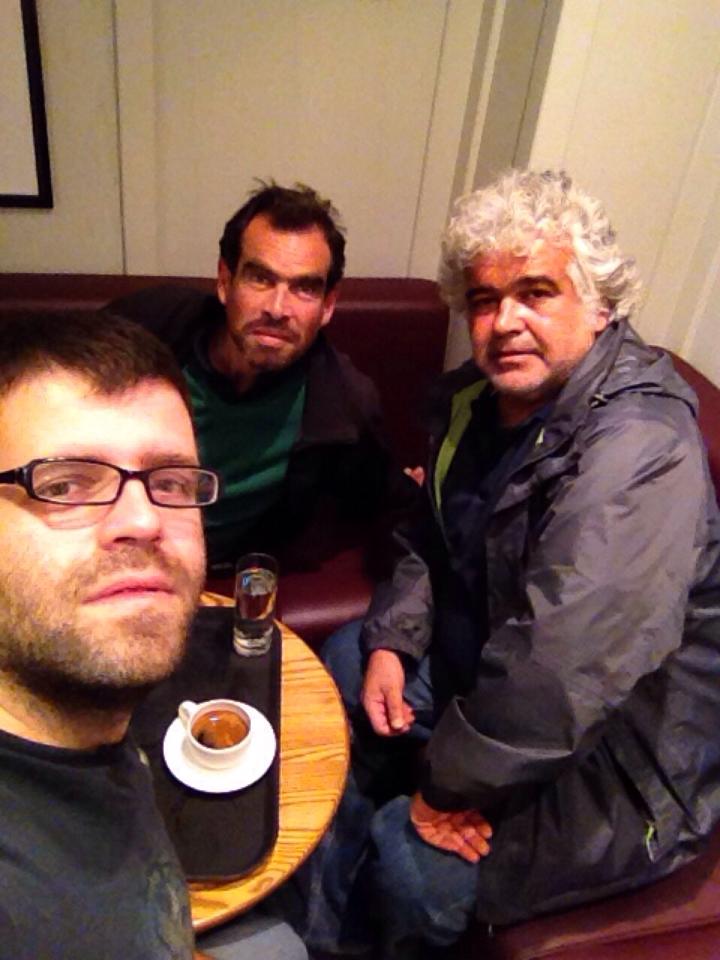
This was published at the National…
For a week in June, Syrian writers and artists toured England, giving readings and workshops to promote “Syria Speaks: Art and Culture From the Frontline”, a book reflecting the country’s new revolutionary culture. British-Syrian novelist Robin Yassin-Kassab describes the experience.
*
In Bradford we met a woman who had tried as hard as she could to forget she was Syrian. We didn’t discover her original trauma, but we heard its symptoms over a British-Pakistani curry. She hadn’t spoken Arabic for years, and never told anyone where she was from. Once a policeman detained her for an hour because she refused to tell him her origin.
In Bristol, on the other hand, we met a little old woman who, with her red hair and flowery dress, we might have mistaken for English. But she was a Damascene, and she wept when I read a description of her city. Afterwards she came to introduce herself. “I’ve lived in England for thirty years, and I didn’t realise until the revolution that I had a fear barrier inside. Then I noticed I’d never talked about Syria. I’d tried not to even think about it. But those brave youths gave me courage; they gave me back my identity and my freedom.”
So the Syrian revolution is alive and well in Bristol if not in Bradford, for this is where the revolution happens first, before the guns and the political calculations, before even the demonstrations – in individual hearts, in the form of new thoughts and newly unfettered words. Syria was once known as a ‘kingdom of silence’ in which public discourse was irretrievably devalued by enforced lip-service to the regime and its propaganda pieties. As a result, many Syrians describe their first protest as an ecstatic event, a kind of rebirth. In “Syria Speaks”, Ossama Mohammed’s story “The Thieves’s Market” concerns a woman who attends the state’s official demonstrations, until her friend is murdered for participating in an oppositional one. “I grew up,” she says, “came of age, abandoned someone and was abandoned, on a march that finished yesterday.” When that coerced march ended and a thousand new ones began, Syrians found unprecedented liberation simply by expressing honest opinions in the presence of their neighbours, by breaking the barriers of fear.
Beware the Game of Shadows in Syria
I am a signatory to this letter published by the Guardian.
As supporters of the Syrian people’s struggle for freedom and democracy, we are concerned by the British government’s decision to re-establish diplomatic relations with Iran in response to the crisis in Iraq (Shortcuts, G2, Iran, 18 June).
There is a grave danger that the Iranian government will see this as a licence to extend its already substantial intervention in Syria in support of its client – the Assad regime – which could not have survived this long without Iranian support.
Thousands of troops from the Iranian Revolutionary Guard and the Basij militia are actively fighting in Syria on the regime’s side, as are Iran’s proxies, Hezbollah and the Iraqi Shia militias. To ally with Iran in order to combat Isis is deeply ironic, since there is considerable evidence that the Syrian regime has been colluding with Isis: Assad’s air force bombs civilians, schools, markets and hospitals without mercy but declined to attack Isis’s massive headquarters in Raqqa until the Iraq crisis erupted.
The Syrian regime has been playing a game of shadows in which this covert collusion with the growth of Isis has been used to undermine the democratic opposition and strengthen its own claim to be a bulwark against “terrorism”. To accept Iran – and by implication Bashar al-Assad – as allies in the fight against Isis is to fall for this deception.
Peter Tatchell, human rights campaigner, Haytham Alhmawi, director of Rethink Rebuild Society, Reem Al-Assil, activist, Adam Barnett, journalist, James Bloodworth, editor of Left Foot Forward, Mark Boothroyd, International Socialist Network, Sasha Crow, founder of Collateral Repair Project for Iraqi and Syrian Refugees, Naomi Foyle, writer and coordinator of British Writers in Support of Palestine, Christine Gilmore, Leeds Friends of Syria, Bronwen Griffiths, writer and activist, Juliette Harkin, associate tutor, University of East Anglia, Robin Yassin Kassab, author and co-editor of Critical Muslim, Tehmina Kazi, human rights activist, Maryam Namazie, Fitnah – Movement for Women’s Liberation and Equal Rights Now – organisation against women’s discrimination in Iran, Fariborz Pooya, Worker-communist party of Iran UK, Mary Rizzo, activist, translator and blogger, Christopher Roche, Bath Solidarity, Naame Shaam campaign group http://www.naameshaam.org, Brian Slocock, political scientist and blogger on Syria, David St Vincent, contributing writer and editor, National Geographic Books, Luke Staunton, Merseyside Syria Solidarity Movement – UK Continue reading “Beware the Game of Shadows in Syria”
Syria Speaks on Front Row
I spent the last eight days on tour with Syria’s greatest novelist Khaled Khalifa, artist Khalil Younis, and writers Malu Halasa and Zaher Omareen. We were promoting the Syria Speaks book, a collection of art, cartoons, essays, short stories and novel extracts from revolutionary Syria. It felt useful to approach the subject through human stories rather than banging the head against the tired old political discourses. I’m writing about the tour and book for a piece which should be published next month. In the meantime, here on BBC Radio 4′s Front Row, Khaled, Malu and I discuss the new culture, Khaled’s experience under bombs, and the ISIS phenomenon.
First There Was the Word
I and lots of other writers participated in this BBC radio 4 programme on ‘British Muslim writing’. The programme is written and presented by Yasmin Hai. Those interested in this may also be interested in Clare Chambers’s book “British Muslim Fictions“.
The Hat of Invisibility
 Bostjan Videmsek interviews Yassin al-Haj Saleh, former political prisoner and one of Syria’s foremost intellectuals, on ‘civil war’, sectarianism, and the geo-political conspiracy theories which render the people of the Middle East invisible.
Three years and three months into the conflict, Syria and its people have more or less been forgotten by international community, the media, even NGOs. How does this effect life on the ground and the conflict itself?
I do not approve of words like ‘conflict’ and ‘crisis’ in describing our struggle. The connotations of these terms cover up the responsibilities of the terrible situation in Syria, that of a regime that had been ruling the country for 41 years when the revolution started 38 months ago, and that killed perhaps 40,000 Syrians in a previous generation (between 1979 and 1982). There are many ways to forget the Syrian struggle; one of them is to refer to a vague and distant conflict. I think the sort of symptomatic forgetfulness you refer to in the question is only a continuation by different means of the coverage which speaks about ‘conflict’ and ‘crisis’.
Having said that that, life on the ground is affected by barrel bombs thrown from helicopters over civilian neighborhoods in Aleppo, by chlorine gas bombs thrown over people in Kafr Zeta near Hama, and by fighter jets bombing towns of the eastern Ghouta near Damascus. This affects life more than being forgotten by the international community, the media, and NGOs. People are not killed because they are forgotten. They were always forgotten in the past, then they revolted against their masters, and decided to remind all the world of their existence. They are being killed because they revolted, and they are being punished for their insistence on visibility by being forgotten again.
On Syria’s Alawis
 Here’s a brief extract from my essay on Syria’s Alawi community, its history and doctrines and its political fortunes under Assadist rule and during the revolution, written for the Sects issue of the Critical Muslim. If you haven’t done so yet, please subscribe, and encourage your library or college to do so. The next issue will be a Syria special.
Syria’s CIA-backed military coup in 1949 was the first in the Arab world. Although there was a later parliamentary interval, the coup brought the army (and therefore rural minority groups) into the centre of Syrian political life, and a pattern of coup and countercoup set in, only brought to an end when Hafez al-Assad, an Alawi air force officer, rose to absolute power in the 1970 ‘Correctionist Movement’, achieving stability through totalitarian control.
From one perspective, Assad’s early years were golden years for the Alawis, as they and other hitherto marginalised sects (Druze and Ismailis) as well as rural Sunnis moved into the cities and entered state elites. (“Syria’s Peasantry, the Descendants of its Lesser Rural Notables, and their Politics” by Palestinian Marxist Hanna Batatu is a wonderfully comprehensive, wonderfully written study of the mechanics and personalities of this movement). The regime settled Alawis (often low-ranking soldiers and their families) in strategic suburbs on the approaches to Damascus. In these early years too, the Ba‘ath demonstrated loyalty to its rural base and its proclaimed socialist values by building schools, clinics and roads for the villages.
In Response to Assad’s Bombs
The heroic citizens of Aleppo respond to the Assad regime’s latest barrel bomb attack, which killed over thirty civilians this morning. Over a hundred Syrians are still being killed every day. In Arabic – but it needs no translation.
 P U L S E