Category: Israel
Artist Lowkey on Gaza flotilla in London
Israelis massacre activists on aid flotilla
Scenes from the massacre:
UPDATE I, II, III, IV and V on the BBC’s despicable coverage below.
Al Jazeera International, 30 May 2010 — A deadly attack has taken place off the coast of Gaza – as Israeli forces stormed at least one ship – attempting to break the blockade of Gaza. Commandos lowered themselves from helicopters and onto the Mavi Marmara – the lead ship in a flotilla of six vessels which are carrying aid for the Palestinian territory…Israeli radio is reporting the death toll may be as high as 16 people. Al Jazeera’s Jamal Elshayyal onboard the ship sent this report before communications were cut
According to multiple reports the death toll now stands at 16, with over 60 injured. You can follow Al Jazeera International and Press TV‘s excellent live coverage. You can also follow the flotilla’s Twitter feed.
Mustafa Barghouti on Al Jazeera rightly notes that this constitutes an act of war against multiple countries. The ship was in international waters carrying the flags of several countries. This is a flagrant violation of international law.
Continue reading “Israelis massacre activists on aid flotilla”
Violent Logic: A Review of M. Shahid Alam’s Israeli Exceptionalism: The Destabilizing Logic of Zionism
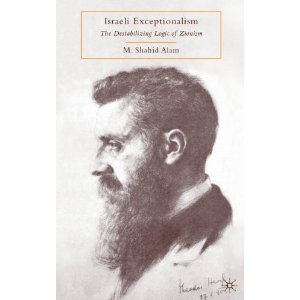 People have been against both the idea and practice of Zionism since its inception. Zionism is an ideology that has never earned the support of all Jews, and one that has never been accepted by the vast majority of Palestinians, Arabs, and Muslims. Zionism has likewise failed to achieve significant support in the so-called Third World, and has been almost uniformly rejected by black nationalists inside the United States. Yet Zionism has been successful insofar as its desire to create a Jewish-majority nation-state has been achieved. Despite its discursive self-image as a liberation movement, Zionist practice is colonialist and brutally violent.
In his latest book, Israeli Exceptionalism: The Destabilizing Logic of Zionism (Palgrave Macmillan), M. Shahid Alam explores these paradoxes with great skill and insight. Israeli Exceptionalism takes its place among a series of recent books that question the logic of Zionism. Most of these books argue in favor of a one-state solution to the Israel-Palestine conflict; inherent in that argument is a rejection of Zionism. Alam takes a slightly different approach in his rejection of Zionism, one that is global in scope. He points out that “[a]s an exclusionary settler colony, Israel does not stand alone in the history of European expansion overseas, but it is the only one of its kind in the twentieth and twenty-first centuries” (14). Israel, in other words, is an anomaly: a settler colonial society still in thrall of the ideologies and racism of the nineteenth century. As with the European colonization of North America, Zionism conceptualizes itself as an exceptional force of good in history.
A Day to Remember: Resistance and Liberation Day 2010
by Brenda Heard
Anniversaries measure time. In one respect, they are an artificial concept. We decide, for instance, that twenty-five years of marriage should be celebrated, but we ignore the subsequent days as merely marking the path to twenty-six years. And reaching twenty-six years, though obviously a greater length of marriage, will not be celebrated with the same gusto as the twenty-fifth anniversary that boasts pre-printed greeting cards and foil balloons.
As the contrivance of marking anniversaries in many ways defies common sense, we might ask ourselves why we do it. Perhaps it is because the infinite, amorphous magnitude of time must be taken in bite-size pieces. It would otherwise be overwhelming. When we stop the passage of time—no matter how arbitrarily, no matter how superficially—then we are in effect looking for significance in what we accomplish with our lives.
On the 25th of May 2010, we observe the ten-year anniversary of the Lebanese Resistance and Liberation Day. A full decade has passed since the victory that baffled the Western world. A twenty-two year military occupation was virtually uprooted and expelled. The balance of global power was unhinged.
Continue reading “A Day to Remember: Resistance and Liberation Day 2010”
Norman Finkelstein v. Benny Morris
To readers I would highly recommend Norman Finkelstein’s new book, ‘This time we went too far’. It is the most systematic and thorough dismantling of the hasbara edifice erected by Israel and its apologists (including Morris). On paper, Morris is a fine historian, but in his media appearances he always dons the hat of the propagandist. In this debate from Russia Today’s CrossTalk, Benny Morris comes across as defensive and boorish. He uses the familar tools of the propagandist, derision and ridicule, to evade serious questions. Every one of his claims about Gaza — that Hamas used human shields, and that its leadership took sanctuary in basements of hospitals — is rebutted by extensive research carried out by the Goldstone Commission, Amnesty International and Human Rights Watch. (via MondoWeiss)
On this edition of Peter Lavelle’s CrossTalk, he asks his guests whether the current “indirect talks” between the Israelis and Palestinians are a waste of time.
The New York Times gets lost in a minefield
On Friday 14 May, The New York Times‘ Public Editor Clark Hoyt published a piece called ‘Semantic Minefields’. The focus of Hoyt’s article was, in his own words, the questions Times‘ journalists “juggle” on a daily basis, “as they try to present the news in clear and evenhanded language”.
The last example given by Hoyt related to “the Israeli-Palestinian conflict”. Here’s the background:
When Cooper wrote this month about a lunch that Obama had with Elie Wiesel, the Nobel laureate and Holocaust survivor, she said the president was trying to mend fences with American Jews upset at the administration’s stance against construction of “Jewish settlements in East Jerusalem.”
Nathan Dodell of Rockville, Md., said it was “tendentious and arrogant” to use the word “settlements” four times in the article when the Israeli prime minister, Benjamin Netanyahu, has explicitly rejected it in relation to East Jerusalem. Obama has used the term himself to refer to construction in East Jerusalem, and Cooper told me, “I called them settlements because that’s the heart of the dispute between the Israelis and the United States: settlement construction in Arab East Jerusalem, which the Palestinians want for an eventual Palestinian state.”
But to Dodell, she was taking sides. He asked why she didn’t use a neutral term like “housing construction.”
Incredibly, there is not one mention of international law, where the illegitimacy of settlements in the Occupied West Bank – including East Jerusalem – has been repeatedly affirmed by the UN Security Council, the General Assembly, the High Contracting Parties to the Fourth Geneva Convention, the European Union, and the International Court of Justice judges in their 2004 advisory opinion.
Perhaps Cooper cited international law to Hoyt – but he doesn’t say so. The closest the Public Editor gets himself is when he writes that Israel’s claim to a ‘united’ Jerusalem is “not recognized by the United States and most of the world”.
But apparently, settlement is “a charged word” and so “articles by Times reporters in Jerusalem do generally use words like ‘housing’ instead of ‘settlement’.”
We also learn about the Times’ Ethan Bronner’s opinion: basic principles of international law are discarded in favour of Bronner’s personal impressions of some of Occupied East Jerusalem having “the feeling” of settlements that other areas do not.
The Public Editor’s conclusion? The journalist in question “should have found a more neutral term”.
No wonder that Hoyt feels the need to finish with the reassurance that newspapers are about “nuance and real understanding”. Because one would be forgiven for thinking that the Times‘ approach to Palestine/Israel is about confusion and misinformation.
Continue reading “The New York Times gets lost in a minefield”
Margaret Atwood Cashes In
By Jennifer Matsui

Novelist Margaret Atwood’s decision to travel to Tel Aviv to share a literary prize worth a million dollars has ignited a controversy in which the septuagenarian author and vice-president of the literary human rights organization PEN International has come under fire by Palestinian rights activists. Ms Atwood’s acceptance of the Dan David Prize, whose previous laureates include Al Gore and Tony Blair, is viewed by Ms Atwood’s critics as a betrayal to the ideals she supposedly represents, and an unwitting endorsement of Israel’s race exclusive policies.
The Canadian author’s insistence that refusing the blood-spattered trophy would be tantamount to “censorship” rings as false as her commitments to justice as an anti-apartheid activist, and as a writer who has made tyranny and oppression recurring themes in her novels, elevating her from fiction writer to public intellectual. “False” because “justice for some” is hardly an ethical stance with any merit, and certainly not one that will maintain her status as an “oppositional intellectual”. Sadly, this “intellectual” has made no effort to research the subject of Israel’s illegal occupation of Palestinian land and its unyielding, systematic oppression of the Palestinian people (as many Jewish and Israeli scholars and activists themselves have bravely condemned). Otherwise, she would use the occasion of the invitation to denounce an increasingly murderous regime and call upon its people to support sanctions, boycotts and divestments until their government accepted the rule of International law and reversed its policy of displacement and expulsion of Arab people from their ancestral lands. Instead the once outspoken author has chosen to put monetary interests ahead of the principled moral stances she has taken in the past, in order to lay claim to a tainted prize given each year to fame-hungry “artists” looking to boost sagging sales of their product while making all the appropriate noises to the press about free speech.
Nakba day – يوم النكبة Yawm al-Nakba 2010
By Mazin Qumsiyeh
 Today is the day we actually commemorate Nakba Day, 14 May 1948, the date the state of Israel was declared. However, it is not the beginning of our Nakba (catastrophe) nor its end. Over 200 villages were ethnically cleansed in the six months before 14 May 1948. This simple fact illustrate that it is not the founding of the militarized state of Israel that began the Nakba but that it was a pivotal moment in it. After that date, the wave of ethnic cleansing was being done in a name of a nation-state established by and for Jews from Europe and not just the terrorist underground Jewish militias. The ethnic cleansing accompanying the foundation of this apartheid Jewish state and its maintenance meant the destruction of 530 villages and towns and meant that in the past 9 years alone over 10,000 homes were destroyed in the West Bank (including occupied Jerusalem), Gaza, and the Negev.
Today 7 million of the 11 million Palestinians around the world are refugees or displaced people. The Israeli population according to the Israeli central bureau of statistics is 7,510,000 of which 5,984,500 are “Jews and others” (presumably the others are Druze, Russian non-Jews, and similar categories) and 1,525,500 Palestinian Arabs (1). The population of Palestinians in the West Bank and Gaza is 4 million allowed to live on areas A & B, small parts of the 22% of Palestine occupied since 1967 (2). The total area allowed for Palestinian use is 2.5% of the area of pre-1967 Israel (3) plus areas A & B of the West Bank . In total this comes to 2.5% of 78% and 29% of the 22% that is the West Bank and Gaza (4). The total geographic access to all remaining Palestinians (5.525 million) is thus 1.95%+6.38%=8.33% while the Jewish and other population (Zionist preferred) consists of 5.5 million with access to the remaining lands comprising 91.67% of historic Palestine.
Continue reading “Nakba day – يوم النكبة Yawm al-Nakba 2010”
Myth and Memoricide: Shlomo Sand’s “Invention of the Jewish People”

This review essay was published at The Drouth.
A nation is “a group of persons united by a common error about their ancestry and a common dislike of their neighbours.” Karl Deutsch.
“I don’t think books can change the world, but when the world begins to change, it searches for different books.” Shlomo Sand.
Our Assumptions About Israel
Here is what we in the West, to a varying extent, whether we are religious or not, assume about the Jews and Israel:
The Jews of the world, white, black and brown, are the sons of Abraham, Isaac and Jacob. Moses, after leading the Jews out of Egyptian enslavement, gave them laws. Emerging from the desert, the Jews conquered the promised land of Canaan, which became Judea and Israel, later the mighty kingdom of David and Solomon. In 70CE the Romans destroyed the temple at Jerusalem and drove the Jews from their land. A surviving Jewish remnant was expelled when Muslim-Arab conquerors colonised the country in the 7th Century. And so the Jews wandered the earth, the very embodiment of homelessness. But throughout their long exile, against all odds, the Jews kept themselves a pure, unmixed race. Finally they returned, after the Holocaust, to Palestine, “a land without a people for a people without a land.”
This story has been told again and again in our culture. Today we find bits of it in Mark Twain and Leon Uris, in Hollywood’s output and in church pulpits, and of course in the mainstream news media. American Christian Zionists – devotees of the Scofield Bible – swear by it, and swear to support Israel with all the power of their voting block until the Risen Christ declares the apocalypse.
Continue reading “Myth and Memoricide: Shlomo Sand’s “Invention of the Jewish People””
 P U L S E