A war of Western imperialism?

by Ahmed Moor

Photo: Scott Nelson

There is a lot about the Western intervention in Libya that could go wrong – and it remains to be seen whether bombing Gaddafi and his mercenaries is a good decision.

However, large numbers of people around the world appear to support the objectives of the anti-regime forces. Also, the indigenous resistance movement – which requested help – would have been annihilated in the absence of those air strikes.

George Bush’s legacy of destruction extends beyond the piles of brick, flesh and mortar that we have been tallying for a decade now in Iraq and Afghanistan.

More than any other figure in the post-war 20th century, the last American president did more to erode the gains in legitimacy made by supranational institutions and their proponents.

After the Iraq war, the United Nations began to be perceived as a US rubberstamp body – or worse – as a meaningless exercise in bureaucracy.

The UN can only function legitimately through consensus (or consensus-lite) decision-making and it was clear that the US was strong-arming weaker states in 2003.

George Bush and the neoconservatives hijacked the legitimate language of consensus-based intervention for their own ill use.

So activists are not wrong to react cynically when they hear that language today; I don’t believe that bombing Gaddafi is a humanitarian gesture.

Continue reading “A war of Western imperialism?”

Gaddafi’s assassins and rapists

Recently, there have been numerous assassination attempts on leading rebels in their eastern stronghold of Benghazi. Some documents have been found, detailing those set to be killed. And many more so-called ‘Gadaffi lists’ are thought to exist.

Continue reading “Gaddafi’s assassins and rapists”

Fight for Ajdabiya continues

Forces loyal to Libyan leader Muammar Gaddafi are said to have taken up key positions around the opposition-held city of Ajdabiya.

The eastern city has been fought over now for more than two weeks.

Many people have fled and others are hiding indoors.

Al Jazeera’s James Bays reports on the desperate conditions for people who have chosen to stay.

Prison of Terror

by Nafissa Assed

On the 17th of March I headed to the airport, leaving Tripoli for safety reasons. The internet has been cut off in Libya since 3rd March, phone lines are very bad in all the cities, and some cities are totally isolated (no phone lines, no water, no electricity) – like Zawiya, Misurata, and now Benghazi’s too. God only knows what is coming next. After we lost the internet, Tripoli became a prison of terror.

Qaddafi’s thugs are celebrating all the time, and every day gunfire starts and stops all of a sudden, at any second. Out of a complete silence, we see cars passing by our building playing very loud music, songs for Qaddafi. At other times (usually between 2 and 4 am) we hear gunfire that gradually increases, with no celebrations or cars chanting his name around the streets.

Continue reading “Prison of Terror”

Rory Stewart on the Libyan intervention

Rory Stewart offers by far the most astute analysis of the dilemmas Libya presents. Written for the London Review of Books, its reproduced here in full:

Until yesterday, I thought we were at the end of the age of intervention. The complacency that followed the collapse of the Soviet Union had been shattered by the Balkan wars; despair was followed by the successful interventions in Bosnia and then Kosovo; then triumphal pride led us to disaster in Iraq and Afghanistan. Midway through the period, in 2000, it seemed we could intervene anywhere. By 2010, it felt as though we would not venture abroad again. What had begun with the irresistible victory of democracy, the free market and the United States, ended with occupation, financial crisis and American impotence.
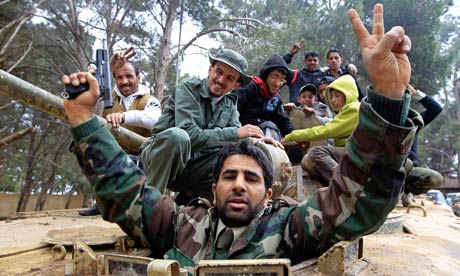
It seemed doubly unlikely that we would ever intervene in a country like Libya. Even oil-less, Central Asian Afghanistan was perceived by many Muslims as the object of a crusading infidel occupation, driven by Israel and designed to establish bases or extract cheaper oil. Any move against Libya – an Arab, Muslim country, obsessed with its struggle against colonialism and dripping with oil – seemed bound to be perceived in the most hostile and sinister terms by its neighbours, by the developing world and by the Libyans themselves.

Nor did Libya appear to meet the criteria for intervention under international law. Gaddafi was the sovereign power, not the rebels, and he was not conducting genocide or ethnic cleansing. In Bosnia, by contrast, 100,000 people had died in a few weeks; and it was Bosnia itself – a sovereign, UN-recognised state – which formally requested the intervention. Kosovo was a less clear case, but the intervention targeted Milosevic, and followed the Balkan wars, which he had stoked, and the displacement of 200,000 people and clear evidence of ethnically-targeted atrocities. This interventionist worldview, which might have seemed in 1999 the quintessence of global governance and consensus, had, however, begun to seem a fading Western obsession. By 2011 Brazil, India and South Africa, as well as China, were on the Security Council. And none of them supported intervention.

Continue reading “Rory Stewart on the Libyan intervention”

Gaddafi bears responsibility

French-Lebanese scholar Gilbert Achcar on the no-fly zone in Libya:

Over at Al Jazeera, Marwan Bishara asks:

So who bears the responsibility for turning Libya into a war zone and an object of an international military intervention?

Could it be those who confronted a peaceful civil uprising for freedom with lethal force, and when it escalated into a full-fledged revolt, used aerial bombardments, heavy artillery to quell it?

Libya could have and should have gone Tunisia or Egypt’s path of change. But while their militaries conceded the need for regime change, in Libya the family-led powerful militias, financed and groomed to defend the regime’s “country estate”, sided with their pay masters.

While the Gaddafis continue to show images of pro-Gaddafi demonstrators in Tripoli to offset the images of widespread anti-Gaddafi/pro-change, in reality, Libya is not divided between two visions for their country.

Rather between a majority that seeks free and prosperous Libya, and a mostly small heavily-armed minority that runs or benefits from a corrupt rule.

Continue reading “Gaddafi bears responsibility”

Introducing Nafissa Assed

Our correspondent in Tripoli, who’s been sending us such stirring and terriying reports, is now safe in Morocco. She is finally able to renounce her anonymity. She wants me to tell you her name in capital letters, NAFISSA ASSED, daughter of a martyr, proud Libyan citizen. Read her self-description after the break.

Continue reading “Introducing Nafissa Assed”

Infantile Leftism

picture by Ali Farzat

It certainly feels uncomfortable to watch American, British and French planes enforcing a no-fly zone over Libya, bombing Libya’s anti-aircraft defences and destroying Libyan tanks. Certainly the hypocrisy of the West and the Arab dictators is as galling as ever. There’s no chance of a no-fly zone over Palestine and Lebanon, nor over Saudi-occupied Bahrain. I can understand very well the fears of some that the West will overstay its welcome – although I think this is very unlikely indeed.

I am pleased, however, that the joint British-French-Lebanese (with Hizbullah in government in Lebanon) resolution for the no-fly zone has been adopted by the United Nations, that the massacres of the Libyan people may be minimised or stopped, that liberated Benghazi will probably not now fall to the tyrant.

If Britain, France and others are seeking influence in post-Qaddafi Libya by pleasing the Libyan people, that’s fine by me. Perhaps they fear their companies being banned from Libya as a punishment for supporting the dictator, and they are taking this opportunity to make amends. Again, fine. This is how things are done between strong, free countries which respect each other. It’s not the same as, for instance, Western powers arming and politically supporting the Saud family in return for military bases which are hated by the Saudi Arabian population.

Continue reading “Infantile Leftism”

A Tribe Called Libya

Our Tripolitanian witness is alive and well in an Arab country beyond Libya’s borders. Free to use the internet again, she has sent some old reports. This one is from March 7th.

Today is the 7th March 2011, one of the most horrible days that Libya has witnessed since the ‘Greatest Libyan Revolution’ began. Zawiya has seen the nastiest massacres. The city was attacked from 8 am until 9pm; in the morning there were over 1500 protestors in the city streets, and by the end of the day there was no one. Hundreds were brutally murdered by heavy machine guns, missiles, and tanks, others were seriously injured, and some were lucky enough to stay alive.

Continue reading “A Tribe Called Libya”

Tripolitanian Abnormality

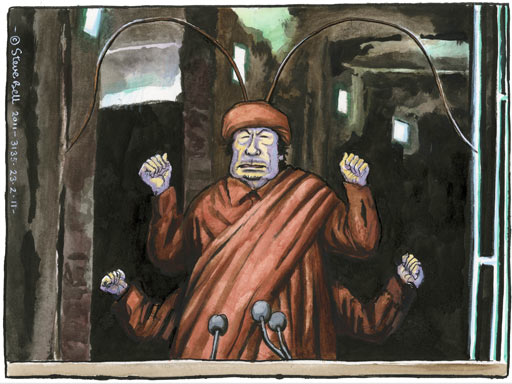
Steve Bell's Qaddafi

Our Tripolitanian witness is alive and well in an Arab country beyond Libya’s borders. Free to use the internet again, she has sent some old reports. The first is from early March.

Today I went out in my area, Ben Ashour, and all the shops were still closed in the main street. I stopped by the bakery for bread and I found a long line of people waiting; the bakery of my area gives each person a rationed number of loaves so each can have at least some bread by the end of the day. I also went to Fashloom, near my neighborhood, and I noticed a weird silence and only a few people walking in that area, the walls all clean of the anti-Qaddafi graffiti that had covered them earlier. I also noticed two cars belonging to Qaddafi’s thugs parked (and undoubtedly armed) in the corners of the tiny streets of Fashloom. Some thugs were dressed like civilians and yet I could tell who they were by their car. Others were wearing military outfits and standing alertly in front of their cars. A member of my family sadly confirmed to me that some families they know in Fashloom (and other areas) had buried their epic martyrs in the gardens of their houses, for they were scared the bodies would be taken away from them by Qaddafi’s thugs.

Continue reading “Tripolitanian Abnormality”