Is TV news one-sidedly in support of Israel?

The Real News interviews Sut Jhally, director/producer of the film Peace, Propaganda & the Promised Land U.S. Media & the Israeli-Palestinian Conflict (watch it here), on the one sided nature of coverage of the conflict.

It was good to see that the excellent study conducted by the Glasgow University Media Group was mentioned.  The study had a number of interesting results including that, due to the absense of historical background given in news coverage, many people in the UK believe that the Palestinians are in fact occupying the Occupied Territories.

The Left-Wing Media Fallacy

Excellent report by Media Lens on the myth of the institutional left-wing bias in the British media, citing Jeremy Bowen, the BBC, and ‘national treasures’ such as Channel 4’s Jon Snow.

It is a mistake to imagine that media corporations are impervious to all complaints and criticism. In fact, senior editors and managers are only too happy to accept that their journalists tend to be ‘anti-American,’ ‘anti-Israel,’ ‘anti-Western,’ indeed utterly rotten with left-wing bias.

In June 2007, an internal BBC report revealed that Auntie Beeb had long been perpetrating high media crimes, including: “institutional left-wing bias” and “being anti-American”. (‘Lambasting for the “trendy Left-wing bias” of BBC bosses,’ Daily Mail, June 18, 2007) Continue reading “The Left-Wing Media Fallacy”

Israel ‘using tourist sites to assert control over East Jerusalem’

The Judaisation of Jersusalem continues reports Rory McCarthy. Israel is using its well-known tactic of building tourist sites on falsified Jewish ‘historical spots’ to erase the past of the indiginous population. Unfortunately McCarthy’s own historical account of the Israel-Palestine conflict only starts with Israel’s annexation of Gaza and the West Bank in 1967, rather than extending back to 1948 with the ethnic cleansing of Palestine, which would provide readers with the context required to understand how that same policy has continued since.

Israel is quietly extending its control over East Jerusalem in alliance with rightwing Jewish settler groups, by developing parks and tourist sites that would bring a “drastic change of the status quo in the city”, according to two Israeli groups.

Ir Amin, a group working for a shared Jerusalem, said the purpose of the “confidential” plan was to link up several areas of East Jerusalem surrounding the Old City with the goal of asserting Israeli control and strengthening its claim to Jerusalem as its capital city. Israel captured East Jerusalem in 1967 and later annexed it, a move not recognised by the international community. Continue reading “Israel ‘using tourist sites to assert control over East Jerusalem’”

Adam Curtis on Journalism

The world’s finest documentary film maker Adam Curtis on the state of journalism (cheers Kim).

The Rise and Fall of the TV Journalist

Oh Dearism

(For those unfamiliar with Adam Curtis’s films, he is parodying his own style).

The fog of media misinformation

The superb Nick Davies questions why the British press swallowed whole the police line that Ian Tomlinson died of a heart attack while their courageous officers attempted to revive him in the face of violent attacks by G20 protesters, only for citizen journalism to expose this falsehood a week later. In turn Davies examines the damning evidence that officers and the Metropolitan Police’s PR machine attempted to mislead the press and cover their own backs. One of the best voices around on the current state of the UK media.

The family of Ian Tomlinson, who died at the G20 protest this month, are planning to file a new complaint to the Independent Police Complaints Commission (IPCC). This will deal not with the events that led to his death but with the fog of media misinformation that followed it. It is a complaint that will go to the heart of the way in which the news media operate – to the frequently undeclared relationship between reporters and the press officers on whom they rely and, in turn, the officials on whom these spokesmen rely on for much of their raw material. And it will pose a question that both sides often prefer to ignore: can they trust each other?

The superb Nick Davies questions why the British press swallowed whole the police line that Ian Tomlinson died of a heart attack while their courageous officers attempted to revive him in the face of violent attacks by G20 protesters, only for citizen journalism to expose this falsehood a week later. In turn Davies examines the damning evidence that officers and the Metropolitan Police’s PR machine attempted to mislead the press and cover their own backs. One of the best voices around on the current state of the UK media.

The family of Ian Tomlinson, who died at the G20 protest this month, are planning to file a new complaint to the Independent Police Complaints Commission (IPCC). This will deal not with the events that led to his death but with the fog of media misinformation that followed it. It is a complaint that will go to the heart of the way in which the news media operate – to the frequently undeclared relationship between reporters and the press officers on whom they rely and, in turn, the officials on whom these spokesmen rely on for much of their raw material. And it will pose a question that both sides often prefer to ignore: can they trust each other?

There were six days of substantially false coverage about a man who apparently died of a heart attack as he walked home while a screaming mob of anarchists hurled missiles at the police officers who tried to help him. Any inquiry into this media misinformation will want to find out whether that was simply the hyperbole of ignorant reporters or the product of bad practice at the Metropolitan police, the City of London police or the IPCC.

Continue reading “The fog of media misinformation”

Israel’s garrison-like hilltop settlements

It is a mark of how the US media’s uncritical coverage of Israel is eroding when you see Roger Cohen in the New York Times consistently being allowed the space to describe the desolate scenes in the West Bank which are punctuated by “garrison-like settlements on hilltops”. In his latest article he writes of US Secretary of State Hillary Clinton’s visit there, in which he states: “If you’re looking for a primer of colonialism, this is not a bad place to start.” This type of language represents a promising shift in the Times’ op-ed pages.

The sparring between the United States and Israel has begun, and that’s a good thing. Israel’s interests are not served by an uncritical American administration. The Jewish state emerged less secure and less loved from Washington’s post-9/11 Israel-can-do-no-wrong policy.

The criticism of the center-right government of Prime Minister Benjamin Netanyahu has come from an unlikely source: Secretary of State Hillary Clinton. She’s transitioned with aplomb from the calculation of her interests that she made as a senator from New York to a cool assessment of U.S. interests. These do not always coincide with Israel’s.

I hear that Clinton was shocked by what she saw on her visit last month to the West Bank. This is not surprising. The transition from Israel’s first-world hustle-bustle to the donkeys, carts and idle people beyond the separation wall is brutal. If Clinton cares about one thing, it’s human suffering.

Continue reading “Israel’s garrison-like hilltop settlements”

The kind of things he writes…

Michael Tomasky isn’t the sharpest tool in the box. Sources tell me that the Guardian hired him because they were looking for a US commentator on the cheap, and he was all they could afford. The analysis as you can see is mediocre, and frankly quite worthless. You never get anything better than a diluted summary of the conventional wisdom in Washington, i.e., the accumulated inanity of the windbags that constitute the US punditocracy. See for example this piece on Paul Krugman’s critique of Obama’s economic policy. Strike that. The piece doesn’t say anything about Paul Krugman’s critique; this glorified gossip columnist reduces it to a personal feud. But more egregiously, see this report on Obama’s handshake with Chavez. The liberal realist that he is, he ridicules the tantrums of the extremists on Fox News etc to defend Obama. He does so however on the grounds that past presidents have shaken hands with bad people too! Not content with taking cheap swipes at Hugo Chavez, he then goes on to disparage his choice of a gift for the US president. He divines Obama’s inner feelings about the gift, telling us he was ‘not too happy’, because ‘We all know who Eduardo Galeano is, and what kind of books he writes’. As a matter of fact we do: he writes Great Books. Books of the kind that the Tomasky’s of the world will probably never read because they will remind them of their own inadequacies. Or perhaps simply because they are just too illiterate. That’s why the Guardian got him for a discount.

Here are ‘the kinds of things [Galeano] writes‘.

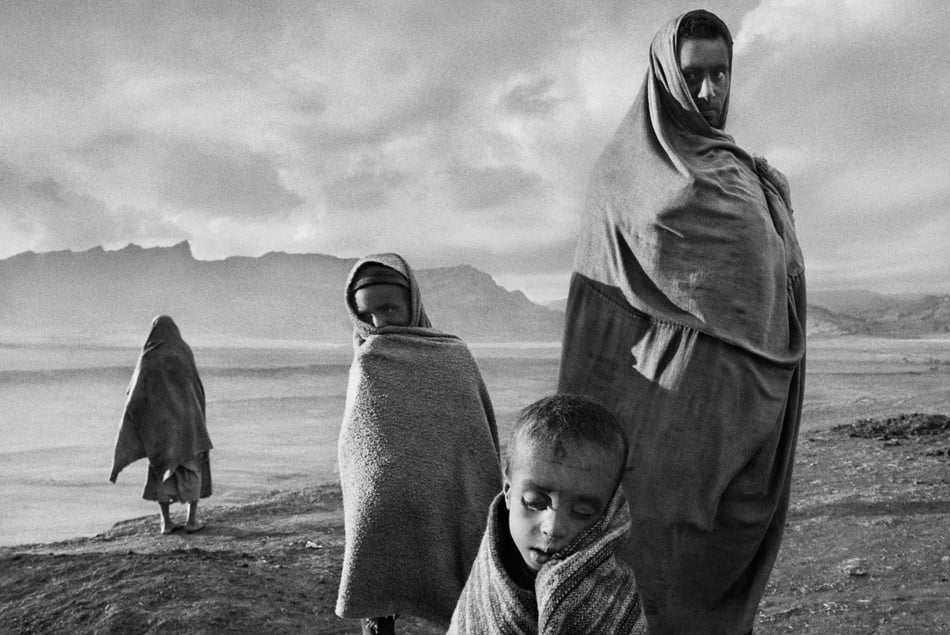
Salgado, 17 Times

Eduardo Galeano’s introduces An Uncertain Grace, a collection of Sebastião Salgado’s photography:

1. Are these photographs, these figures of tragic grandeur, carvings in stone or wood by a sculptor in despair? Was the sculptor the photographer? Or God? Or the Devil? Or earthly reality?This much is certain: it would be difficult to look at these figures and remain unaffected. I cannot imagine anyone shrugging his shoulder, turning away unseeing, and sauntering off, whistling.

2. Hunger looks like the man that hunger is killing. The man looks like the tree the man is killing. The trees have arms, the people, branches. Wizened bodies, gnarled: trees made of bones, the people of knots and roots that writhe under the sun. The trees and the people, ageless. All born thousands of years ago – who knows how many? – and still they are standing, inexplicably standing, beneath a heaven that forsakes them.

3. This world is so sad that the rainbows come out in black and white and so ugly that the vultures fly upside down after the dying. A song is sung in Mexico:

Se va la vida por el agujero Como la mugre por el lavadero. [Life goes down the drain Like dirt in the sink.]

And in Colombia they say:

El costo de la vida sube y sube y el valor de la vida baja y baja. [The more the cost of living goes up the less life is worth.]

But light is a secret buried under the garbage and Salgado’s photographs tell us that secret.

Continue reading “Salgado, 17 Times”
A Crucial Distinction

peter-gooderhamWhy exactly did Britain lead a walkout of the UN anti-racism conference yesterday? True to form, rather than focusing on the obvious issue of what was said in the speech, and why the protesting governments considered it so objectionable, the media focused on the narrow diplomatic issues raised by the walkout itself. On BBC Newsnight Jeremy Paxman interrogated the UK Ambassador to the UN in Geneva in his usual manner,  firing off innocuous questions masked in an aggressive and irreverent tone. First he why the UK government had attended the conference in the first place.  He later accused the Ambassador of playing into the hands of the wicked Ahmedinajed. “What you have done today is exactly what someone like President Ahmedinajed wants,” Paxman complained, “He’s won today.”

One section of the interview however was revealing:

Jeremy Paxman: What is the difference between Zionism and racism?

Peter Gooderham: Well we see the two as being quite distinct…

Jeremy Paxman: Yeah what’s the difference?

Peter Gooderham: Well Zionism is a political movement related to the establishment of a homeland…

Jeremy Paxman [quietly]: So are some forms of racism.

Peter Gooderham:…a Jewish homeland, in the er…in what is now Israel and racism is something else. I mean racism is, I think we all know it when we see it and it’s not, it’s not that, and we have fought long and hard at the United Nations to keep that, to maintain that distinction.

So there you go. Zionism is not racism because we know racism when we see it and it’s not that. Just like we know terrorism when we see it, and it’s not this.

A dick named Cox

What do you call someone who in 2009 believes that ‘Blair must have believed that WMD existed, since even the peace lobby did…[s]eeking to protect oil supplies wouldn’t have been an entirely ignoble concern…he might honestly have thought this would be in our own best interests. Alastair Campbell …could still have believed in the policy he was enforcing’ and thinks In the Loop is a bad film because it ‘excludes the part played by principle’?

There is much that one could criticize about the Armando Iannucci film In the Loop. That it couldn’t be as credulous as the tools in the New Labour press is not one of them. It is a travesty the British press should allow bovine oafs like David Cox to defile their pages.