Will the Afghan Surge Succeed?

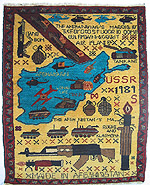
Soviet Exodus War Rug

M. Shahid Alam

More than eight years after dismantling the Taliban, the United States is still mired in Afghanistan. Indeed, last October it launched a much-hyped ‘surge’ to prevent a second Taliban takeover of Afghanistan, not imminent yet, but eminently possible.

The first dismantling of the Taliban was a cakewalk.

In 2001, the United States quickly and decisively defeated the Taliban, killed, captured or scattered their fighters, and handed over the running of Afghanistan to their rivals, mostly Uzbeks and Tajiks from the Northern Alliance.

Unaware of Pashtoon history, American commentators were pleased at the smashing victory of their military, convinced that they had consigned the Taliban to history’s graveyard.

Instead, the Taliban came back from the dead. Within months of their near-total destruction, they had regained morale, regrouped, organized, trained, and returned to fight what they saw as a foreign occupation of their country. Slowly, tenaciously they continued to build on their gains, and by 2008 they were dreaming of taking back the country they had lost in 2001.

Could this really happen? That only time will tell, but prospects for the Taliban today look better than at any time since November 2001.

Continue reading “Will the Afghan Surge Succeed?”

Rahimullah Yusufzai on the Taliban, Al-Qaida and the ‘Af-Pak’ theatre

Kudos to The Real News for giving its viewers an opportunity to listen to Rahimullah Yusufzai, the most respected authority on the politics of the Afghanistan-Pakistan frontier. Yusufzai was also among our 20 Top Global Media Figures of 2009.

Capture of leader will not weaken Taliban: Taliban is so strong now they have probably already replaced Baradar


Continue reading “Rahimullah Yusufzai on the Taliban, Al-Qaida and the ‘Af-Pak’ theatre”

Offensive in Marja directed at US public opinion

The reported arrest of Mullah Abdul Ghani Baradar by US forces in cooperation with Pakistan is significant. He was a key member of the Quetta Shura, the central command of the Afghan Taliban. Pakistan sees the Afghan Taliban as a strategic asset in its struggle against regional rivals. It would be odd therefore to hand over such a key figure to US forces. I therefore suspect three possible scenarios: 1) The reported negotiations that Baradar had been conducting with  coalition forces were unauthorized by the shura, and therefore they chose to throw him under the bus with Pakistani cooperation to preempt any possible betrayal; 2) Baradar has already cut a deal and the ‘arrest’ is staged to make his coming in from the cold appear more respectable; 3) Pakistan is trying to signal its indispensability to the Taliban who in recent months had been growing increasingly recalcitrant. Either way, it is unlikely that Baradar’s arrest will do much to diminish the gains that the Taliban have been making in recent year. Here I would also like to recommend one of the best, most comprehensive, books on the Afghan Taliban: Antonio Guistozzi’s Koran, Kalashnikov, and Laptop: The Neo-Taliban Insurgency in Afghanistan 2002-2007.

In related news, one of the world’s finest investigative reporters, Gareth Porter of the Inter Press Service is just back from Afghanistan. He notes that the attack on Marja is meant to prepare Americans to accept negotiations with Taliban.

President of Cant

By Tariq Ali

A year since the White House changed hands, how has the American empire altered? Under the Bush Administration it was widely believed, in both mainstream opinion and much of the amnesiac section of the left, that the United States had fallen under an aberrant regime, the product of a virtual coup d’état by a coterie of right-wing fanatics—alternatively, ultra-reactionary corporations—who had hijacked American democracy for policies of unprecedented aggression in the Middle East. In reaction, the election to the Presidency of a mixed-race Democrat, vowing to heal America’s wounds at home and restore its reputation abroad, was greeted with a wave of ideological euphoria not seen since the days of Kennedy. Once again, America could show its true face—purposeful but peaceful, firm but generous; humane, respectful, multi-cultural—to the world. Naturally, with the makings of a Lincoln or a Roosevelt for our time in him, the country’s new young ruler would have to make compromises, as any statesman must. But at least the shameful interlude of Republican swagger and criminality was over. Bush and Cheney had broken the continuity of a multilateral American leadership that had served the country well throughout the Cold War and after. Obama would now restore it.

Rarely has self-interested mythology—or well-meaning gullibility—been more quickly exposed. There was no fundamental break in foreign policy, as opposed to diplomatic mood music, between the Bush 1, Clinton and Bush 2 Administrations; there has been none between the Bush and Obama regimes. The strategic goals and imperatives of the us imperium remain the same, as do its principal theatres and means of operation. Since the collapse of the USSR, the Carter Doctrine—the construction of another democratic pillar of human rights—has defined the greater Middle East as the central battlefield for the imposition of American power around the world. It is enough to look at each of its sectors to see that Obama is the offspring of Bush, as Bush was of Clinton and Clinton of Bush the father, as so many appropriately biblical begettings.

Continue reading “President of Cant”

Brzezinski on the Soviet occupation of Afghanistan

Zbigniew Brzezinski has always ranked high in leftist demonology for allegedly luring the Soviets into Afghanistan and ‘creating’ the Mujahideen thereby destroying a government which was bringing womens’ rights and education to the benighted, medieval people. Typically, this analysis accords no agency to the Afghans themselves: the natives can only be manipulated, they have no will of their own. It is always the outsider that knows what’s best for the native: for the neoconservatives it is Uncle Sam, for leftists it as Kremlin. As Brzezinski correctly notes here, however, the Soviets were already deeply engaged in Afghanistan long before the invasion. The arms supplies only started after the invasion, and escalated around 1982. The war was a popular liberation struggle. The US support only hastened the Soviet exit, it wasn’t indispensable to it. The Afghans would have fought anyway.

Leaving aside his dubious views in other areas, on Afghanistan Brzezinski is right. And the interviewer’s attempt to impose a teleological narrative on developments in Afghanistan is rather frivolous. There was no inevitability to all that has happened in Afghanistan. Much like the neoconservatives, leftists seem predisposed to accept the Enlightnement belief in the linear progress of history. They fail to appreciate the  contingency of it all.

(The first part of this interview is here)

Afghanistan: The Kashmir Connection

It is a mark of how far right things have moved in the past 30 years that even a Cold War hawk such as Zbigniew Brzezinski can come across sounding more reasonable than the putatively ‘liberal’ US president. The following is an interesting interview in which Brzezinski explicates his oft-misrepresented position on Central Asia. It also marks the clear split between the realist and neoconservative worldviews. Though both are marinated in American exceptionalism, unlike the neoconservatives, the realists have a sense of the limits of US power. That’s the main reason why all of them opposed the Iraq war. Brezinski’s comments about Afghanistan toward the end of the interview are notable: as he points out, the US cannot resolve the conflict unless it addresses the issue of Kashmir first. This same opinion was forwarded by Graham Usher earlier in the London Review of Books, and most recently by Pankaj Mishra in the New York Review of Books. I have excerpted at length Mishra’s must-read article below.

Obama’s long speech on Afghanistan on December 1 did not refer even once to India or Kashmir. Yet India has a large and growing presence in Afghanistan, and impoverished young Pakistanis, such as those who led the terrorist attack against Mumbai last November, continue to be indoctrinated by watching videos of Indian atrocities against Muslims in Kashmir. (Not much exaggeration is needed here: in late November an Indian hu-man rights group offered evidence of mass graves of nearly three thousand Muslims allegedly executed over the last decade by Indian security forces near the border with Pakistan.) Another terrorist assault on India is very likely; it will further stoke tensions between India and Pakistan, enfeebling America’s already faltering campaign against the Taliban and al-Qaeda.

Continue reading “Afghanistan: The Kashmir Connection”

Speaking Truth to Power

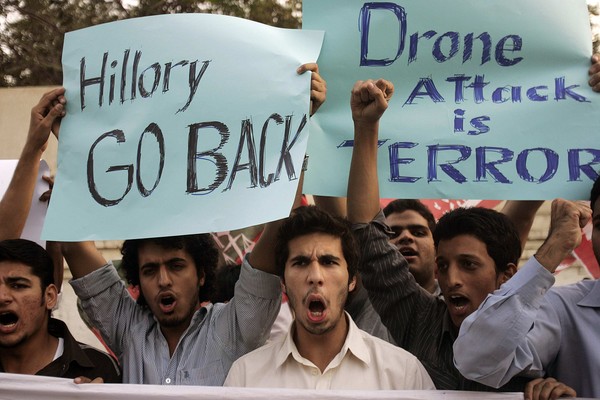
Students in Lahore, Pakistan, protest against the visit of U.S. Secretary of State Hillary Clinton. (K.M. Chaudary/AP Photo/October 29, 2009)

by Kathy Kelly

There’s a phrase originating with the peace activism of the American Quaker movement: “Speak Truth to Power.”  One can hardly speak more directly to power than addressing the Presidential Administration of the United States. This past October, students at Islamabad’s Islamic International University had a message for Secretary of State Hillary Clinton.  One student summed up many of her colleagues’ frustration. “We don’t need America,” she said. “Things were better before they came here.”

The students were mourning loss of life at their University where, a week earlier, two suicide bombers walked onto the campus wearing explosive devices and left seven students dead and dozens of others seriously injured. Since the spring of 2009, under pressure from U.S. leaders to “do more” to dislodge militant Taliban groups, the Pakistani government has been waging military offensives throughout the northwest of the country.  These bombing attacks have displaced millions and the Pakistani government has apparently given open permission for similar attacks by unmanned U.S. aerial drones.   Every week, Pakistani militant groups have launched a new retaliatory atrocity in Pakistan, killing hundreds more civilians in markets, schools, government buildings, mosques and sports facilities.  Who can blame the student who believed that her family and friends were better off before the U.S. began insisting that Pakistan cooperate with U.S. military goals in the region?

Continue reading “Speaking Truth to Power”

Obama kills over 700 Pakistanis in 44 drone strikes in 2009

Victims of Obama's drone attacks

The Pakistani daily Dawn — a pro-US paper not known for its antiwar stance — reports that US drones killed over 700 civilians in 44 bombings since Obama took office in January 2009. Of the 44 attacks, only five succeeded in hitting their target. In other words, Obama has surpassed his predecessor’s murderous record in Pakistan. (Of course these attacks are carried out with the complicity of Pakistan’s ruling elites — as Jane Mayer reported, and as Pervez Musharraf confessed — and are cheered on by native informers such as Ahmed Rashid).

PESHAWAR: Of the 44 predator strikes carried out by US drones in the tribal areas of Pakistan over the past 12 months, only five were able to hit their actual targets, killing five key Al-Qaeda and Taliban leaders, but at the cost of over 700 innocent civilians.

Continue reading “Obama kills over 700 Pakistanis in 44 drone strikes in 2009”

Pakistan’s ‘Oral’ Society

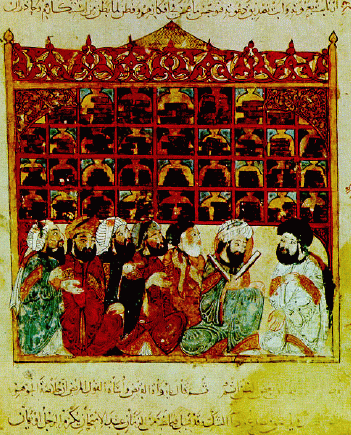
Public library of Hulwan, Baghdad

M. Shahid Alam

(Note: This essay was written nearly twenty years back, in April 1991. A great many changes have come to Pakistan since then, but I am afraid that the observations I had made then about ‘orality’ of Pakistani discourse still hold true. Pakistan’s best young minds do not go where their hearts and their talents lead them. Instead, overwhelmingly, they still pursue job security. Sadly, education – even for the brightest – is still mostly vocational education. With the introduction of multiple private cable channels, however, orality has entered a new age. The oral discourse, previously confined to drawing rooms and campuses, is now led by ‘talking heads’ in television studios. Is this discourse now more solidly rooted than before in the written word, in history and the social and natural sciences? I doubt it: and why should it? Pakistan’s brown Sahibs continue to drag the country deeper into dependency; they work overtime to trap Pakistanis in the most superficial consumerism, without the capital, technology and skills that support this malaise in developed Western societies. In other words, Pakistan is still caught in the disease that Jalal Al-i Ahmad had described in his book, Gharbzadagi Occidentotis: A Plague from the West.)

I first became aware of differences between ‘oral’ and ‘literate’ societies when I returned to Pakistan in 1979 – after an absence of some five years in the United States and Canada – to take up a fellowship at the Applied Economics Research Center, affiliated to the University of Karachi.

Continue reading “Pakistan’s ‘Oral’ Society”

What the US Elite Really Thinks About Israel

Senator William Fulbright had first called the US Congress an Israeli Occupied Territory

Our friend Jeffrey Blankfort on the surprising results of CFR survey — surprising, to the extent that it goes against the lefitst conventional wisdom which has accorded Israel the status of a ‘strategic asset’; much less so, however, when it comes to revealing the level ignorance about the situation in Pakistan. For background, also see Blankfort’s rejoinder to Joseph Massad’s fatuous attack on John Mearsheimer and Stephen Walt.

The Council on Foreign Relations is always near the top of the Left’s list of bogeymen that stand accused of pulling the strings of US foreign policy. It is right up there with the Bilderberg Group and the Trilateral Commission, right? Wrong. If that was the case,  those arguing that US support for Israel is based on it being a “strategic asset”  will have a hard time explaining a Pew Research Center survey on America’s Place in the World, taken of 642 CFR members between October 2 and November 16. The Pew poll  not only reveals that the overwhelming majority, two-thirds of the members of this elite foreign policy institution, believes that the United States has gone overboard in favoring Israel, it doesn’t consider Israel to have have much importance to the US in the first place.

Continue reading “What the US Elite Really Thinks About Israel”