During the journey from Ramallah to Nablus I got talking to the middle-aged man sitting beside me. It turned out he’d been in prison for five years, cramped in a cockroach-run tent with tens of other men. At the kiosk at the end of my street I got talking to a white-haired young man. A few nights earlier the two owners of the kiosk had been taken away in an Israeli jeep. The white-haired man’s brother had been killed in 2007. He himself had done eleven years inside. I got talking to a writing student whose brother was constantly detained. A Palestinian friend of mine who now lives outside did ten years in Israeli jails. Two and a half of them were underground. Almost every male I met in Nablus had been imprisoned at some point. There are at least 8500 prisoners currently inside. But my friend tells me he felt more free inside the small prison than he did inside the larger. So here’s the statistic that counts: in all the territories controlled by the apartheid state of Israel there are 5,300,000 Palestinian prisoners. The other half of the Palestinian people is locked outside in exile. Here’s Saed Abu-Hijleh describing temporary detention.
Category: Palestine
Hope, and How Not to Visit Palestine
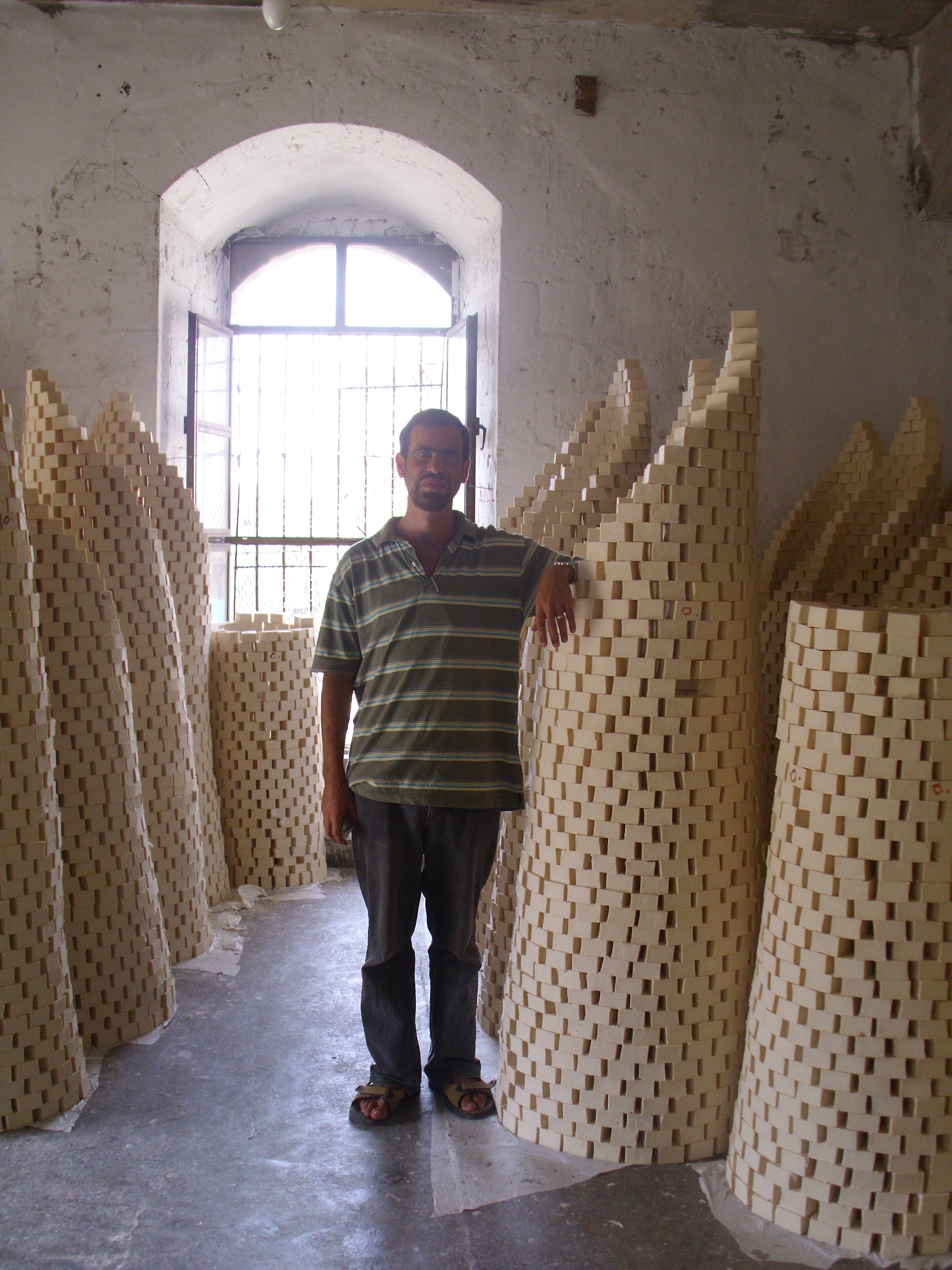 My visit to Nablus coincided with the first Palestinian Human Rights Film Festival at an-Najah University. Even better than the films shown were the panel discussions afterwards, on issues such as refugees, resistance and women’s rights. The first film I saw was “To Shoot an Elephant” (watch it here), a brutal, highly-recommended documentary shot by International Solidarity Movement activists who happened to be in Gaza as the 2008/09 massacre unfolded. After the screening the audience communicated with director Alberto Arce via a video link-up to Spain. (Alberto is permanently banned from entry into Israeli-controlled territory.)
Alberto said this: “It is not my job to tell the Palestinians what to do. It’s my job to support the Palestinians and to witness what’s happening to them. The Palestinians have suffered so much from the actions of foreigners, and foreigners have no right to impose their beliefs on Palestinians.”
The Martyrdom of Shaden al-Saleh
This video (over the fold) concerns Israel’s 2002 murder of a Palestinian teacher,cultural activist and neighbourhood organiser, Shaden al-Saleh. Shaden was the mother of Saed Abu Hijleh, who witnessed the murder and gives his own account here. Saed teaches political geography at Nablus’s an-Najah University, writes poetry, blogs, organises, and provides me with wonderful food and information, for which I’m very grateful. He’s a well-educated member of the Nablus middle classes. He’s also been shot in the belly and in the shoulder and has been imprisoned five times. But his suffering is not unusual. Everybody in Nablus has a story to tell. I’ve just returned from the prison, and over the next couple of weeks I aim to convey a few of the stories I heard. An example of Saed’s English-language poetry is over the fold.
John Mearsheimer on the State of the Israel Lobby
John Mearsheimer, professor of political science at the University of Chicago and co-author, along with Stephen Walt, of ‘The Israel Lobby and US Foreign Policy ,’ spoke with IPS about the Israel lobby.
Cléa Thouin, Assistant Editor of the Journal of Palestine Studies, asked Mearsheimer about the state of the Lobby and the prospects for peace between Israel and the Palestinians.
Continue reading “John Mearsheimer on the State of the Israel Lobby”
Settlers blamed for mosque blaze
Prayer rugs and Quran copies burnt in a West Bank mosque, in fire said to have been started by Israeli settlers.
The Making of a Virtual Palestinian State
Mosaic Intelligence Report: October 1, 2010 — Direct talks between the Palestinians and Israel might collapse. Will Netanyahu agree to extend the settlement freeze? And, does the prospect for a Palestinian Sate remain viable?
The letter Dajani talks about was actually Dennis Ross’s initiative, who was once described by his own subordinate as ‘Israel’s lawyer’. MJ Rosenberg’s blistering take on Ross’s treacheries is a must read.
Continue reading “The Making of a Virtual Palestinian State”
Infamous Israeli Interrogator becomes police chief in Israel
RussiaToday – The appointment of an infamous Israeli interrogator to a high-ranking police post has sent shockwaves among human rights groups. Known among inmates as Captain George, he’s accused of numerous cases of torture and abuse of Arabs. Now that he’s in charge of Arab affairs, many Palestinians fear for their lives. RT’s Paula Slier reports from Israel.
The Criminalization of BDS in France
by Najate Zouggari
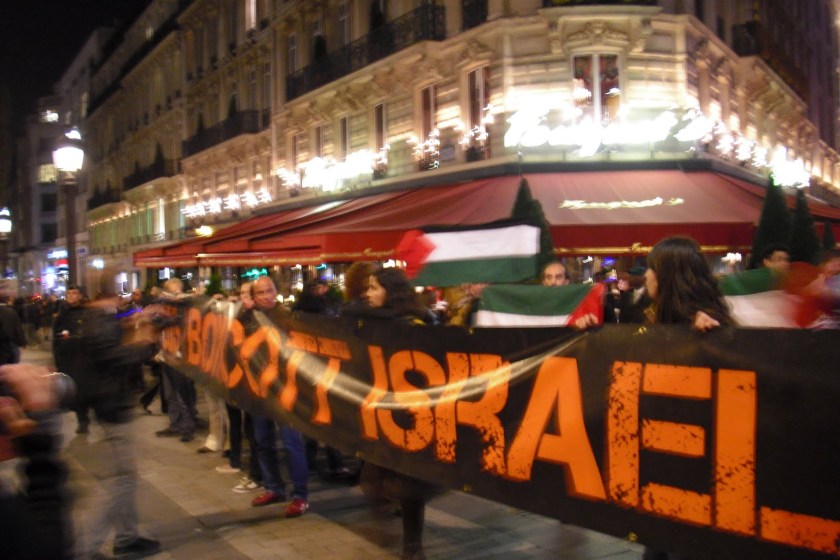
French authorities received the request of pro-Israeli plaintiffs who finally managed to turn the international solidarity movement – and its non-violent expression of resistance against the colonial state of Israel – into a potentially punishable action.
Before reaching the tribunals and the symbolic weight of a juridical expression, this criminalizing discourse was previously set as a clear position on the opinion battlefield: many journalists and commentators harshly criticized the BDS campaign, some of them even smart enough to admit that even if the IDF — “the most moral army in the world” of “the only democracy of the Middle-East” — was perhaps not perfect, Israeli artists should still be encouraged to meet up and present their work in French festivals, universities. Apart from the fact that with such a specious reasoning racial segregation would still exist in South Africa, this discourse is omitting – either by dangerous naïveté or immoral bad faith – that culture is strictly related to the state’s apparatus: materially, through the reception of grants-in-aid, and ideologically, as an instance of reciprocity with the rest of the society. Israeli artists based in Israel are not floating in the air of abstraction: whether some complacently idealist French commentators like it or not, artists are legitimate and recognized members of the society they live in — the margin is still inside the sheet. The fact Israeli artists pay taxes to the Israeli state and serve in the Israeli military while their army bombs Palestinian civilians (with even white phosphorus as some allege) makes them indirectly but firmly responsible of the ongoing colonization, ethnic-cleansing and racist policies promoted by their government. Exempting Israeli artists and intellectuals of their moral responsibility is subsequently a poisoned gift in the long-term, and an easy way to criminalize the BDS movement in the short-term.
Obama’s UN speech ‘nothing new’
Barack Obama, the US president, has urged countries in the United Nations to get behind Middle East peace efforts in an address at the UN General Assembly. But Ali Hasan Abunimah, a Palestinian-American journalist and co-founder of Electronic Intifada, an independent web site about the Israeli-Palestinian Conflict, said Obama’s speech did not represent anything new. “That bodes very ill for the peace process that he’s so invested in,” Abunimah told Al Jazeera’s Shihab Rattansi, speaking from the US state of Indiana.
“Let’s judge him not by what he says, but what he does.”
Reese Erlich: “Stop using the word ‘terrorist'”
Defining what a terrorist is and isn’t is a major dilemma. What one may consider terrorism, another may consider resistance. So where does one draw the line? Reese Erlich tackles that topic in his latest book “Conversations with Terrorists: Middle East Leaders on Politics, Violence, and Empire.” Erlich is a veteran journalist who has covered U.S. foreign policy for decades. He has freelanced for National Public Radio, Radio Deutsche Welle, the Australian Broadcasting Corp. Radio, the Canadian Broadcasting Corp. Radio, and writes for The San Francisco Chronicle and The Dallas Morning News.
Drawing on firsthand interviews and original research, Erlich argues that yesterday’s terrorist is often today’s national leader and that today’s freedom fighter may become tomorrow’s terrorist. By branding all of American’s opponents as “terrorists,” it makes it more difficult to look beyond the individual or the political group and understand what they are really all about. I caught up with Erlich recently and here’s what he had to say.
Continue reading “Reese Erlich: “Stop using the word ‘terrorist’””
 P U L S E