Robert Fisk, Richard Murphy and Azzam Tamimi discuss the Nobel Peace Prize to Barack Obama. Does he deserve the prize? And what has he achieved? Or was the award granted in the hope he would succeed in the future?
Category: Palestine
Bring on The Third Intifada!
 After hearing that the Palestine Liberation Organization has decided to abandon a resolution requesting the Human Rights Council to forward Goldstone’s report to the UN Security Council, the thought flashed through my head that if I was Palestinian, I’d vote Hamas. What could have possibly possessed them, but a sheer disconnect from their people? One must ask, is their money that good?
Fatah Vs. Hamas
On many occasions, we that are born free (all is relative) find it hard to understand Palestinian mentality. Just this week, I’ve had exhausting debates about the safety of children, during the Bil’in weekly protest. Though I can’t defend or agree with allowing your children to be near the fence, when the army is 101% likely to fire gas grenades, I firmly believe that mindsets under occupation are something we don’t fully understand. Maybe when I’m a mother to a child that’s been snatched from his bed at night, arrested, beaten and interrogated, I’ll have a different perspective on danger.
By the same token, I believe it may be extraordinarily hard to make that fateful choice, when you’re at the voting booth. Although Hamas has been cynical towards its people during the Gaza massacre (claiming to have “won the war” and other flamboyant rhetoric), as if militaristic ego was a top priority; If I were Palestinian this latest in a long line of PLO sell-outs would seem much more cynical, to me.
President Blair
If the Irish vote to ratify the Lisbon Treaty, Tony Blair, former British prime minister and current lecturer on faith, peace, and Palestinian submission, is expected to become the European Union’s first president. I wrote the following hymn to Blair in October 2007, when the unpleasant prospect of his presidency was first raised.
 I’ve often thought that Abu Hamza al-Masri, the ex-imam of Finsbury Park mosque, must have been designed in a CIA laboratory. Not only did he – before his imprisonment – fulminate in a shower of spittle against various brands of kuffar, he also had an eye patch and a hook for a hand. You can’t imagine a more photogenic Islamist villain.
If my supposition is correct, then Tony Blair may well have been invented by the Iranian secret service, for of all the neo-cons he’s the one who most looks the part. I refer to the physiognomic combination of weakness and fury, the slight chin wobbling beneath that eye with its wild glint of certainty – the staring left eye, fixed on something the rest of us can’t see, something that makes reality irrelevant – and the teeth both fierce and mouselike, and the shininess of both forehead and suit. Most politicians wear suits, but few suits declare ‘hollow salesman’ so much as Blair’s. The voice too – the hurried speech and breathy tones of a public schoolboy approaching orgasm – that repulsive aural mix of complacency, stubbornness and privilege.
Israel Social TV Presents: Olives Under Occupation
Operating since 2006, Social TV was established out of deep concern from the ability of Israeli Media to perform its duty as democracy’s “watch dog”. In the last two decades three major corporations have gained control over most of Israel’s television channels, newspapers, radio channels and popular news sites. As a result Israel’s media has become quite homogenous and pluralism of opinion declined… Today Social TV is the only independent on-line TV channel in Israel.
On Palestinian Civil Disobedience — Neve Gordon
A simple google search with the words “Palestinian violence” yields over 86,000 pages, while a search with the words “Palestinian civil disobedience” generates only 47 pages.
Sometime in 1846, Henry David Thoreau spent a night in jail because he refused to pay his taxes. This was his way of opposing the Mexican-American War as well as the institution of slavery. A few years later he published the essay Civil Disobedience, which has since been read by millions of people, including many Israelis and Palestinians.
Kobi Snitz read the book. He is an Israeli anarchist who is currently serving a 20 day sentence for refusing to pay a 2,000 shekel fine.
Thirty-eight year-old Snitz was arrested with other activists in the small Palestinian village of Kharbatha back in 2004 while trying to prevent the demolition of the home of a prominent member of the local popular committee. The demolition, so it seems, was carried out both to intimidate and punish the local leader who had, just a couple of weeks earlier, began organizing weekly demonstrations against the annexation wall. Both the demonstrations and the attempt to stop the demolition were acts of civil disobedience.
Continue reading “On Palestinian Civil Disobedience — Neve Gordon”
Sabra and Shatila
Genre-specific readers be alerted: this is first draft fiction, not reportage – though its material is entirely factual. Twenty seven years ago today.
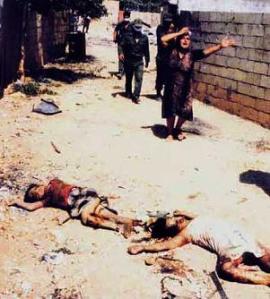 The militia were Arabs, brother Arabs.
The Phalangists were already baying from east Beirut, howling revenge. Now Israel flew Haddad’s militia, la crème de la crème, up from the south. Both groups assembled at the airport, for General Sharon to ensure all were properly kitted out: with weapons, military rations, medical supplies; Israeli cocaine and Lebanese hashish; Mediterranean testosterone, bad breath.
Then he uncaged them.
At six on Thursday evening. In the first penetration, three hundred and twenty men were brought on thirty trucks. Four gangs invading from four approaches. These were the most blood-addicted, rape-happy, battle-addled of militiamen, men long ago surfeited on outrage, men who required ever more extreme atrocities to stir their glutted senses. Ever wilder, ever sharper.
Israel lit the sky for them. White phosphorus flares trailing and dancing. Fire above like a terrible sun in the ceiling, a sun switched on in anger, while the children are sleeping.
Peace propaganda and the Israeli consensus
George Mitchell is in Israel/Palestine as the White House’s special envoy, in a visit described as “a final push to revive Middle East peace talks”. The focus remains on Israel’s so –called settlement ‘freeze’, with Mitchell reported as saying that there was still work to be done on the “Israeli-American dispute over construction in the West Bank”. Ahead of his meeting with Mitchell today, Netanyahu has confirmed that there will not be a “complete halt to building” in the settlements, telling a Knesset committee that “a reduction on building in Judea and Samaria will only be for a limited period”.
The ‘freeze’ is the latest warmed-up gimmick to be offered by the international community’s peace process’, though even by the standards of previous efforts such as the ‘Road Map’ and ‘Annapolis’, the settlement freeze is transparently lacking in seriousness. The Israeli government’s definition of a ‘freeze’ excludes: settlement activity in occupied East Jerusalem; 2,500 housing units already under construction; and, hundreds of new units just recently announced.
That the ‘freeze’ will last in the region of six to nine months is rather academic, given that it will make no difference to this year’s total settlement housing consolidation compared to previous years. As Ha’aretz pointed out, “instead of construction permits being given gradually throughout the year, the government intends to issue hundreds of permits within a few days, before the official announcement of the “freeze” is made”.
Even the PM’s spokesperson Mark Regev has found it hard to spin what Deputy PM Eli Yishai has called merely a “strategic delay”. The new construction in West Bank colonies ahead of the ‘freeze’ Regev argued was a case of doing something now to “actually make progress possible tomorrow”. MK Nissim Ze’ev, visiting a settlement outpost, felt no need to resort to such contortions, encouraging the settlers that there is “no one in the government who doesn’t want more and more construction throughout Judea and Samaria”, but that owing to tensions with the US, there are currently “limitations”. Continue reading “Peace propaganda and the Israeli consensus”
Sabra And Shatila: On massacres, atrocities and holocausts
In honour of the victims of the Sabra Shatila massacre, we are republishing this piece by Sonja Karkar from 2007. May we never forget this Israeli-enabled Phalangist crime. Warning: the following article depicts the horror of a massacre and should be read by mature readers — details of the atrocity appear over the fold.
 Sabra And Shatila
On massacres, atrocities and holocausts

by Sonja Karkar, Women for Palestine and Australians for Palestine
The Massacre
It happened twenty-five years ago – 16 September 1982. A massacre so awful that people who know about it cannot forget it. The photos are gruesome reminders – charred, decapitated, indecently violated corpses, the smell of rotting flesh, still as foul to those who remember it as when they were recoiling from all those years ago. For the victims and the handful of survivors, it was a 36-hour holocaust without mercy. It was deliberate, it was planned and it was overseen. But to this day, the killers have gone unpunished.
Sabra and Shatila – two Palestinian refugee camps in Lebanon – were the theatres for this staged slaughter. The former is no longer there and the other is a ghostly and ghastly reminder of man’s inhumanity to men, women and children – more specifically, Israel’s inhumanity, the inhumanity of the people who did Israel’s bidding and the world’s inhumanity for pretending it was of no consequence. There were international witnesses – doctors, nurses, journalists – who saw the macabre scenes and have tried to tell the world in vain ever since.
Continue reading “Sabra And Shatila: On massacres, atrocities and holocausts”
Looking For Eric, Melbourne Festival, and the Cultural Boycott

In response to an earlier attack by Richard Moore of the Melbourne International Film Festival, The Guardian published an edited version of a response (‘Boycotts don’t equal censorship‘) by Ken Loach, Paul Laverty and Rebecca O’Brien. Here is the original.
When we decided to pull our film Looking for Eric from the Melbourne film festival following our discovery that the festival was in part sponsored by the Israeli state we wrote to the Director Richard Moore with our detailed reasons. Continually he has dishonestly misrepresented us and does so again (Comment is Free 27th Aug ‘09) by stating that “to allow the personal politics of one film maker to proscribe a festival position…..goes against the grain of what festivals stand for.” Later “Loach’s demands were beyond the pale”. Once again Mr Moore, this decision was taken by three film makers, (director, producer, writer) not in some private abstract bubble, but after long discussion between us and in response to a call for a cultural boycott, including film festivals, from a wide spectrum of Palestinian civil society, including writers, film makers, cultural workers, human rights groups, journalists, trade unions, women’s groups, student organizations and many more besides. As Moore should know by now “The Palestine Campaign for the Academic and Cultural Boycott of Israel” (PACBI) was launched in Ramallah in April 2004, and its aims, reasons, and constituent parts are widely available on the net. This in turn is part of a much wider international movement for “Boycott, Divestment, and Sanction” (B. D. S.) against the Israeli State.
Continue reading “Looking For Eric, Melbourne Festival, and the Cultural Boycott”
An Abnormal Nationalism
The ultimate goal…is, in time, to take over the Land of Israel and to restore to the Jews the political independence they have been deprived of for these two thousand years…The Jews will yet arise and, arms in hand (if need be), declare that they are the masters of their ancient homeland.”—Vladimir Dubnow, 1882
Zionism is best described as an abnormal nationalism. This singular fact has engendered a history of deepening conflicts between Israel – leading an alliance of Western states – and the Islamicate more generally.
Jewish ‘nationalism’ was abnormal for two reasons. It was homeless: it did not possess a homeland. The Jews of Europe were not a majority in, or even exercised control over, any territory that could become the basis of a Jewish state. We do not know of another nationalist movement in recent memory that started with such a land deficit – that is, without a homeland.
Arguably, Jewish nationalism was without a nation too. The Jews were a religious aggregate, consisting of communities, scattered across many regions and countries, some only tenuously connected to others, but who shared the religious traditions derived from, or an identity connected to, Judaism. Over the centuries, Jews had been taught that a divinely appointed Messiah would restore them to Zion; but such a Messiah never appeared; or when he did, his failure to deliver ‘proved’ that he was false. Indeed, while the Jews prayed for the appearance of the Messiah, they had no notion about when this might happen. In addition, since the nineteenth century, Reform Jews have interpreted their chosenness metaphorically. Max Nordau complained bitterly that for the Reform Jew, “the word Zion had just as little meaning as the word dispersion…He denies that there is a Jewish people and that he is a member of it.”
 P U L S E