PULSE editor Robin Yassin-Kassab was on the BBC’s Radio 4 last night to comment on the situation in Syria. You can read his recent post on the subject here.
UPDATE: Jeb Sharp of the BBC interviews Robin for PRI’s The World.

Will Syria experience a civil war? There’s already a civil war of narratives, pitching the regime’s version against everyone else’s, and a social civil war, in which Syrians find themselves shocked by the responses of their friends and relatives, and find new friends and unexpected allies, realigning their perspectives and values as they do so. Many Syrians are still so scared of the unknown, and so deep in the slave mentality, that they wish to believe what the old authority tells them.
But decreasingly so. Most people have a time limit on their gullibility, or their self-deception. The lies of state TV and the ridiculous ad-Dunya channel, though they come as thick as summer flies, cannot cover the dazzlingly obvious – that the regime is torturing children to death, shooting women and old men, and randomly arresting, beating and humiliating the innocent. That Syria’s tanks and helicopter gunships should be liberating the Golan, not slaughtering Syrians. That the protestors are patriots seeking their basic rights. (I gave up having the argument about Salafis and foreign infiltrators weeks ago on the basis that anyone who wants to believe the regime version will believe it regardless of facts and logic.)
There are still diehards who point to Syria’s social and cultural ills as a reason for sticking with the regime. Give it a chance, they say. Let it reform, as it will undoubtedly do. The alternative is sectarian civil war.
Al Jazeera reports that at least 20 people have been killed along the Syrian frontier during a pro-Palestinian rally marking the “Day of Defeat” in the 1967 war.
 Amid debate with Joshua Landis in the comments section of the previous post, I wrote this:
Another point about sectarianism. Remember the fight bewtween Alawis and Ismailis some years ago in Masyaf (was it Masyaf?). There was a good piece about it on Syria Comment. Somebody at the time (perhaps Joshua) pointed out that the fight wouldn’t have reached the proportions it did if there had been respected civil society figures who could have knocked the young men’s heads together. But there weren’t any such figures, because any natural authority figure was perceived as a threat by the regime and had been removed. Masyaf is a microcosm of Syria.
Then a visitor called AK posted the following comment, which is very worth reading.
Syrians lived together even before the arrival of Al Assad family to power. Mind you, majority of Alawii are poorer now than forty years ago. You just need to visit any Alawii village (including Kurdaha) to establish that yourself..
Today another 29 Syrians, including a child, were slaughtered in their streets. Today Hugo Chavez referred to Syrian President Bashaar al-Asad as “my brother.” He claimed that Syria is “the victim of a fascist attack,” but he wasn’t referring to his fascistic brother, he was referring to the people.
Lance Selfa at Socialist Worker analyses Chavez’s perverse stand. It should be noted that Turkish PM Erdogan has regained his popularity since he took a strong line against Qaddafi and Asad.
WHEN THE revolution sweeping the Arab world struck Libya and Syria, the governments there chose to act in the same way that the Bahraini monarchy did against its internal opposition: Open fire on unarmed crowds, arrest large numbers of people and outlaw demonstrations.
These actions have rightly received widespread condemnation from supporters of the Arab revolutions. But they have received at least tacit support from Venezuelan President Hugo Chávez, who is widely considered an important figure on the international left.

The Syria Comment website is an indispensable source for news and views on Syria. Unfortunately, it now requires a health warning.
In a recent article Joshua Landis writes that the protestors “failed to provoke a confessional split in the army as happened in Lebanon. Sunni soldiers have not split from Alawis, despite all the talk about “shabbihas,” which is code for Alawis.”
This, as so often in recent weeks, is an example of Syria Comment taking leave of reality in order to slander the uprising. I’ve been following activist websites and facebook pages, and talking to Syrians of a range of backgrounds. I haven’t come across anyone who aimed to achieve a ‘confessional split’ in the army. Of course, the protestors wanted a split in the army, between patriots and the dogs of the state. They wanted Syrian soldiers to refuse to fire on unarmed Syrian people, and it seems in Dara’a they got what they wished for. Nobody wanted a confessional split.

Like all Syrians pure or hyphenated I’ve been regarding my father’s country over the last weeks with the utmost horror. The Damascus suburb where I got married is currently sealed off by tanks, its dovecots occupied by snipers. When I lived and worked there, Syria felt like a land of promise. Did it have to come to this?
On the one hand, Hafez al-Asad, father of the present president of Syria, was a ruthless dictator who put down a violent uprising (in the 1980s) by slaughtering 20,000 people in the city of Hama. On the other, his regime brought stability after two decades of non-stop coups, provided services to urban and rural areas alike, educated a middle class to staff the public sector, and based its legitimacy, often with good reason, on a nationalist foreign policy.
The regime liberalised somewhat in the latter years of Hafez’s reign, once the Islamist opposition had been neutralised. Syria remained a dictatorship, dissidents were still jailed, but it was no longer a country of fear. When Bashaar took over from his father eleven years ago Syrians hoped for accelerated reform within continued stability. And the regime did make a good start at liberalising the economy, but reneged on early promises of political reform. The model was China, not Gorbachev’s Russia, but growth levels were never Chinese. The result was the enrichment of a new bourgeoisie simultaneous with the undercutting of safety nets for the poor majority.
Syrian revolutionary chants are as distinctive, creative, as powerful and sometimes as comical as their Egyptian equivalents. One of my favourites parodies Qaddafi’s threat to hunt down the Libyan opposition ‘alley by alley, house by house’:
zanga zanga dar dar alley by alley, house by house
bidna rasak ya bashaar we want your head, O Bashaar
In the film below, residents of Um Shurshouh in besieged Homs enjoy a talbeeseh, or bridegroom’s wedding party. The neighbourhood itself is the bridegroom. The leader calls out a verse, and the crowd repeats it.
Traditional calls of welcome to those arriving at the party:
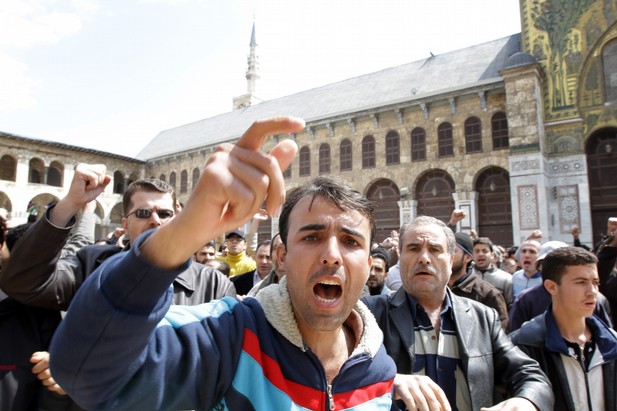
Despite the mass arrests, the beatings and torture, the besieged towns and suburbs, the blocked-off mosques, and the killings of up to a thousand people, Syrian heroes today demonstrated in Damascus, Aleppo, Homs, Hama, Idlib, Qamishleh, Amouda, Latakia and elsewhere.
The film below was made in Dera’a last month. It is very distubing to watch, but also very inspiring. I love the courage and compassion and the solidarity of those wonderful people who work against bullets and fear to rescue one fallen. That’s the best of Syria, and there’s a great deal of it. I challenge anyone to watch the film and then claim that the Syrian regime still enjoys any legitimacy at all. “Khawana!” scream these brave men at their persecutors. “Traitors!”
More videos smuggled through the media blackout can be seen at Sham News.
Upmarket central Damascus, Corncob square and the shopping precinct below. ‘Salafi terrorists’ singing the Syrian national anthem. The mukhabarat playing various roles.
 P U L S E