Committees, Councils and Cultural Production

Omar Aziz
Omar Aziz

In this presentation on Syria – in green Seattle’s public library  – Leila al-Shami talks about Razan Zeitouneh, founder of the Local Coordination Committees, and Omar Aziz, the anarchist who first thought of building local councils. And I talk about the revolution’s cultural and media achievements. Interesting questions from the audience afterwards.

On the Brian Lehrer Show

Amreeka March-May 2016 033In New York (what an astounding city), Leila and I were interviewed by Brian Lehrer for his show on WNYC. We talked about Syria’s failing ceasefire, the illusory Damascus Spring, Assad’s collaboration with George W Bush, the history of the Baath, and Obama’s deals with Iran and Russia. A couple of listeners called in with questions – one about the sectarian element.

You can listen to the interview here.

Burning Country at the Middle East Institute

Someone in New York sneered and said Washington was a sterile city, but I liked DC a lot during our two-day visit. The centre is full of people from everywhere, lobbying, plotting and misgoverning. The rest of the city has a mainly black population. We stayed with wonderful people, ate good food, and the sun was shining, the trees in bloom. I met my niece, lots of lovely Syrians, and some great Arab thinkers at the Tahrir Institute, most notably Hassan Hassan. The Museum of the American Indian is worth a visit too.

At the Middle East Institute our talk was chaired by the scholar Charles Lister, author of the indispensable book The Syrian Jihad. Here Leila talks about the aspects of the Syrian revolution rendered invisible by Western commentary, and I talk about what’s stopping us seeing: ideological assumptions, and the fact of war. Q and A afterwards.


Talking about Syria in Chicago

On a pier poking into the icy turquoise of Lake Michigan, looking back at Chicago’s brutal towers, Leila and I were interviewed on Syria by Jerome McDonnell, an engaging host, for WBEZ’s Worldview. We talked about Razan Zaitouneh, revolutionary councils, imperialist intervention, American policy, Islamism, Robert Fisk, and the farmers and dentists who make history. Jerome McDonnell hosted us again that evening at Chicago University’s International House.

Listen to the 30-minute interview here.

The Arab of the Future

This was my review for the Guardian of Riad Sattouf’s graphic memoir.araboffuture
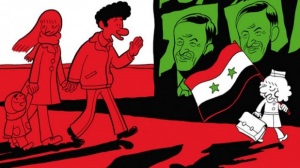
The graphic novel has proved itself over and over. It already has its classical canon: Spiegelman on the Holocaust, Satrapi on girlhood in Islamist Iran, and (perhaps most accomplished of all) Joe Sacco’s ‘Footnotes in Gaza’, a work of detailed and self-reflexive history. Edging towards this company comes Riad Sattouf’s ‘The Arab of the Future’, a childhood memoir of tyranny.

Little Riad’s mother, Clementine, is French. His father, Abdul-Razak, is Syrian. They meet at the Sorbonne, where Abdul-Razak is studying a doctorate in history. Those with Arab fathers will recognise the prestige value of the title ‘doctoor’. But Abdul-Razak is more ambitious. He really wants to be a president. Studying abroad at least allows him to avoid military service. “I want to give orders, not take them,” he says. When humiliated, he sniffs and rubs his nose.

Abdul-Razak is a pan-Arabist who believes the people (“stupid filthy Arab retards!”) must be educated out of religious dogma. For reasons of both vanity and ideology he turns down an Oxford teaching post for one in Libya. The family takes up residence in a flat which doesn’t have a lock, because Qaddafi has ‘abolished private property’. Little Riad sees Libya all yellow, its unfinished buildings already crumbling. He sings the Leader’s speeches with kids in the stairwell and queues with his mother for food (only eggs one week, just bananas the next).

When Qaddafi decrees that all must change jobs, teachers becoming farmers and vice versa, the family leaves, via France, for Syria, another country which “seemed to be under construction”. A disturbed Abdul-Razak has already absorbed news of the 1982 massacre in Hama. Now one dictator’s portraits are replaced by another’s. The bribery starts in the arrival hall.

Then to the ancestral village outside Homs, which is sexually segregated, afflicted by power cuts, soundtracked by howling dogs and calls to prayer. Riad’s weathered grandmother licks specks from children’s eyeballs. It’s this sort of detail, drawn with the cartoon clarity of childhood perception, which makes the book such a success.

The village boys, fascinated by Riad’s European toys, kick a puppy about for fun. Mokhtar and Anas, his bullying cousins (Riad is related to everyone in the village) call him Yahudi (Jew) on account of his blonde shock of hair.

Riad’s father – though by no means a hateful character – is the story’s foremost authoritarian, incapable of admitting ignorance or error, guilty of sectarianism, anti-black racism, misogyny and superstition (these last two intertwined). He suffers the inferiority/ superiority complex of the rapidly upwardly mobile, and he believes in strong men – Qaddafi, Saddam, Hafez al-Assad – against the evidence of their depredations. All these are faults typical of his Arab generation.

Continue reading “The Arab of the Future”

On Boston’s Radio Opensource

This was a strange experience. We were told in a long pre-interview that the actual interview would be just us (Leila and I), and would be focused on civil society in Syria. On the day, however, they brought in LRB-contributor Hugh Roberts and American commentator Jeffrey Sachs, so the conversation became enwebbed in a US-centric alternate reality. The host is Chris Lydon. Listen to it here.

Binet, Hitler and Putin

Putin1This (slightly subedited) was first published at the New Arab/ al-araby al-jadeed.

I’ve just finished “HHhH”, an excellent ‘non-fiction novel’ by the French writer Laurent Binet. It tells the true story of Operation Anthropoid, the assassination of top Nazi official Reinhard Heydrich co-ordinated by the Czechoslovak resistance and the British government.

In the Nazi surveillance agency, the SS, Heydrich was second in command only to Heinrich Himmler (or perhaps he was even more important than his boss – “HHhH” is the German acronym for ‘Himmler’s Brain is Called Heydrich’). He was the highest official in Nazi-occupied Czechoslovakia, and the chief architect of the ‘final solution’ for Europe’s Jews – the Holocaust.

The larger background to the drama of the assassination is Britain and France’s betrayal of Czechoslovakia, the final layer in these states’ disastrous appeasement of Hitler in the 1930s.

Germany had been defeated in World War One. The post-war settlement forced Germany to pay enormous reparations to the victors. This national humiliation was immediately followed by economic collapse and social disorder. Hitler emerged from this context, a strong leader promising to restore German order and pride, identifying enemies domestic and foreign, and lamenting the scattering of the German people across various borders.

Continue reading “Binet, Hitler and Putin”

With Syria Solidarity UK

It was a pleasure to give a talk at the LSE. The talk was organised by the brilliant Syria Solidarity UK.

Here is Part One:

and (after the break) Part Two:

Continue reading “With Syria Solidarity UK”

Free City Radio

Here I am talking about the Syrian revolution and our book ‘Burning Country’ on Canada’s Free City Radio. Topics include democracy, how Assad engineered a war, and the meanings of the word ‘jihad’.

Frontline Doctors: Winter Migrant Crisis (BBC Documentary)

https://www.youtube.com/watch?v=giVYfIcgN58

Chris and Xand van Tulleken – doctors, part-time aid workers and twin brothers – want to see for themselves what conditions are like for migrants fleeing through Europe at the height of winter. They travel to Lesbos in Greece, through the Balkans and on to Berlin and Calais to understand what’s being done on a medical and humanitarian level in response to the refugee crisis.
Spending time with medics, charities and volunteers in camps and clinics, at border crossings and transit points, they find out what the situation is like on the ground and, wherever possible, lend a hand in the biggest migration crisis of our times.