Peace or Pacification

aleppoThis was published at the Canadian Centre for Policy Alternatives.

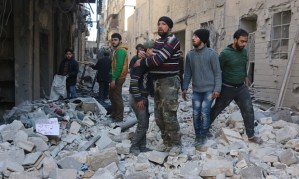
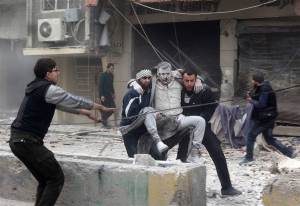
As I write, state representatives are attending the theatre in Geneva. (The talks were stopped on February 3rd). In Syria, meanwhile, reality prevails: in one day a tented camp of the displaced in the Lattakia hills is bombed, barrel bombs rain on the south and the Damascus suburbs, Russia’s cluster bombs crumple over the north, and up to a hundred people are asphyxiated by chlorine gas in Moadamiyah. Let’s hope the seats in the theatre are nice and comfy.

Russia, the prime mover of the process, is inviting its own ‘opposition’ delegates. It complains (with Assad and Iran) that the actual opposition delegation contains ‘terrorists’. The thousands of Iranian-backed transnational Shia jihadists in Syria are not considered terrorists and should not be discussed at this stage.

The United States accepts these terms, and instead of the ‘transitional government’ agreed upon as the ultimate goal in previous Geneva talks, it speaks now of a ‘national government’. In other words Assad – responsible for the overwhelming number of civilian casualities and displacements – can stay, so that all may confront the ‘greater evil’ of jihadism.

Yet 80% of Russian bombs are falling not on ISIS but on the opposition to both ISIS and Assad, that is, on the communities which previously drove ISIS from their areas. A quarter of a million more have been displaced as a result of the Russian assault, which hits courthouses, schools, hospitals and aid convoys.
Continue reading “Peace or Pacification”

Speaking at Chatham House

Here I am on stage at Chatham House last week with the journalist Mina al-Oraibi. Mina was a lot more optimistic about Russia’s ‘peace process’ than I was. Am I allowed to point out without seeming rude that the process has already dramatically collapsed?

On the Media, Diplomacy and Pacification

Thanks to the people at Chatham House who interviewed me and then made this short film.

International Legacies of the Genocide in Rwanda

James Traub, journalist and author, gives a presentation addressing how the United States’ reaction to the crisis in Syria does and does not reflect lessons learned from the genocide in Rwanda, during the Symposium on the 20th anniversary of the Genocide against the Tutsi that took place on March 31, 2014.

Syria: ‘Burning Country’ book launch at Amnesty International UK

Robin Yassin-Kassab in conversation with Kristyan Benedict (@KreaseChan) of Amnesty International UK.

Five Year Reflection

picture from anadolu agency
Russian bombing in the eastern Ghouta. picture from Anadolu Agency.

The Guardian asked ten Arab writers to reflect on the revolutions five years on (or in). My piece is here below. To read the others too (including Alaa Abdel Fattah from Egyptian prison, Ahdaf Soueif, and notable others), follow this link.

Five years ago the Guardian asked me to evaluate the effects of the Tunisian uprising on the rest of the Arab world, and specifically Syria. I recognised the country was “by no means exempt from the pan-Arab crisis of unemployment, low wages and the stifling of civil society”, but nevertheless argued that “in the short to medium term, it seems highly unlikely that the Syrian regime will face a Tunisia-style challenge.”

That was published on January 28th. On the same day a Syrian called Hassan Ali Akleh set himself alight in protest against the Assad regime in imitation of Mohamed Bouazizi’s self-immolation in Tunisia. Akleh’s act went largely unremarked, but on February 17th tradesmen at Hareeqa in Damascus responded to police brutality by gathering in their thousands to chant ‘The Syrian People Won’t Be Humiliated’. This was unprecedented. Soon afterwards the Deraa schoolboys were arrested and tortured for writing anti-regime graffiti. When their relatives protested on March 18th, and at least four were killed, the spiralling cycle of funerals, protests and gunfire was unleashed. Syria not only witnessed a revolution, but the most thoroughgoing revolution of all, the one that has created the most promising alternatives, and the one that has been most comprehensively attacked.

Continue reading “Five Year Reflection”

More Talking

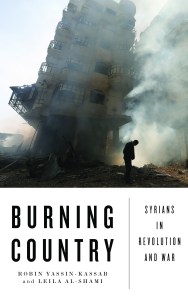
And if you follow this link, and listen from 40 minutes till the end, you’ll hear me talking On BBC Radio 4’s ‘The World Tonight’ about Syria’s revolution and war. I was invited because our book Burning Country has been released. It tells the Syrian people’s stories first and foremost, before examining the global responses and results. We feel this drama has been very badly reported in the main, and we hope the book will fill some important gaps. So please read it.

Talking About the Councils

If you follow this link you’ll hear me talking on BBC World Service radio (‘Newshour’) about Syria’s revolutionary councils, decentralisation, refugees, and the ‘peace process’ illusion.

(I made a mistake here. I said Syrians need at least one or two hundred dollars to escape Syria. Slip of the tongue. I should have said they need one or two thousand.)

Burning Country UK Events

Yassin T03090Thanks to assistance and inspiration from Syrian activists, fighters, journalists, doctors, artists, and thinkers, our book ‘Burning Country: Syrians in Revolution and War‘ is published on January 20th, and launched that evening at Amnesty International in London. In the following days and weeks I’ll be speaking about the book at other venues in London, and in Nottingham, Manchester, Lancaster, Glasgow and  Edinburgh. A list of events below (and we’ll be in the US in April).

First, please read the endorsements, of which we’re very proud:

For decades Syrians have been forbidden from telling their own stories and the story of their country, but here Robin Yassin-Kassab and Leila al-Shami tell the Syrian story. Their words represent the devastated country which has denied them and their compatriots political representation. Burning Country is an indispensable book for those who wish to know the truth about Syria.’ – Yassin al-Haj Saleh

Burning Country is poised to become the definitive book not only on the continuing Syrian conflict but on the country and its society as a whole. Very few books have been written on ‘the kingdom of silence’ that effectively capture how we all got here while not omitting the human voice, the country’s heroes and heroines — a combination that is rare but essential for understanding the conflict and its complexities. Robin Yassin-Kassab and Leila Al-Shami have written a must-read book even as the conflict still rages to understand what happened, why it happened and how it should end.’ – Hassan Hassan, co-author of ISIS: Inside the Army of Terror (New York Times bestseller), Associate Fellow, Chatham House, London

Continue reading “Burning Country UK Events”

Break the Sieges

“We are too weak to walk or to cover the story. I was at the makeshift hospital and there were 200 who fainted today. Yesterday alone seven people were poisoned from eating raw cat meat that wasn’t cooked properly. The situation is really bad. We have infants who died because they didn’t have any milk. Today a family ate thorns.” — a media activist in Madaya.

Continue reading “Break the Sieges”