Wedging Trump

Anthony Scaramucci — his friends call him “the Mooch” — is a blow-dried, gold ringed hedge fund trader straight out of Central Casting. Last summer, when Donald Trump dismissed finance people like him as parasitic swindlers who “move around papers,” Scaramucci snarled that Trump was “another hack politician” who would “probably make Elizabeth Warren his vice-presidential nominee,” considering his “anti-American” insults to the finance industry. “You’re an inherited money dude from Queens County,” the Mooch taunted Trump on the Fox Business Channel, doing his best impression of a guy asking another guy if he’d like to step outside for a minute.

Today, Scaramucci is a member of Trump’s presidential transition team.

Scaramucci’s journey from trash talker of presidential nominee Trump to economic advisor to President-elect Trump tracks Trump’s own abrupt transformation from firebrand populist outsider to Wall Street-friendly insider — an about-face that wasn’t just predictable but repeatedly predicted. As a man without an ideology, Trump is not a change agent but an opportunistic pragmatist. His goal is not to reshape the American economy or even the Republican Party, but to use the presidency to build his global brand and enrich himself and his family in the process. People like Scaramucci and Steven Mnuchin, Trump’s choice for Treasury Secretary, a former Goldman Sachs mortgage banker who made his fortune and his legend exploiting the pain of the foreclosure crisis, may have been odd choices for the grenade-lobbing, drain-the-swamp-and-burn-the-whole-system-down presidential candidate version of Donald Trump. But they’re just the right kind of advisors for the self-dealing, oligarchical, President-elect version of Trump: the real Trump, the one who will be crowned Leader of the Free World next month.

Continue reading “Wedging Trump”

The Gamble: The Left’s Bet on a Trump Loss

How leftists were blinded to Trump’s winning prospects

The gamble was this, and many on the left were sure the odds were stacked: Hillary Clinton would overcome the sweeping forces of global reaction and be the next president of the United States, liberating the politically savvy to focus on her–the locus of real power, the fascist, but with a smile and a pantsuit–and come out looking prescient as all hell for having never bought into liberal hysteria over Donald J. Trump. Say what you will about Trump, this woke-as-fuck cadre claimed, at least he wouldn’t nuke Moscow over the proxy war in Syria.

Gambling that Clinton was the one and Trump just a boogeyman distraction did, at some point, seem reasonably safe, and so we were confidently assured. “It’s obvious she’ll win,” Salon’s Benjamin Norton observed in a late June microblog. “Wall Street, most media, State Dept., foreign policy elites, neocons, etc. all back Clinton.” Striking a similar tone, Zaid Jilani of the Intercept dismissed the possibility of a proto-fascist billionaire’s ascendance to the White House as “theatrics.”

“Trump has no policies, no real team, no real campaign,” Jilani argued. “He’s about as dangerous as a fruit fly.”

The ballots having been cast, we can confidently state: Shit.

The left isn’t alone in having gotten this wrong, but what might be cause for introspection is why the political subculture that prides itself on its superior analysis of reality didn’t grasp what was happening. It’s not that criticizing the neoliberal hawk in the race was not the right thing to do, but that the dogma that she was a shoo-in led some to lay off the man who was to become president.

Glenn Greenwald spent the weeks leading up to the election portraying the far-right demagogue who was set to become the world’s most powerful man as a victim of mainstream media bias and center-left anti-communism. At the same time, he compared the media’s inquiries into Trump’s Russian oligarch ties to Senator Joseph McCarthy’s House Un-American Activities Committee (which Trump surrogate Newt Gingrich actually wishes to revive).

Trump, Greenwald told Slate, adheres to a “coherent philosophy that is non-interventionist.” This, at the time, was offered as part of the explanation for why the liberal establishment was going so hard on Trump over his alleged ties to Russia. Greenwald stuck to this line even after Trump called for many more airstrikes around the globe and “bombing the hell out of” Libya, Iraq and Syria in particular. As with other contemporary leftist apologism for a fascist, this one began with a liberal. (“Donald the Dove, Hillary the Hawk,” was the title of Maureen Dowd’s column in the New York Times.)

The Green Party’s Jill Stein took it further, saying America’s Berlusconi would keep us out of World War III. “Hillary Clinton’s foreign policy is much scarier than Donald Trump’s,” she tweeted alongside the hashtag #PeaceOffensive, contrasting the fascist with the neoliberal by saying that at least the former “does not want to go to war with Russia.” By the end of the campaign, it was commonplace to see Trump–say what you will–referred to as a practitioner of “know-nothing isolationism,” as journalist Rania Khalek did, contrasting that ideology with his opponent’s bombs-away neo-conservatism.

We have a few weeks to go before Trump gains the power to drone strike weddings abroad, a modern presidential rite of passage that, judging by the rise in global defense stocks since his election, investors are convinced he will continue as the next Commander-in-Chief. His desire for peace with Russia, the smart money says, won’t mean peace elsewhere, like Syria, where he has proposed an escalated bombing campaign in alliance with Vladimir Putin and Bashar al-Assad.

Without any Trump-embossed missiles having yet been fired, it already seems like a singularly dumb, quaint, and naive idea that he would drop less of them than Hillary. Why, then, did some on the left suggest the guy on the right would be a man of relative peace?

Because it wasn’t about him, and he wasn’t supposed to win.

“I’d assumed that the danger of Trump and the danger of Clinton were of two different orders,” explained British leftist Sam Kriss in a post-mortem. Trump was a danger because of what he said, but “Clinton was dangerous because of what she would actually do, because Clinton was going to win the election. I was a sucker, the kind who gets duped precisely by believing himself to be too smart for any kind of con.”

The problem wasn’t that it was wrong to believe Clinton a danger, but that dwelling on the evils of the horrible, neoliberal status quo she represented blinded some to the fact that things could get worse. In some cases, this led to a failure to effectively critique and prepare for the next President, from the left.

Trump won, Kriss argues, “because the standard formula of American liberalism–eternal war abroad coupled with rationally administered dispossession at home and an ethics centered on where people should be allowed to piss and shit–is a toxic and unlovable ideology.” As rhetoric, it pleases those who adhere to the leftist consensus: Yes, racism is a real problem and social justice matters, but neither is as important as the class war. Scratching away the smarm, though, yields no better understanding of U.S. politics.

No candidate was running on a platform of peace: Clinton had a record of supporting war while Trump was running on the promise of doing war more brutally and efficiently, stripped of limp-wristed anchors like democracy promotion and nation-building. People who voted on either the Republican or Democratic ticket were not casting their ballots against empire. Nor were they voting against an ethics “centered” on where people relieve themselves, by which Kriss means the revanchist crackdown over transgender Americans using bathrooms that match their gender identity.

Not only is the implication that Trump votes were a response to “politically correct” defenses of basic human rights morally wrong, but it’s also at odds with the complementary claim that they voted for jobs. Neither claim is backed by what happened on Election Day. In North Carolina, both the Republican governor and Republican lawmaker who prided themselves on a law banning transgender people from using public bathrooms lost to Democrats whose opposition to the transphobic law was a centerpiece of their campaigns.

Kriss and others nodding at the “piss and shit” shorthand for “identity politics” do not, presumably, oppose people using bathrooms that match their gender, much less believe a group of oppressed people, nearly half of whom have attempted suicide, deserve to be discriminated against and assaulted for that choice.

But what this leftist cadre dismissive of Trump’s prospects represents, above all, is an antiquated ethics that centers and romanticizes a proletariat class that doesn’t really exist in the U.S. In this ethics, issues pertaining specifically to the rights of racial minorities or the LGBT community are seen as neoliberal deflections from what really matters. As Jacobin editor Connor Kilpatrick argues, claims of prejudice among the white rural electorate are an elite tactic to deflect from elite failures. “Diversity rhetoric,” he maintains, “has obscured that 63 percent of [the] USA is white,” while “only 3.8 percent LGBT.” By this math, it’s just political correctness that has been alienating all those budding socialists who wear t-shirts emblazoned with the Confederate flag.

It’s not that Trump voters lacked material concerns. The neoliberal consensus has failed, pushing millions of Americans into precarious lines of work. This is part of the reason why Trump did better with members of unions than Mitt Romney did in 2012. But their class politics shouldn’t be overstated either: Trump only did four percent better than the last Republican presidential nominee, losing union workers by 19 points to Clinton, according to the AFL-CIO. Likewise, Trump did better with those making under $50,000 by about 3 percent compared to Romney. Most working-class voters sided with Clinton over Trump, who won thanks to 290 electors, but which is expected to be 2 million votes less. Others looked at them both, felt nauseous, and decided to stay home.

U.S. liberalism is a toxic ideology, at home and abroad, but jettisoning “identity politics”–the defense of vulnerable people on issues that are matters of life and death–is the absolute wrong lesson to take from a four percent swing among registered voters who actually decided to vote. Trump’s campaign was itself based on identity: whiteness. The response is not abandoning identity in politics, but developing a more radical version of it that advocates equality within a socialist critique of an economic system designed by and for predominantly white men with capital.

What the left needs, is to be defined by more than just its necessary anti-liberalism, wherein explanations for right-wing revanchism that rely on racism are written off as neoliberal excuse-making. Sure, Trump’s voters may not be 60 million Klansmen, but we shouldn’t whitewash the fact that millions had no problem expressing their discontent with a vote for a racist misogynist whose campaign events looked like Klan rallies. The latter were okay with expressing whiteness–and the whiteness of the final vote tally was overwhelming–at the cost of everyone who didn’t look like them.

Clinton’s Death Star liberalism was the most progressive policy platform yet in a general election, thanks in no small part to the push from Sanders. But that’s not saying much, and ultimately, anything she promised was already tainted by her embodiment, to right and left voters, of everything that’s wrong with the status quo. But it would be a ghastly mistake to take from her loss the lesson that the left ought to ignore the human rights of the most vulnerable in order to make short-term gains with a racist white minority.

As leftists, our ethics must be centered not on the four percent, but on the growing, soon-to-be majority of people excluded from the Trump voter coalition–those who were under assault from white supremacy and “traditional” bigoted values long before November 8 and will only continue to be assaulted under his regime. A lot should be thrown out in the wake of Hillary Clinton’s loss, beginning with the candidate herself, but detoxing this country of liberalism should mean replacing her brand of center-left corporatism with an economic program of radical wealth redistribution based on anti-racist, anti-sexist, anti-homophobic, and anti-transphobic values. We don’t need to wait until after the class war to do things as basic as naming white supremacy or letting people use the bathroom that best corresponds to their gender identity.

Charles Davis is a journalist whose work has been published by outlets such as Al Jazeera, The Nation and The New Republic. Follow him on Twitter: @charliearchy


Workings of the Myth

How stereotyping abets ISIS and the authoritarian state

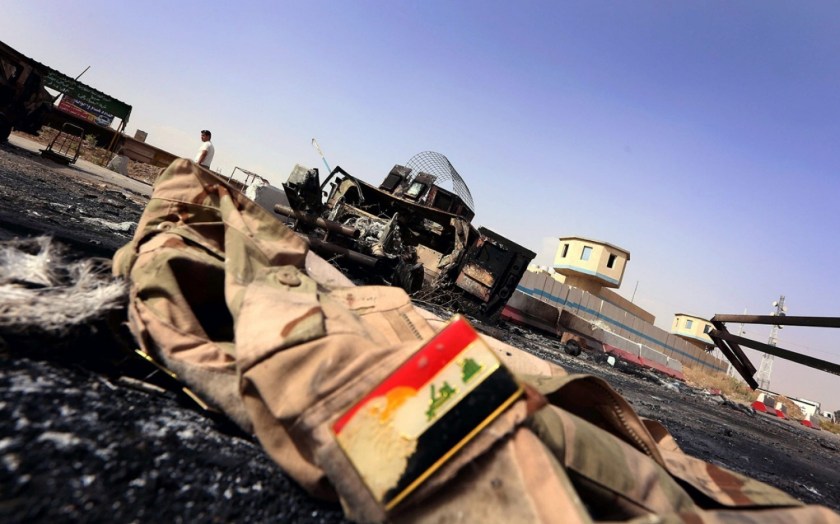
headlineimage-adapt-1460-high-iraq_isil_uniform_061114-1402565677379
Aftermath of Iraqi Army’s battle with ISIS

by Bente Scheller

Brussels, Paris, Istanbul, Baghdad, Nice: The attacks in recent months have claimed the lives of hundreds of people. Whether the so-called “Islamic State” (Daesh/ISIS) admits to being responsible for the attacks or whether investigations reveal its delinquency is of secondary importance: in the words of Achim Rohde, ISIS has become the regularly reappearing “enemy of humanity” (Rohde, 2016).[1] Several levels come together in the assessment of the risk that this enemy—as its predecessor al-Qaida before it— poses to Western societies: a fundamental fear trickles into everyday life, a fear of a hardly calculable force that arbitrarily accepts civilian victims and explicitly targets them; and that fear melds with Islamophobia and racism. This amalgam ensures that the fight against terrorism is oftentimes defined by populist responses that detract from practical political decision, decisions that are not always easy to promulgate.

The lack of a widely accepted definition of terrorism leaves it open to subjective interpretation. Right-wing movements invariably mobilize against the unassimilable  “other”. The more alien and violent the depiction of the “other”, the easier it becomes to distance oneself and to construct one’s own moral superiority by demonising the “other”.

Continue reading “Workings of the Myth”

Anarchists in Agrabah

bakunin-syrian-anarchos
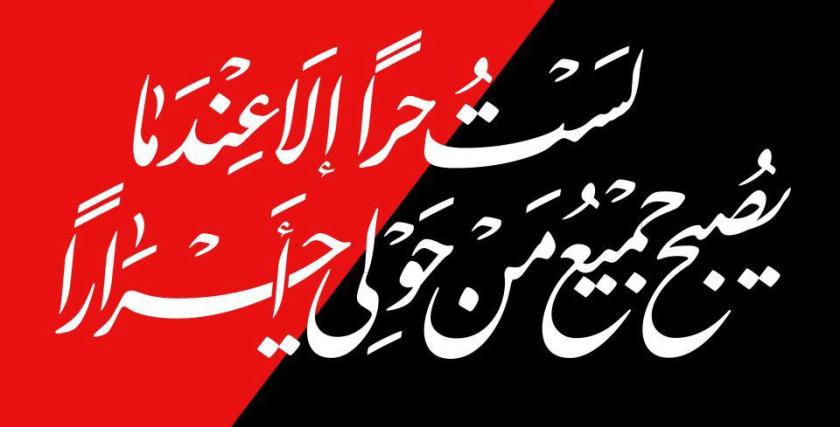
Syrian Anarchist banner: “I am truly free only when all human beings are equally free” – Bakunin, 1871.

On Saturday October 29th, 2016, Leila Al Shami and Robin Yassin Kassab, authors of the book ‘Burning Country: Syrians in Revolution and War’, were invited by the London Anarchist Book Fair to give a talk on Syria. As Leila wrote yesterday night, they “had in particular wanted to focus on anti-authoritarian struggles, self-organization as well as issues of militarism, sectarianism and the rise of Islamist extremist groups.” Shortly before speaking, Robin told me that some people were going around the book fair saying that ‘a pro-Jihadi Syrian nationalist fascist’ was going to give a talk and that he must be prevented from doing so. We laughed it off.

Robin and Leila sat down and, barely having had the time to introduce themselves, they were interrupted. One man, later identified as Amir Taaki, went on stage, followed by about seven friends, one of whom was in full military garb, and started ranting about Robin’s alleged love for Jihadis, Syrian nationalism, Ahrar Al Sham and other such inanities. Robin left and Leila, who had tried to stay and reason with them, ended up leaving too. 

As for Taaki, he is a British-Iranian who was involved in the creation of BitCoin and who never misses an opportunity to boast that according to Forbes he was ‘their top 30 under 30 list for 2014’. He claims he has just returned from Rojava, an achievement he thought was enough to qualify him to speak on Syria as a whole. That an actual Syrian Kurdish Anarchist from Rojava, Shiar Neyo, was already on the panel didn’t prevent him from trying to hijack it. The self-appointed representative of Kurdistan had sent several emails to Leila demanding a spot on their panel – demanding, not asking.

Those of us familiar with this neo-colonial and racist arrogance expressed by foreigners after visiting ‘the region’ for a few months can think of a few Taakis we’ve met over the years.

When all resistance proved to be futile, the organizers were forced to let Taaki speak for a few minutes. He then proceeded to speak for as long as he wanted (10-20 minutes before people in the audience started complaining again), and what a monologue it was! He rambled on about how Kurdish culture is inherently egalitarian and how it’s a light in a dark world. He spoke of ancient Mesopotamia, of some bloody pyramids and of how all of that linked to some mystical Kurdish Shangri-La that all Anarchists and revolutionaries must defend. His rambling reminded me of what a book on Orientalism for Children would look like. Taaki told us how he ‘went there thinking that he’ll teach them’ but instead ‘they taught me so much’; ‘these people’ who he described as heroic men and women engaging in guerilla warfare in the mountains while reading Bookchin and Nietzsche (I’m not joking). ‘Kurdistan’ is apparently replacing ‘the Orient’ given that the latter has failed to satisfy westerners who got bored of Aladdin.  

Not only that, but they were profoundly racist. Taaki, in his Aladdin monologue, listed Turkey and Saudi Arabia as the two most racist countries on the planet, an odd statement given the existence of a settler colonial state, Israel, on one of Syria’s borders or, for that matter, the existence of instutitionalized racism in many countries of the region, including my own, Lebanon, and beyond. One of them even told me ‘you people’. When I asked him what people he was talking about given the fact that I was raised in a Lebanese Arab Catholic family, he went silent. When I lost my patience and yelled ‘f-ing white people’, two of them accused me of being racist against white people. They started yelling about how it’s unfair to paint all of them with the same brush. All Lives Matter, folks.

Kurdish friends who later heard about what happened were horrified at how a group of mostly white people used Kurdistan, the Kurdish struggle for autonomy and social justice and pretty much all struggles in and around Kurdistan to fit their orientalist fantasy. Kurds didn’t really exist in Taaki’s monologue. It was a bizarre manifestation of racism mixed with Islamophobia and Kurdish diaspora ultra-nationalism. In fact, when we went back in with Shiar Neyo in an attempt to confront Taaki and his cult followers, who by then had emptied the whole room of its original audience and replaced it with a dozen ‘anarchists’ who all knew one another, his cult followers shut Neyo down and called him disgusting.

Neyo soon understood that this was not a crowd that cared much about Rojava, Syria as a whole or anything for that matter. The people of Syria, Arabs or Kurds, were irrelevant to them. Neyo told them that this is not what solidarity looked like and we left. Leila and Robin’s talk was canceled. Neyo’s talk was canceled. Syrian Arabs and Syrian Kurds were not allowed to talk on Syria. Instead, some British guy who hasn’t written a single article on Syria was allowed to control the narrative because he’s been to Rojava, learned Kurdish and ‘about Kurdish culture’. By those standards, I should be Queen of England by now. Never has Said’s ‘permission to narrate’ sounded so relevant to my ears.

This was a strange event, one which Leila told me she had never witnessed despite giving countless talks with Robin on Syria. And this included talks with actual Shabbiha in the room. Taaki’s cult followers didn’t seem to have any ‘ideology’ other than engaging in orientalist fantasies. There wasn’t anything ‘anarchist’ about them given that they shut down a panel featuring a Syrian Arab anarchist, Leila, and insulted a Syrian Kurdish anarchist, Shiar. They also repeatedly harassed people, yelled at them and called them Jihadi sympathizers. They refused to stop filming people’s faces despite being repeatedly asked by the organizers and members of the audience to stop filming as this violated the very basic definition of a safe space – especially one on Syria with so many still having family in regime or ISIS-controlled areas. What a funny version of Anarchism it is in which the basic notion of solidarity is rejected.

Yassin al-Haj Saleh on the Syrian Majority

yassin-al-haj-salehIt’s worse than just a shame that people in the West rely on their own ignorant, ideology-driven ‘informants’ on Syria, from Cockburn and Chomsky to Landis and Kinzer, rather than seeking out the analysis of progressive Syrians, people who actually understand the country and its people from their first-hand experience of life and struggle. This is particularly the case when Syria boasts thinkers of the standard of Yassin al-Haj Saleh, surely one of the most significant intellectuals in the world today.

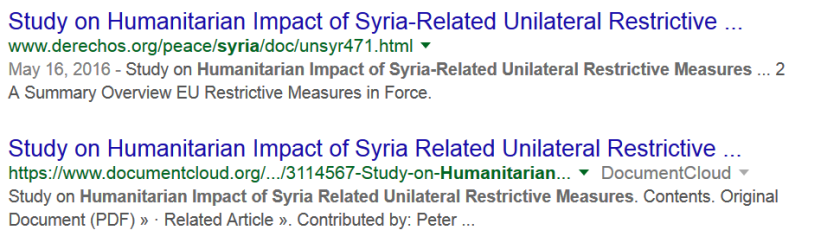
In the article below, first published in Arabic and English at al-Jumhuriya, Yassin considers Syria’s past, present and possible futures. He makes the key point that the question of tyrannous Sunni majority rule will never arise in Syria, because there is no ‘Sunni Arab majority’. Though Sunni Arabs are a majority of the population, they are incapable of unifying into a political force, because their Sunni Arabism is only one component of their identity. They are divided by class, region, urban or rural location, lifestyle, education, as well as schools and shades of belief. Any government in the name of the ‘Sunni Arab majority’ would inevitably use the name for propaganda purposes, and would inevitably be another minority regime, drawn from one narrow subsection of Sunni Arabs and having to violently subdue the rest. (This is entirely true. More than that, even amongst Sunni Islamists, there isn’t a majority view on the shape of government or those who should draft and staff it).

Yassin’s thoughts on the western desire to ‘protect minorities’ (an old colonial trope now most visible on the fake left) are invaluable. His take on the Kurdish issue is a brilliant antidote to western leftist  fetishisation of the PYD.

Everything published at al-Jumhuriya is worth reading. The site should be bookmarked and referred to frequently. Here’s Yassin’s latest piece in full:

This article is addressed to an unidentified, moderately informed and well-meaning reader, and it suggests to them a vision for a just Syrian resolution, examining potential problems and hindrances in its path.

What is a resolution in Syria?

Syrians engaged in public affairs are always being asked about our conception of a resolution to the Syrian conflict. Rarely is the question a mere inquiry about what just resolutions may be possible. Instead, it is usually to provoke a concession that the issue is “complicated,” the resolution beyond the realm of possibility, or perhaps, that a solution is not attainable without setting the clocks back to a time before March 2011. Apart from that, the question often stems from a deafening ignorance of the history of political dissent in Syria, and of the squashed struggles towards democratic transition by a previous generation of Syrians. This line of questioning is also divorced, from any insight, albeit modest, of the different phases leading to the current juncture in our struggle.

Nevertheless, this article tackles that question of resolution directly, imagining an earnest unidentified reader, who genuinely aspires to a just resolution to the prolonged Syrian calamity, or one at least in the vicinity of justice.

Let’s get to the heart of the matter: A just solution in Syria should be based on establishing a new political majority in the country, one in which an expanding majority of Syrians become familiar with its political representation, and do away with minoritarian, oligarchical rule, in turn laying the foundation for a new Syria and an assimilative Syrian regime. This requires the end of Assadist rule, and of Daesh and any Salafist-jihadist groups, in addition to instituting political and cultural equality for the Kurds with no nationalistic hegemony . It requires laying the foundations for a democratic Syria that is based upon citizenship.

Continue reading “Yassin al-Haj Saleh on the Syrian Majority”

Syria and The Intercept: The Case for Editorial Intervention

Capture1.PNG

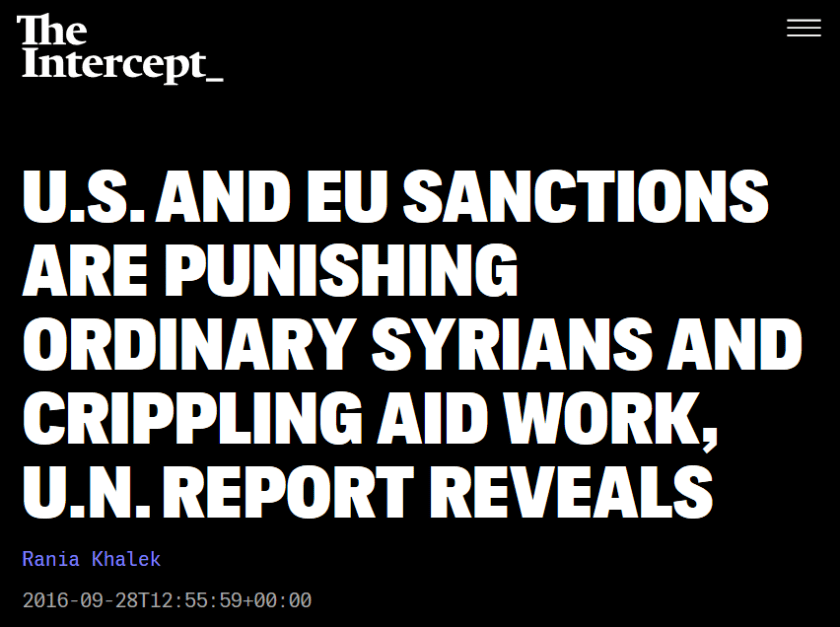
The online publication launched by eBay founder Pierre Omidyar recently published what it billed as a major scoop: “Internal United Nations assessments obtained by The Intercept reveal that U.S. and European sanctions are punishing ordinary Syrians and crippling aid work during the largest humanitarian emergency since World War II.” These sanctions were likened by author Rania Khalek to the siege the U.S. imposed on Iraq, which a U.N. report in 1999 said had doubled child mortality in the country, leading to “the death of 500,000 children.”

Khalek’s piece was well received by others who prefer to omit the words “barrel bombs,” “cruise missiles” and “starvation sieges” from their coverage of Syria’s humanitarian crisis, which has seen roughly 500,000 people killed since 2011, the majority, according to the U.N., killed at the hands of the Syrian regime and its allies. Russia’s RT and the state-run Syrian Arab News Agency both amplified the story’s conflation of targeted sanctions against Bashar al-Assad and his top officials with an all-encompassing economic embargo. “US and EU economic sanctions on Syria are causing huge suffering among ordinary Syrians and preventing the delivery of humanitarian aid, according to a leaked UN internal report,” wrote The Independent’s Patrick Cockburn.

The problem for The Intercept and those who reported on its claim is the oft-unwelcome truth among those committed to blaming someone other than Bashar al-Assad for the bulk of the suffering in Syria: The only hint of truth in Khalek’s lede is that Syrians are suffering through the worst war the world has seen since Adolf Hitler’s self-inflicted demise in a bunker underneath Berlin.

To start: What is billed as “Internal United Nations assessments” is but one report that wasn’t internal and, explicitly, does not reflect the view of the United Nations. The Intercept has since acknowledged this in one of the corrections issued at the end of Khalek’s piece: “The report referenced was prepared for the U.N. and does not reflect the U.N.’s official position.”

Capture.PNG

The latter clause is perhaps intentionally suggestive: “official,” if you know what I mean. What is not explicitly stated is that the report that was “obtained” was a report available freely online at least four months earlier, authored not by a U.N. official or agency but by an official, Justine Walker, at the British Bankers’ Association, an organization institutionally inclined to favor Western trade with literally whomever, capital and those who possess it not troubled by grave violations of human rights.

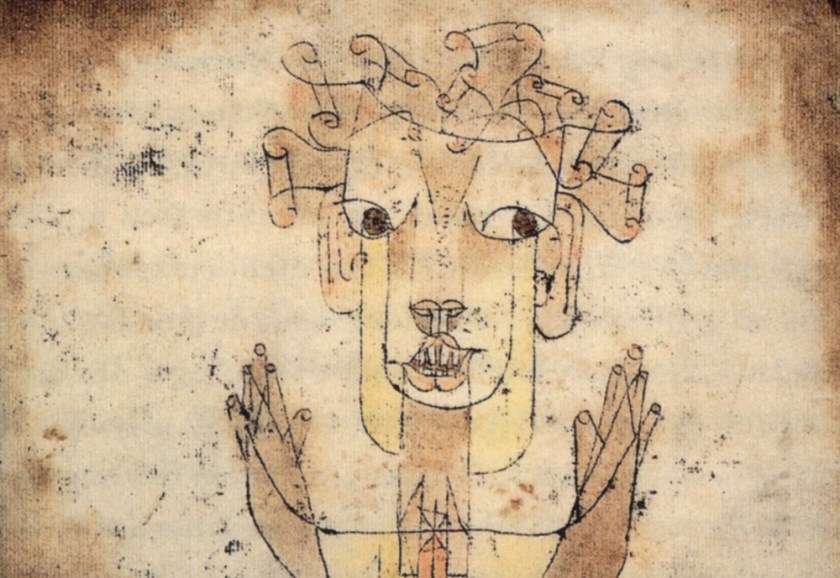
Capture4.PNGThat this is not a “U.N. report,” as The Intercept states in its headline, or a “United Nations” assessment, as Khalek states in her lede, is buried all the way back on page three of this banker’s assessment: “The views expressed are entirely those of the author and should not be considered to constitute any official statement.”

Capture3.PNG

Attributing one view solicited by an organization to the organization as a whole is like suggesting an OpEd from the foreign minister of Iran reflects the institutional take of The New York Times, which after all commissioned it. And yet: The headline, and the lede, persist, admitting a fatal mistake as hard for some as admitting who is chiefly to blame for punishing ordinary Syrians.

Gilbert Achcar: What are the prospects for peace in Syria?

Our friend Gilbert Achcar on the bleak situation in Syria

Notes towards a theory of Max Blumenthal

download.jpeg


As half a million souls have evaporated into smoke, largely at the hands of the Assad regime, Max Blumenthal instructs his readers to be suspicious of the organizations dedicated to putting a lid on the suffering.

He performs this by making a few salient points about the problematic nature of NGOization, funding channels and influence of big powers which tend to haunt aid organizations everywhere, particularly those operating in desperate situations. He goes on to point out that those organizations are toeing the line of Washington’s foreign policy elites who are calling for an NFZ in order to overthrow the regime.  Of course, one needn’t wonder if maybe, just maybe, the countless barrel bombs, cluster bombs, chlorine bombs, thermite bombs and bunker busters may have anything to do with compelling one to calling for an NFZ.

I don’t have to rehearse the criticism made but you can read Scott Lucas’ forceful rebuttal to his piece here and others’ here.

What I’m interested in what went on in his head before he sharpened his pencils. What is the purpose of transforming aid organizations during the time of war and genocide into objects of scrutiny and suspicion? Who does that serve?

The task is made difficult once one recalls that Blumenthal, after all, used to be one of us—that is, on the side of Syria’s democrats and revolutionaries. In 2012, he resigned from al-Akhbar over what he called the “newspaper leadership’s pro-Assad tendency”, pointing out that:

Yet the mere existence of Western meddling does not automatically make Assad a subaltern anti-imperial hero at the helm of a “frontline resisting state,” as Ghorayeb has sought to paint him. Nor does it offer any legitimate grounds for nickel-and-diming civilian casualty counts, blaming the victims of his regime, or hyping the Muslim Threat Factor to delegitimize the internal opposition . . . Besides exploiting the Palestinian cause, the Assad apologists have eagerly played the Al Qaeda card to stoke fears of an Islamic takeover of Syria . . .In joining the Assad regime’s campaign to delegitimize the Syrian opposition by casting it as a bunch of irrational jihadis (ironically, they seem to have little problem with Hezbollah’s core Islamist values), Assad’s apologists have unwittingly adopted the “war on terror” lexicon introduced by George W. Bush, Ariel Sharon, and the neocon cabal after 9-11. Not only have they invoked the scary specter of The Terrorists (gasp!) to justify morally indefensible acts of violent repression . . . “

What bothers Blumenthal today isn’t the somewhat common silence or apologia for Assad and Putin in alt-journalism and left-wing circles, nor is it the ongoing intervention of Russia, Iran and sectarian militias on behalf of a brutal regime. What bothers him is a hypothetical regime change operation undertaken by the United States. These are classic, even caricatural, tropes that he railed against not too long ago.

Enquiring minds wish to know: how can someone who has stood on the side of justice consistently suddenly barbarize themselves this quickly?


“The great Indian disaster of 1947 has barely entered the public consciousness. Distance, and a sense of helplessness, presumably account nowadays for this seeming indifference, just as they account for the relative calm that greets the news from Nigeria. What can one do about it, and who cares about dead African babies anyway? Certainly not the New Left: its leaders have not uttered a sound on the subject. But then there is no political mileage to be got out of a conflict which opposes Africans (with some foreign backing) to each other. As for morality, we all know by now what the Realpolitiker of the New Left (not to mention the Old Right) think of such sickly bourgeois sentiments.”—George Lichtheim

If it has been said that the institution of slavery is war and can only be defeated by war, the same can be said about the Assad regime. No serious observer thinks that Assad will cede an inch of power to the opposition without military defeat or threat. The regime has made up its mind about a Final Solution a long time ago. “Assad or we burn the country” as a pro-regime graffiti encapsulates the logic. 

Blumenthal is forcefully aware of all of this. In fact, he’s written about it and has likely concluded that the war of extermination will continue unabated unless there’s some limited form of foreign intervention. 

But he’s grown torn between maintaining an internationalist commitment to Syrian democrats and the fear of being in the bad company of neocons. It’s clear that Blumenthal simply sees no other way—or lacks the confidence to do so—to appear to be in such bad company without compromising himself morally.

Knowing this, he inserts his head and hands into the pillory. Thinking to himself that only by earning the scorn of neoconseratives—whom he could represent as the spear of the backlash—can he turn himself into a victim deserving commiseration and, in his mind, self-exoneration from the guilt of silence. And here’s something he could really believe in. But what he doesn’t know is that in the process he has doubly compromised himself by turning the figure of the neocon into a straw man that can be hung over the head of the defenceless and their advocates in the West.

Hence why I don’t think what he wrote is journalism. It’s an exercise in a sort of secularized Catholic penance for the white man’s burden. In other words, he has contrived an all-too solipsistic performance of self-flaeggelation that has effectively shut Syrians’ voices out, hence why he didn’t interview a single Syrian for his piece. The issue isn’t what Syrians think, the issue is that John McCain happens to agree with some of their demands.

Blumenthal wants to have it both ways. He, and his contemporaries, think they can sustain a politics of Realpolitik while avoiding the impression that they are callous. He wants to maintain the commitment of refusing a compromise with U.S. imperialism in a world far from ideal (such virtue! such courage!) while avoiding an uneasy conscience. Why call for some form of limited intervention when it can fail and perhaps haunt your career forever? After all, it’s only dead Syrians.


“I was right to be wrong, while you and your kind were wrong to be right”—Pierre Coutrade

But he sees a bigger payoff with what he’s written. He’s banking on the likelihood that sooner or later the United States and its European allies will intervene to put a halt to the carnage that is tearing not just the Middle-East apart, but at the very fabric of European democracy. In other words, he wants the United States to intervene.

That is the only way he can be redeemed for what he wrote. And when that happens, he’d like to be there to tell us that despite his Machiavellian cynicism that was fiercely criticized, he was right all along. He has crucified himself on the cross, and like the Christ’s body, he carries within him the prospect of redemption. In his mind, he may be wrong but he’s wrong for the right reasons.

Cynical, right?

It is worth noting that Christopher Hitchens took such a gamble too when he decided to support the invasion of Iraq—betraying his own principles and friends in the process. Like Hitchens, he carries a violently contemptuous attitude towards his former comrades whom he derides for their naïveté, principle and “idealism.” Despite adopting the symbols of liberation and inverting the signs, Hitchens after all still considered himself a leftist, even a Marxist, as late as 2010. Because isn’t that an effective prophylactic against an uneasy conscience?

By attacking the only groups and individuals who are committed to the protection of civilians in Syria, Blumenthal has found a target to sublimate and project what he called his “anguish” at the carnival of apologia and conspicuous silence from those on the Left After all, we—those who stress political and arms support for Syria’s democrats—have been fighting a lost battle for the hearts and minds of progressives in the West. Not knowing how to help without committing the Great Apostasy of demanding that the liberal democracies pull their weight around Syria’s democrats, Blumenthal has come to be tired of the despair and discomfort of calling for help from the imperium—who wouldn’t? What he wants instead is to make sense of it all. He wants to give his life and its place in History meaning.

That’s why he thinks it’s 2003. Those were simpler times, when the world was divided between the Good and the Neocon. When opposing your government’s war assured you immunity from moral conundrums. And if you buy the thesis that history does indeed repeat itself, you can avoid ruminating on the constantly terrifying novelty of the present.

Such farce.

Shorn of all substance, all that remains is the affect and optics of interrogating imperialism. But if you look past the optics, you realize that the ontology at play remains deeply entrenched in a colonial unconscious. “We are the prime movers of History” is a fairly therapeutic thought amidst the chaos. 


Aleppo in a Time of Monsters

For the US, there is no categorical imperative against genocide. “Never again” is retrospective grandstanding.

During the Siege of Sarajevo in 1994, when a Bosnian Serb mortar shell landed in a marketplace, killing 68 and wounding 144, US president Bill Clinton, who had campaigned on a promise of “never again” to genocide, threw up his arms. “Until those folks get tired of killing each other over there, bad things will continue to happen,” he said.

Two decades later, confronted with indiscriminate bombings in Aleppo and a starvation siege in Madaya, Barack Obama waxed similarly fatalistic. “The Middle East is going through a transformation that will play out for a generation”; this, he said, was “rooted in conflicts that date back millennia.”

There are no conflicts in the Middle East that date back millennia. The conflict in Syria is just over five years old. Nothing about it is fixed. In its scope and its intensity, in its balance of forces and its cast of characters, the conflict has constantly evolved. The only thing that has remained static, however, is the international response.

Continue reading “Aleppo in a Time of Monsters”

A Call to Stop the Bombing of Aleppo

A Statement from Friends for a NonViolent World (FNVW)

FNVW Calls for Stopping the Bombing of Aleppo

It is time for all peace organizations to speak out clearly.  We at FNVW since 2011 have supported both the Syrian nonviolent movement and nonviolent activists in their struggle for human rights and a democratic Syria for all Syrians without any group monopolizing power to impose its own agenda.

Throughout this struggle FNVW has opposed the United States as well as any other country or organization sending weapons and/or troops to any of the parties in the conflict. Friends for a NonViolent World affirmed that the United States must remain solely committed to diplomatic and humanitarian efforts to resolve this crisis.  And we have been outspoken in our opposition to the extreme Salafist groups in the armed opposition and any party in the conflict who have committed crimes against humanity. Continue reading “A Call to Stop the Bombing of Aleppo”