McChrystal’s ‘counter-terrorism’ without McChrystal

In this clip, the host isn’t particularly well-informed about Afghanistan and some of his comments are plain silly. But some of Wilkerson’s commentary is interesting. As Gareth Porter has repeatedly pointed out, the war is rooted in domestic political consdierations. It has nothing to do with US strategic interests, Leftist conspiracy theories notwithstanding (which for some reason excuse the war’s present architects to always focus on Zbigniew Brzezinski, a man who has been advising against occupying Afghanistan for 9 years).

Lawrence Wilkerson: Overall objectives and basic strategy in Afghanistan are wrong – it’s time to leave.

Continue reading “McChrystal’s ‘counter-terrorism’ without McChrystal”

That lean and hungry look

by Tariq Ali

General Stanley McChrystal’s kamikaze interview had the desired effect. He was sacked and replaced by his boss General David Petraeus. But behind the drama in Washington is a war gone badly wrong and no amount of sweet talk can hide this fact. The loathing for Holbrooke (a Clinton creature) goes deep not because of his personal defects, of which there are many, but because his attempt to dump Karzai without a serious replacement angered the generals. Aware that the war is unwinnable, they were not prepared to see Karzai fall: without a Pashtun point man in the country the collapse might reach Saigon proportions. All the generals are aware that the stalemate is not easy to break, but desirous of building reputations and careers and experimenting with new weapons and new strategies (real war games are always appealing to the military provided the risks are small) they have obeyed orders despite disagreements with each other and the politicians.

Continue reading “That lean and hungry look”

“Americans Don’t Flinch” – They Duck!

by Kathy Kelly and Dan Pearson

June 24, 2010

Yesterday, accepting General McChrystal’s resignation, President Obama said that McChrystal’s departure represented a change in personnel, not a change in policy. “Americans don’t flinch in the face of difficult truths or difficult tasks.” he stated, “We persist and we persevere.”

Yet, President Obama and the U.S. people don’t face up to the ugly truth that, in Afghanistan, the U.S. has routinely committed atrocities against innocent civilians. By ducking that truth, the U.S. reinforces a sense of exceptionalism, which, in other parts of the world, causes resentment and antagonism.

While on the campaign trail and since taking office, President Obama has persistently emphasized his view that attacks against civilians are always criminal, unless the U.S. is the attacker, in which case they are justified. We heard this again, yesterday, as the President assured the U.S. people that we will persevere in Afghanistan. “We will not tolerate a safe haven for terrorists who want to destroy Afghan security from within, and launch attacks against innocent men, women, and children in our country and around the world.”

In considering the security of Afghan civilians, it’s crucial to ask why, on May 12, 2009, General McChrystal was selected to replace General McKiernan as the top general in Afghanistan. News reports said it was because he had experience in coordinating special operations in Iraq. That experience involved developing death squads, planning night raids, and coordinating undercover assassinations. McChrystal proved, since his appointment, that he could organize atrocities against Afghan civilians and simultaneously present himself as a protector of Afghan civilians. In doing so, he relied on collaboration and cooperation from Defense Secretary Gates, General Petraeus and President Obama. They are united in their culpability.

Continue reading ““Americans Don’t Flinch” – They Duck!”

Taliban is a national insurgency, not an international terrorist movement

Riz Khan interviews Abdul Salam Zaeef, the former Afghan ambassador to Pakistan under the Taliban regime, and Jere van Dyk, author and journalist and one time captive of the Taliban.

In 2002, Pakistan violated diplomatic protocol to kidnap Zaeef and hand him over to the United States. He spent the next several years first at Bagram and then at Guantanamo Bay, constantly being tortured and abused. Jere van Dyk on the other hand is a US journalist who at one point was kidnapped and imprisonsed by the Pakistani Taliban. Here both recount their respective experiences under captivity and their views on Afghanistan’s future. Zaeef insists that the Taliban’s goals are regional, and they have no interest in picking fights abroad.

An AIPAC tool in progressive clothing

Florida Congressman Alan Grayson has emerged as something of a progressive hero in recent months. He also made a cameo on Democracy Now. Some of his initiatives, such as the “War Is Making You Poor” do indeed merit support. But as our friend Max Blumenthal revealed, the man moonlights as an AIPAC tool while off camera. In the US it is not uncommon for people to be progressive and extreme Zionists at the same time. They rarely get called on it (I don’t believe Bill Maher or Greg Palast have ever been). But Grayson finally had his comeuppance when he appeared on Scott Horton’s Antiwar Radio. Listen for yourself:

McChrystal faces ‘Iraq’ moment

Gareth Porter, one of PULSE’s 20 Top Global Media Figures of 2009, discusses Afghanistan.

TheRealNews — 20 June 2010 — McChrystal confronts the specter of a collapse of United States political support for the war

Unrest in Pakistan

Moving Beyond the U.S. National Interest

by Josh Brollier and Kathy Kelly

June 18, 2010

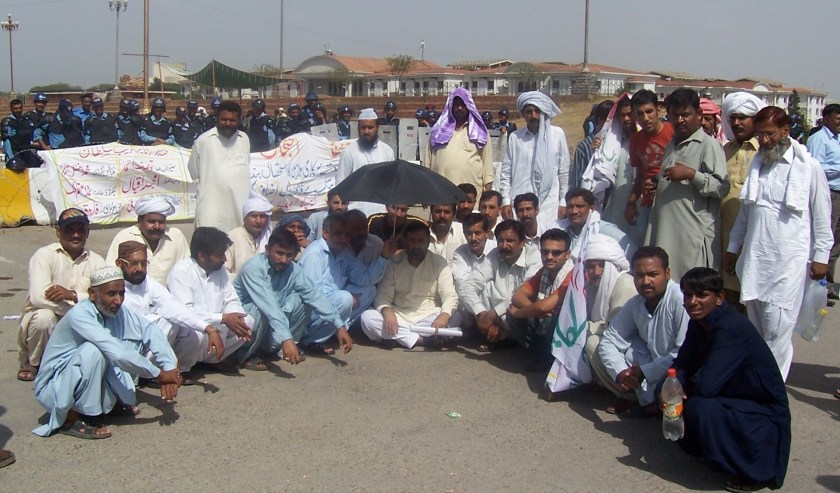
All Pakistan Clerks Association Protest at Parliament in Islamabad

“The military is the muscle that protects the ruling elite from the wrath of the people,” says Pakistani political analyst Dr. Mubashir Hassan. “Right now, people are out on the street; blocking roads, attacking railway stations, etc. If you read the papers, it seems as though a general uprising has started all over Pakistan.”

Dr. Hassan says that sporadic outbursts of anger in Pakistan won’t coalesce into a people’s revolution anytime soon. The demonstrators are too disorganized. But, the sheer volume of daily protests shows that many sectors of Pakistani society have pressing needs and priorities that do not include enlistment as foot soldiers in a proxy force for the United States’ War on Terror.

Dr. Hassan, a co-founder of the People’s Party of Pakistan, is a respected scholar and statesman. Last year, when we met with him, he had just returned from a visit, in the U.S., with Professors Noam Chomsky and Howard Zinn, his contemporaries in seeking to build just and fair social structures. Last month, in Lahore, he spoke with us about U.S. interference in the region and changing dynamics in Pakistan.

Continue reading “Unrest in Pakistan”

Nuclear Iran – Is There An Option?

Not for the US but plenty for Iran, says Mosaic Intelligence Report. It says sanctions are futile and the United States only harms its own interests.

linktv — 17 June 2010 — (Mosaic Intelligence Report: June 17, 2010) The US imposes more sanctions on Iran. Iranian President Ahmedinejad remains defiant. Are sanctions enough to stop Iran’s nuclear program? And who will pay the price?

Amy Goodman on Gaza attack, BP oil spill catastrophe and Obama’s wars

RTAmerica — 14 June 2010 — RT’s Anastasia Churkina sits down for an exclusive interview with award-winning journalist, TV/radio host and author Amy Goodman to talk about all the latest stories the mainstream media has not been too truthful about.

Why Turkey is Looking East

Good analysis from Link TV’s Mosaic Intelligence Report. Also see this excellent analysis of Erdogan’s rise by Patrick Cockburn.

linktv 11 June 2010 — (Mosaic Intelligence Report: June 11, 2010) Turkey votes against UN sanctions on Iran. Erdogan is a hero in the Arab world. Did Turkey abandon its EU dreams? And why is it looking towards the East?

channelled French-Russian philosopher Alexandre Kojève’s idiosyncratic reading of Hegel[1] to


[1] Kojève, from whom Fukuyama borrowed the notion of ‘end of history’, was a major influence on Bloom.