Just before the weekend dies, a little music. PULSE readers may already know British-Iraqi rapper LOWKEY from his regular appearances at rallies for justice. He’s a great speaker, and a great rapper. Intelligent rhymes intelligently delivered.
Category: US Foreign Policy
A Process of Change – Nasrallah to Petraeus
 It’s important to remember that Hizbullah leader Hassan Nasrallah’s speeches consist of more than mere rhetoric. One of the reasons for Nasrallah’s enormous popularity in the Arab and Muslim worlds is that, unlike other Arab leaders, he says what he means and means what he says. Hizbullah is the only force to have defeated Israel – once in 2000, when the brutal occupation of south Lebanon was brought to an end, and once in 2006, when Israeli troops attempted to reinvade in order to dismantle the resistance, but bled on the border for five weeks instead. During the 2006 war Israel bombed every TV mast it could find, but failed to put Hizbullah’s al-Manar off the air. Nasrallah spoke on al-Manar of “the Israeli warship that attacked our infrastructure, people’s homes and civilians. Look at it burn!” As Nasrallah uttered these words, a Hizbullah missile did indeed disable an Israeli warship, forcing Israel to move its fleet away from the Lebanese coast.
In mid-February 2010, Shaikh Nasrallah made a speech which may well mark a fundamental change in the Middle Eastern balance of power. The speech, quoted below, should not be read as a string of empty threats, but a signal of new weaponry and fighting capabilities.
Continue reading “A Process of Change – Nasrallah to Petraeus”
Seven Years in Iraq and Counting
by Ahmed Habib
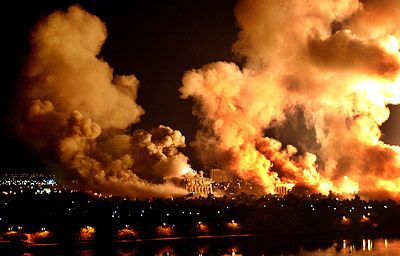 On March 20, 2003, at approximately 5:30 in the early hours of the morning, just at that time where the sun settles into its daytime position over the skies of Baghdad, American jet fighters unleashed indiscriminate firepower over the beautiful city.
Amidst a house filled with resilient spirits, Laila cowered for cover with her neighbours and family. As a twenty year old university student, the Baghdad native had already been through two wars, and a genocidal sanctions regime that limited her childhood to an existence of deprivation and fear.
“This time, it was different, the explosions were so big, we all thought we were going to die,” Laila, a pseudonym used out of fear for her safety, says over a tired phone connection seven years later.
Tens of thousands of kilometres away, activists huddled around a television set, with their heads in their hands, and watched a glorified play by play of death narrated by indifferent talking heads.
“Those are people dying under those bombs, and we couldn’t do anything to stop them,” said Firas from a Toronto apartment, to the backdrop of free flowing tears.
In the lead up to that day, millions of people took to the streets to oppose the impending war, to no avail. Since then, over a million Iraqis have lost their lives, more than five million have been displaced, and countless lives have been destroyed.
The Undue Influence of the Israel Lobby
by Jeffrey Blankfort
 Despite the repeated humiliations suffered during his recent visit to Israel, US Vice President Joe Biden continued to grovel publicly to his Israeli hosts. Yet, according to Yediot Ahronoth, Israel’s most widely read newspaper, Biden had privately complained to the Israeli Prime Minister Benjamin Netanyahu that Israel’s behavior was “starting to get dangerous for us.” “What you’re doing here,” he reportedly said, “undermines the security of our troops who are fighting in Iraq, Afghanistan and Pakistan. That endangers us, and it endangers regional peace.” That Biden made such a statement has been denied by the White House, but it follows closely an earlier memorandum sent by General Petraeus to the Joint Chiefs of Staff and his testimony before a US Senate Armed Services Committee on Tuesday.
In his prepared statement, Petraeus depicted the Israeli-Arab conflict as the first “cross cutting challenge to security and stability” in the CENTCOM area of responsibility [AOR]. “The enduring hostilities between Israel and some of its neighbors present distinct challenges to our ability to advance our interests in the AOR.”
Treading in an area where few members of the US military have dared to go before, Petraeus observed that “The conflict foments anti-American sentiment, due to a perception of U.S. favoritism for Israel. Arab anger over the Palestinian question limits the strength and depth of U.S. partnerships with governments and peoples in the AOR and weakens the legitimacy of moderate regimes in the Arab world.” It should be noted that neither the New York Times’s Elizabeth Bumiller nor the Washington Post’s Anne Flaherty included any reference to these comments by Petraeus in their coverage of his testimony.
Taking Sides: Israel and the lobby against the US
by John Mearsheimer
 In the wake of Vice President Joe Biden’s ill-fated trip to Israel last week, many people would agree with the Israeli ambassador Michael Oren’s remark that ‘Israel’s ties with the United States are in their worst crisis since 1975… a crisis of historic proportions.’ Like all crises, this one will eventually go away. However, this bitter fight has disturbing implications for Israelis and their American supporters.
First, the events of the past week make it clear in ways that we have not seen in the past that Israel is a strategic liability for the United States, not the strategic asset that the Israel lobby has long claimed it was. Specifically, the Obama administration has unambiguously declared that Israel’s expansionist policies in the Occupied Territories, including East Jerusalem, are doing serious damage to US interests in the region. Indeed, Biden reportedly told the Israeli prime minister, Binyahim Netanyahu, in private:
This is starting to get dangerous for us. What you’re doing here undermines the security of our troops who are fighting in Iraq, Afghanistan and Pakistan. That endangers us, and it endangers regional peace.
If that message begins to resonate with the American public, unconditional support for the Jewish state is likely to evaporate.
Continue reading “Taking Sides: Israel and the lobby against the US”
Falluja’s birth defects
Our good friend Dahr Jamail on the Riz Khan show to discuss the dramatic rise in birth defects in Falluja following the two brutal sieges of 2004.
On this episode of the Riz Khan show we ask if US weapons are behind the sharp rise in birth defects in Falluja. Residents of the Iraqi city blame the surge in chronic deformities on controversial weapons used by US forces against Sunni fighters in 2004. But the US military has dismissed those allegations.
Russell tribunal says sanction Israel
Russell Tribunal on Palestine concludes the EU should sanction Israel until violations stop.
Europe’s Alliance with Israel
by David Cronin

One of the pitfalls of specialising in European politics, as I have for the past 15 years, is that certain assumptions become hardwired in your brain. For a long time, my critical faculties shut down when I heard senior EU representatives speak of the Middle East. I happily accepted the official narrative that they were striving for a just resolution to the conflict between Israel and the Palestinians and that it would be foolish to park the so-called peace process in a “blood-soaked lay-by”, in the words of former EU commissioner Chris Patten.
Israel’s attacks on Lebanon in 2006 and on Gaza just over a year ago illustrated how naive and gullible I had been. In the first instance, Tony Blair blocked the EU from formally calling for a ceasefire because he wanted Israel to be given whatever space it perceived necessary to fight Hezbollah (Israel’s slaughter of Lebanese civilians in that 33-day war elicited no more than statements of “regret” from London).
It is true that the Union did urge a halt to the violence that Israel inflicted on Gaza’s 1.5 million inhabitants in late 2008 and early 2009. Yet by describing that attack as “disproportionate”, key EU representatives implicitly approved the Israeli version of events – that everything had been provoked by the missiles Hamas was firing on the southern Israeli towns of Ashkelon and Sderot. “Gaza was a crisis waiting to happen,” Marc Otte, the Union’s Middle East envoy, told me. “Do you think the Palestinians could continue to launch rockets on Israel without Israel reacting?”
Equatorial Guinea: The good, the bad and the ugly
by Agustín Velloso

The Bad
Teodoro Obiang Nguema Mbasogo, Equatorial Guinea’s recalcitrant leader, is a very wealthy man. He has amassed such a fortune that he could only get rid of his bank notes by burning them.
He cannot use his money to buy power – he has, after all, enjoyed that in its absolute form for the last thirty years. His eldest son wants for nothing, and his family is wallowing in plenty. Global Witness published a report entitled ‘The Secret Life of a Shopaholic: How an African dictator’s playboy son went on a multi-million dollar shopping spree in the US’.
Neither does Teodoro Obiang need money to earn a place among the world’s most powerful. He is already a welcome member of this cabal, which often treats him with affection. Welcoming him in Washington back in 2006, erstwhile secretary of state Condoleeza Rice said, ‘You are a good friend, and we welcome you’.
He has been welcomed to Beijing six times by Hu Jintao, who said to him, ‘bilateral relations between our two countries have developed through goodwill’.
Continue reading “Equatorial Guinea: The good, the bad and the ugly”
Rahimullah Yusufzai on the Taliban, Al-Qaida and the ‘Af-Pak’ theatre
Kudos to The Real News for giving its viewers an opportunity to listen to Rahimullah Yusufzai, the most respected authority on the politics of the Afghanistan-Pakistan frontier. Yusufzai was also among our 20 Top Global Media Figures of 2009.
Capture of leader will not weaken Taliban: Taliban is so strong now they have probably already replaced Baradar
Continue reading “Rahimullah Yusufzai on the Taliban, Al-Qaida and the ‘Af-Pak’ theatre”
 P U L S E