AFP — Bestselling author Naomi Klein on Friday took her call for a boycott of Israel to the occupied West Bank village of Bilin, where she witnessed Israeli forces clashing with protesters.
“It’s a boycott of Israeli institutions, it’s a boycott of the Israeli economy,” the Canadian writer told journalists as she joined a weekly demonstration against Israel’s controversial separation wall.
“Boycott is a tactic … we’re trying to create a dynamic which was the dynamic that ultimately ended apartheid in South Africa,” said Klein, the author of “The Shock Doctrine: The Rise of Disaster Capitalism.”
“It’s an extraordinarily important part of Israel’s identity to be able to have the illusion of Western normalcy,” the Canadian writer and activist said.
“When that is threatened, when the rock concerts don’t come, when the symphonies don’t come, when a film you really want to see doesn’t play at the Jerusalem film festival… then it starts to threaten the very idea of what the Israeli state is.”
Al Jazeera’s Empire, with Marwan Bishara. The first short documentary is so bad that it could have been made by the BBC or CNN. Flynt Leverett is insightful as usual, but as much as I love and respect Hamid Dabashi, I think he adds little of value to the discussion.
US Congress passed the supplemental by a vote of 226 to 202.
US President Barack Obama’s election on an anti-war ticket looks even more hollow by the day. First there was the admission that US troops would remain in Iraq in some capacity until 2011 (or beyond, should the Iraqis request it of course). Now Obama’s the re-invasion of Afghanistan is to be escalated after Congress narrowly passed a supplemental $106 billion support fund for its continuation.
Looking at the breakdown of these huge sums we can see that Obama’s Af-Pak policy differs little from that of his predecssors with $80 billion going towards military operations with only $10.4 billion allotted to international development (about $7 billion will go towards the swine flu epidemic). The Neo-cons too showed little concern for the aftermath of their destruction. The measure will go through the Senate today. With no exit-strategy for the quagmire in Af-Pak, Katrina Vanden Heuvel writes that this action threatens both Obama’s ability to “re-engage the international community” and also his domestic plans.
Just a few minutes ago, the Obama Administration’s $106 billion war supplemental passed on the House floor by a vote of 226-202. Congressional Democrats who oppose military escalation were in a tough position. They were whipped aggressively by both Speaker Pelosi and the White House. And they support President Obama. Which is exactly why they did the right thing in voting no.
President Obama himself has said, “There’s got to be an exit strategy.” Yet we are sliding into a military escalation and commitments without a full and necessary national debate about the ends, means, or exit strategy for this war. Continue reading “Obama’s $106 billion war fund approved in House”
Pankaj Mishra is one of the most astute analysts of South Asian politics. In the following he argues that ‘Unless the US president can break his hardline posture, the wars in Afghanistan and Pakistan could prove his Vietnam’.
Last month Richard Holbrooke, the US state department’s special representative, met students from Pakistan’s north-west tribal areas. They were enraged by drone attacks, which – according to David Kilcullen, counterinsurgency adviser to General Petraeus – have eliminated only about 14 terrorist leaders while killing 700 civilians. One young man told Holbrooke that he knew someone killed in a Predator drone strike. “You killed 10 members of his family,” he said. Another claimed that the strikes had unleashed a fresh wave of refugees. “Are many of them Taliban?” Holbrooke asked. “We are all Taliban,” he replied.
Describing this scene in Time, Joe Klein said he was shocked by the declaration, though he recognised it as one “of solidarity, not affiliation”. He was also bewildered by the “mixed loyalties and deep resentments [that] make Pakistan so difficult to handle”. One wishes Klein had paused to wonder if people anywhere else would wholeheartedly support a foreign power that “collaterally” murders 50 relatives and friends from the air for every militant killed.
Chris Hedges examines moves by Russia/China to dump the Dollar as a global reserve currency stating that “it marks the start of a terrible period of economic and political decline in the United States. And it signals the last gasp of the American imperium. That’s over. It is not coming back.”
This week marks the end of the dollar’s reign as the world’s reserve currency. It marks the start of a terrible period of economic and political decline in the United States. And it signals the last gasp of the American imperium. That’s over. It is not coming back. And what is to come will be very, very painful.
Stephen Colbert was recently on a USO tour of Iraq to entertain the illegal occupiers of the country. The show however went far beyond entertainment, and verged on pro-war propaganda. Among other things it included interviews with Ray Odierno, the fellow whose units according to Thomas Ricks were responsible for much of the abuses in the initial phase of the war, and with the Kurdish boot-licker they have installed as Iraq’s deputy prime minister, a truly execrable creature. Surprisingly, no one has spoken out against this supposed enlightened ‘liberal’ whitewashing Bush’s genocidal war. That is, until now. Here is Danny Schechter, the News Dissector’s open letter to Colbert.
Operation Iraqi Stephen
Dear Stephen Strong:
Welcome home, soldier. Your week in Iraq is all over, but the war, of course, isn’t. At least your presence there reminded us that Americans troops are still there. I am sure your presence gave them something fun to do, but hey, Nation, shouldn’t we think a little deeper about this fused exercise in military promotion and self-promotion?
Al Franken went on such a tour when Bush was in command although I noticed that W appears along with other former POTUS’s to endorse your cheerleading for our “service members.”
This week from CounterSpin – “Barack Obama has either been currying favor with Muslims or extending an olive branch in the Middle East depending on which media you consume. We’ll talk with Phyllis Bennis of the Institute for Policy Studies about Obama’s major speech in Cairo, and the size of the gap between words and actions.”
In his latest column, John Pilger de-codes the Obama’s “historic” speech in Cairo “reaching out to the Muslim world”. However seductive, its content was as morally bankrupt as any of Bush’s spiels.
At 7.30 in the morning on 3 June, a seven-month-old baby died in the intensive care unit of the European Gaza Hospital in the Gaza Strip. His name was Zein Ad-Din Mohammed Zu’rob, and he was suffering from a lung infection which was treatable.
Denied basic equipment, the doctors in Gaza could do nothing. For weeks, the child’s parents had sought a permit from the Israelis to allow them to take him to a hospital in Jerusalem, where he would have been saved. Like many desperately sick people who apply for these permits, the parents were told they had never applied. Even if they had arrived at the Erez Crossing with an Israeli document in their hands, the odds are that they would have been turned back for refusing the demands of officials to spy or collaborate in some way.
Antiwar.com brings us news that Israeli minister Yossi Peled is seeking sanctions and regime change… against the USA!
Peled is calling for the Israeli government to seek to influence American elections and cutting trade ties with America. This, let’s remember, is coming from a minister of the country that has received more aid from the US than all of Sub-Saharan Africa combined. Israeli politicians are now so comfortable with their relationship with America they talk about America in the same way America talks about minor Latin American rogue states.
For those, like me, who are skeptical of whether the Obama Administration is going to offer any real change on US policy towards Israel, stories like this offer cause for optimism.
Team Obama may not do enough to pressure Israel, but with fundamentalist misanthropes filling every cabinet post in Israel, there is every chance that it is the Israelis who will bring about an Israeli-American split with their antagonism.
Editor’s note: In 2009 when I read Mahmood Mamdani’s book, I accepted many of its arguments uncritically. Since then I’ve had occasion to reappraise my position and regret many of the things I wrote. Darfur was not my specialisation and I should not have passed confident judgments on it. I should not have doubted the good faith of the many people trying to bring attention to Darfur’s tragedy. Nor should I have been so eager to accept the geopolitical arguments to downplay the real atrocities being committed on the ground. The Bashir regime’s actions in Darfur were unjustifiable, tantamount to genocide, and I should have rejected any argument that downplayed the crimes. The years since 2011 have been an education and I am glad to be rid of the infantile contrarianism that defined my past politics. I am immensely grateful to the influence of the late Tony Judt who guided me towards what is hopefully a more humane and reflective politics. I hereby repudiate this piece and offer my unreserved apologies to the people of Darfur.
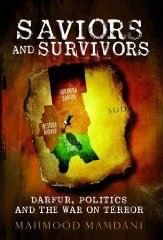
Saviors and Survivors: Darfur, Politics and the War on Terror by Mahmood Mamdani, Verso, 2009.
“Saviors and Survivors: Darfur, Politics and the War on Terror” by Mahmood Mamdani
In Errol Morris’s 2004 film The Fog of War, former US Defense Secretary Robert McNamara recalls General Curtis LeMay, the architect of the fire-bombings of Japan during WWII, saying that “if we’d lost the war, we’d all have been prosecuted as war criminals.” LeMay was merely articulating an unacknowledged truism of international relations: power bestows, among other things, the right to label. So it is that mass slaughter perpetrated by the big powers, from Vietnam to Iraq and Afghanistan, is normalized as “counterinsurgency,” “pacification” and “war on terror,” while similar acts carried out by states out of favor elicit the severest of charges. It is this politics of naming that is the subject of Mahmood Mamdani’s explosive new book, Saviors and Survivors: Darfur, Politics and the War on Terror.
Like the Middle East, parts of Africa have been engulfed in conflict for much of the post-colonial period. While the media coverage in both cases is perfunctory, in the case of Africa it is also sporadic. To the extent that there is coverage, the emphasis is on the dramatic or the grotesque. When the subject is not war, it is usually famine, disease or poverty—sometimes all together, always free of context. The wars are between “tribes” led by “warlords,” that take place in “failed states” ruled by “corrupt dictators.” Driven by primal motives, they rarely involve discernible issues. The gallery of rogues gives way only to a tableau of victims, inevitably in need of White saviors. A headline like “Can Bono save Africa?” is as illustrative of Western attitudes towards the continent as the comments of Richard Littlejohn, Britain’s highest-paid columnist, who wrote at the peak of the Rwandan genocide “Does anyone really give a monkey’s about what happens in Rwanda? If the Mbongo tribe wants to wipe out the Mbingo tribe then as far as I am concerned that is entirely a matter for them.”

 This week marks the end of the dollar’s reign as the world’s



 P U L S E