Andrew Jackson’s illegal and heavily censured actions during the First Seminole War in 1817 were cited recently during the military trial of a Guantanamo prisoner and was used as a precedent for the $690 billion defense authorization bill recently passed by Congress that would give the president unilateral authority to wage war at home or abroad and detain anyone suspected of terrorism or “providing material aid to terrorism” anywhere in the world, indefinitely and without trial. Although there is no direct connection between the Guantanamo case and that legislation, the right of free speech is threatened by both and raises fears that the legislation could be used to squelch any kind of dissension or resistance to government policies or actions. And coming on the heels of the government’s use of “Geronimo” as the code name for Osama bin Laden, the man who epitomized global terrorism, indigenous peoples fear that the legislation could be used against them for asserting their right to self determination, sovereignty and the protection of their lands and resources against exploitation by governments or corporations.
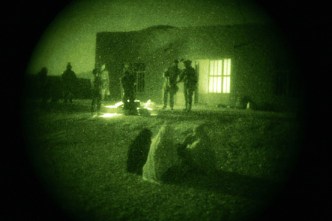
Afghan women and children wait as U.S. Special Operations forces and Afghan soldiers search their home during a night raid in Farah province. (Associated Press)
It’s a bit odd to me that with my sense of geographical direction I’m ever regarded as a leader to guide groups in foreign travel. I’m recalling a steaming hot night in Lahore, Pakistan when Josh Brollier and I, having enjoyed a lengthy dinner with Lahore University students, needed to head back to the guest lodgings graciously provided us by a headmaster of the Garrison School for Boys. We had boarded a rickshaw, but the driver had soon become terribly lost and with my spotty sense of direction and my complete ignorance of Urdu, I couldn’t be any help. My cell phone was out of juice, and I was uncertain anyway of the needed phone number. I bumped and jostled in the back seat of the rickshaw, next to Josh, as we embarked on a nightmare of travel over unpaved, rutted roads in dizzying traffic until finally the rickshaw driver spotted a sign belonging to our school – the wrong campus, we all knew – and eager to unload us, roused the inhabitants and hustled us and our bags into the street before moving on.
We stood inside the gate, staring blankly at a family that had been sound asleep on cots in the courtyard. In no time, the father of the family scooped up his two children, gently moving them to the cot he shared with his wife so that Josh and I would have a cot on which to sit. Then he and his spouse disappeared into their humble living quarters. He reappeared with a fan and an extension cord, wanting to give us some relief from the blistering night heat. His wife emerged carrying a glass of tea for each of us. They didn’t know us from Adam’s house cat, but they were treating us as family – the celebrated but always astonishing hospitality that we’d encountered in the region so many times before. Eventually, we established with our host that we were indeed at the wrong campus, upon which he called the family that had been nervously waiting for our errant selves.
This courtyard scene of startling hospitality would return to my mind when we all learned of the U.S. Joint Special Operations (JSO) Force night raid in the Nangarhar province, on May 12, 2011. No matter which side of the Afghanistan/Pakistan border you are on, suffocating hot temperatures prevail day and night during these hot months. It’s normal for people to sleep in their courtyards. How could anyone living in the region not know this? Yet the U.S. JSO forces that came in the middle of the night to the home of a 12 year old girl, Nilofer, who had been asleep on her cot in the courtyard, began their raid by throwing a grenade into the courtyard, landing at Nilofer’s head. She died instantly. Nilofer’s uncle raced into the courtyard. He worked with the Afghan Local Police, and they had told him not to join that night’s patrol because he didn’t know much about the village they would go to, so he had instead gone to his brother’s home. When he heard the grenade explode, he may well have presumed the Taliban were attacking the home. U.S. troops killed him as soon as they saw him. Later, NATO issued an apology.
In an in-depth investigation, Mehreen Zahra-Malik reveals the sordid details behind the May 17th murder of five Russian/Tajik civilians by Pakistani security forces near Kharotabad in Baluchistan. This article first appeared on Al Jazeera.
One wounded woman makes an appeal for surrender moments before her body is riddled with more bullets.
Jamal Tarakai had barely sat down to a late lunch on May 17 when he heard gunshots. Leaving his food untouched, he jumped on his motorbike and drove towards the source of the noise. About 200 metres from his home in Kharotabad on the outskirts of the capital of Balochistan, Quetta, was a Frontier Corps (FC) check post. As Tarakai pulled up on the chowk, he saw at least five FC guards shooting into a pile of sandbags, the firing so intense it created a whirlwind of dust, making it difficult for the cameraman to see who, or what, was being shot at so fiercely.
Pulling out his camera, the journalist started filming the scene. At some point, there was a pause in the firing. The dust settled, somewhat, and the lower portion of a woman in a red shalwar-kameez could be seen lying on the ground. She slowly raised an arm and waved it in the air, fingers stretched out – to signal surrender? To seek mercy? The outstretched hand prompted two of the men in fatigues to start firing again, until it was certain anything living on the receiving end was now almost certainly dead.
TV channels immediately began to pump out congratulatory stories, cheering the FC guards for a job well done. Five alleged Chechen suicide bombers, including three women, had been killed in an encounter with security forces, it was reported. The Balochistan Home secretary quickly issued a statement saying the suspects were wearing suicide vests and had hurled hand grenades at the FC, killing one FC guard, Naik Mohommad Sajjad. The Capital City Police Officer, Daud Junejo, said the five foreigners were Chechen militants linked with Al Qaeda; that they had been planning to carry out attacks in Quetta; and that the women had showed the officers suicide vests and threatened to blow themselves up.
An investigation by a Bureau of Investigative Journalism team led by Chris Woods conclusively shows that the US government has been lying about civilians casualties in its illegal drone war inside Pakistan. The story was recently covered by the BBC’s Newsnight.
My new piece on the complicity of the Pakistani elite in the US drone war is up on Al Jazeera‘s website.
Pakistanis are enraged by ongoing US drone strikes in their country
Meet Resham Khan. The 52-year-old shepherd was brought on a stretcher to a psychiatric hospital in Islamabad in January, traumatized and unable to speak. The father of six witnessed 15 members of his extended family perish last June when a US drone attacked a funeral procession in his native North Waziristan. The atrocity has left him mute and emotionally paralyzed, his vacant eyes staring into the distance. He gave up on food and drink in the months following the attack; shortly afterward, the pious Muslim gave up on prayer too. His condition also prevented him from looking after his ailing mother who died soon thereafter. And his surviving children have suffered. When the Reuters journalist finally got him to talk, one of the few things he said was ‘Stop the drone attacks.’
Kareem Khan, too, has suffered. On December 31, 2009, his son Zaenullah Khan and his brother Asif Iqbal were among the three people killed in a US drone attack which destroyed their home in Mir Ali, North Waziristan. Kareem’s absence spared him the sight of his mutilated family; and unlike the helpless shepherd, he had the wherewithal to demand justice. In November 2010, his lawyer, Barrister Shahzad Akbar served legal notices to the CIA station chief Jonathan Banks, former Defence Secretary Robert Gates, and former Director of Central Intelligence Leon Panetta for $500 million in damages. Banks, who was in Pakistan on a business visa, took fright and soon fled the scene, and the US government was so terrified of the legal challenge that last month it denied a visa to Barrister Akbar to travel to the US. More survivors have since come forward demanding justice.
My second article in the drones series is now online at Al Jazeera.
Drone pilots pilot the craft from an air conditioned office thousands of miles away. War has never before been so like a video game.(GALLO/GETTY)
In April, the British Ministry of Defence published a study which for the first time gave serious consideration to the moral, ethical and legal aspects of the drone wars. The study advises defense planners that ‘before unmanned systems become ubiquitous’ they must ‘ensure that, by removing some of the horror, or at least keeping it at a distance we do not risk losing our controlling humanity and make war more likely.’ The report is particularly concerned that the low risks of using drones were enabling policy makers to consider military action in places where they would otherwise be hesitant: ‘the use of force is totally a function of the existence of an unmanned capability,’ it suggests.
The conclusions of the report are sobering. So is the fact that it was produced by a British military think tank rather than a US Congressional committee. In the US, the media and political establishment are still romancing the drone with the kind of giddy attention that sometimes borders on the inappropriate. In a May 10, 2009 segment on the Predator drone, Lara Logan of CBS’s 60 Minutes was positively breathless. Two years later, at a New America Foundation conference on drones, Professor Thomas Nachbar of the University of Virginia School of Law declared drones ‘fun’ and argued ‘against more transparency’ in their use.
Drones are attractive to US militarists and their courtiers because they are politically liberating. In their battle against public opinion and institutional inertia, politicians have often found technology an ally. The drones must therefore be understood in the context of a long-standing US desire to develop the technological means for achieving global Pax Americana. And for a century, airpower has been a key component of this vision.
Following is an extract from Armageddon in Retrospect by Kurt Vonnegut in which he describes the scenes of ‘obscene brutality’ he witnessed as a prisoner of war in Dresden which inspired his classic novel Slaughterhouse-Five.
Dresden before the allied bombing
It was a routine speech we got during our first day of basic training, delivered by a wiry little lieutenant: “Men, up to now you’ve been good, clean, American boys with an American’s love for sportsmanship and fair play. We’re here to change that.
“Our job is to make you the meanest, dirtiest bunch of scrappers in the history of the world. From now on, you can forget the Marquess of Queensberry rules and every other set of rules. Anything and everything goes.
“Never hit a man above the belt when you can kick him below it. Make the bastard scream. Kill him any way you can. Kill, kill, kill – do you understand?”
His talk was greeted with nervous laughter and general agreement that he was right. “Didn’t Hitler and Tojo say the Americans were a bunch of softies? Ha! They’ll find out.”
And of course, Germany and Japan did find out: a toughened-up democracy poured forth a scalding fury that could not be stopped. It was a war of reason against barbarism, supposedly, with the issues at stake on such a high plane that most of our feverish fighters had no idea why they were fighting – other than that the enemy was a bunch of bastards. A new kind of war, with all destruction, all killing approved.
Steve Walt, co-author of the ground-breaking The Israel Lobby and US Foreign Policy, gave a keynote address on “Obama’s Foreign Policy and the End of the American Era” at an event is co-hosted by the IIEA and UCD’s Clinton Institute for American Studies. You can download the Post Event Notes from this event here.
My review of Anatol Lieven’s must-read book, originally published at IPS.
It is almost obligatory these days to subtitle books on Pakistan with some conjunction of ‘failed’, ‘dangerous’, ‘lawless’, ‘deadly’, ‘frightening’ or ‘tumultuous’. Pakistan is a ‘tinderbox’, forever on the brink, in the eye of the storm, or descending into chaos. It is an ‘Insh’allah nation’ where people passively wait for Allah. In the narrow space ‘between the mosque and the military’, there is much ‘crisis’, ‘terrorism’, ‘militancy’ and ‘global jihad.’
British author and policy analyst Anatol Lieven’s refreshingly understated title Pakistan: A Hard Country eschews emotion for description, which is fitting because the book is a 519-page myth- busting exercise.
Lieven, currently a fellow at the New America Foundation, argues that some of the alarmist claims about Pakistan are indeed true – it is a corrupt, chaotic, violent, oppressive and unjust country. But it is also a remarkably resilient one. It is not nearly as unequal as India or Nigeria, or for that matter the United States. Its security is beset by multiple insurgencies but they affect a smaller proportion of its territory than the ones India faces. Its cities are violent, but no more so than those of comparable size in Latin or even North America. It has an abysmally low rate of tax collection, but, at five percent of the GDP, it also has one of the world’s highest rates of charitable donations. It is no doubt corrupt, but this is due less to the absence of values than to the enduring grip of the old ones of loyalty to family and clan.



 P U L S E