It was a pleasure to give a talk at the LSE. The talk was organised by the brilliant Syria Solidarity UK.
Here is Part One:
and (after the break) Part Two:
It was a pleasure to give a talk at the LSE. The talk was organised by the brilliant Syria Solidarity UK.
Here is Part One:
and (after the break) Part Two:
Here I am talking about the Syrian revolution and our book ‘Burning Country’ on Canada’s Free City Radio. Topics include democracy, how Assad engineered a war, and the meanings of the word ‘jihad’.
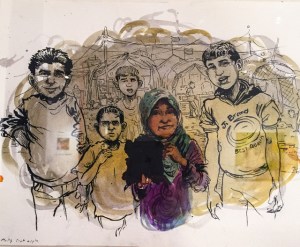 This review was published at the National.
Molly Crabapple’s “Drawing Blood” – “the story of a girl and her sketchbook” – is at once memoir, reportage, literary description, aesthetic enquiry, road novel and romance.
Crabapple’s painting, lying somewhere between Toulouse Lautrec and surrealism, is increasingly celebrated. The surprise here is that her best writing is as provocatively beautiful as her visual art. Her prose is sweet and sour in equal measure, the eye she watches with is both refined and raw. Very often she watches herself. The comfortable clash in her personality of cynic and idealist, highbrow and lowbrow, recalls Saul Bellow’s early characters. Like Augie March, a young Molly shoplifts high-canonical texts and reads them on the elevated trains which pass above slums.
Native of New York, of a stimulating Puerto Rican (Marxist) and Jewish (artist) background, Molly nevertheless hated being a child. School diagnosed her with “oppositional defiant disorder”; by twelve she’d become a goth-punk. At seventeen she was travelling in Paris and Morocco, an American on tour – “nothing but an eye, soaking up the world” – but one seeing a freshly unexotic vision.
“When you draw you are performing quietly,” she writes, “inviting strangers to engage you.” Strangers engage her, of course, wherever he is, whether she’s drawing or not, simply because she possesses (or is possessed by) an attractive female body. This she finds to be both a power and a vulnerability. The financial power leads her to pose for photo shoots. “When I thought of every proposition and threat that I got just walking down the street in my girl body, I decided I might as well get paid for the trouble.” And so she became “rendered into image, untouchable yet tradable.”
Chris and Xand van Tulleken – doctors, part-time aid workers and twin brothers – want to see for themselves what conditions are like for migrants fleeing through Europe at the height of winter. They travel to Lesbos in Greece, through the Balkans and on to Berlin and Calais to understand what’s being done on a medical and humanitarian level in response to the refugee crisis.
Spending time with medics, charities and volunteers in camps and clinics, at border crossings and transit points, they find out what the situation is like on the ground and, wherever possible, lend a hand in the biggest migration crisis of our times.
For more, see the New York Times: Syrian Protesters Take to Streets as Airstrikes Ease.
Syrians took back to the streets during the cease-fire. This is the revolutionary spirit the regime and the Russians are trying to bomb away.
by Gilbert Achcar
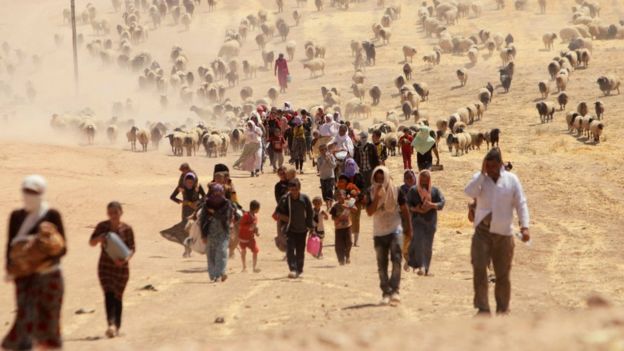
Most people prefer to keep referring to the self-proclaimed Islamic State by the acronym of its previous name: ISIS, the Islamic State in Iraq and Syria (or, more accurately ‘al-Sham’—Greater Syria—approximately translated by some as ‘the Levant’, with the acronym hence turned into ISIL). On this thus-named ISIS, close to forty books and counting have been hitherto published in English, of which the three reviewed here are the best-selling in the UK.
Of these, Patrick Cockburn’s was one of the very first books written on ISIS. It came out in 2014 under the title The Jihadis Return. The one reviewed here is an updated edition with a new title. It recapitulates the views that the author developed in his coverage of events in Iraq and Syria for The Independent. It is written in a most readable journalistic style by an author who is well acquainted with this part of the world, having covered it for many years (especially Iraq). However, the book contains hardly any references to substantiate its numerous assertions other than Cockburn’s personal testimony, often quite anecdotal.
The Savage Peace reveals the appalling violence meted out to the defeated, especially to those ethnic Germans who had lived peacefully for centuries in neighbouring countries.
 Plenty has been written about the armed struggle in Syria, but on left-wing and alternative media sources much of it has been laden with conspiracy theories, or is merely recycled Assad regime propaganda. In this article, soon to be published as part of a collection about the Syrian Revolution, Mark Boothroyd explores the roots of the armed struggle, and what drove the rebellion to the situation it finds itself in today.
Khiyana: The Unmaking of the Syrian Revolution seeks to uproot the false information, reactionary “anti-imperialist” dogma, slurs and slanders which have characterised much of the analysis of the revolt in Syria. It will contain articles by Idrees Ahmed, Budour Hassan, Sam Charles Hamad, Leila Al-Shami, Javaad Alipoor, Louis Proyect, and Michael Karadjis.
Who are the Syrian Rebels: The Genesis of the Armed Struggle in Syria
With the ongoing offensive in Syria by the Assad regime and its Russian and Iranian backers, there has been a renewed interest in Syria’s armed opposition. Despite the figure of 70,000 “moderate” armed rebels being mentioned in the media and in parliament, much of the coverage still talks about Al-Qaeda and ISIS, despite these being relatively minor forces in the armed conflict between the rebels and the regime.
Many commentators like Independent columnist Robert Fisk1, leading Stop The War Coalition (StWC) officer John Rees, and Unite General Secretary Len McCluskey, have mocked or denied the existence of moderate opposition forces. Criticisms that the rebels are not moderates2, that they are a “rump”3 with no support, or that they are Al-Qaeda or Turkish fascists4 have all emerged. Parts of the left and anti-war movement are complicit in creating a narrative that the opposition are entirely Al-Qaeda or ISIS, obscuring the reality that the overwhelming majority of Syrian rebels remain nationalist, of a democratic, secular or Islamic orientation.
Continue reading “Who are the Syrian rebels: The Genesis of the armed struggle in Syria”
Since September 30, 2015 Russia has been carrying out air strikes in Syria in support of its ally President Bashar al-Assad. The campaign has been relentless and growing in intensity, with Russian jets flying 444 combat sorties against more than 1,500 targets between February 10 and 16 alone.
Moscow insists these attacks have only been aimed at fighters from ISIL and other “terrorist groups” such as al-Nusra Front. But monitoring groups, including the Violations Documentation Center and the Syrian Observatory for Human Rights, say thousands of non-combatants have also been killed or wounded. Amnesty International and others have said the bombings may be war crimes. Indeed, Amnesty has also cited consistent reports of second bombardments from planes returning to kill and injure rescue workers, paramedics and civilians attempting to evacuate the wounded and the dead from earlier raids.
So are civilians being deliberately targeted – and could Russia be guilty as charged? In this exclusive report for People & Power, Danish born filmmaker and journalist Nagieb Khaja went to investigate. His remarkable film, shot in Aleppo, Idlib and other rebel-held areas of Syria at the end of last year, is a harrowing, tense and at times breathtaking portrayal of life underneath the Kremlin’s bombs.

This is my latest article for al-Araby al-Jadeed/ the New Arab.
The first fact is this: the Kurds have suffered a terrible historical injustice. The Arabs were rightly enraged when Britain and France carved bilad al-Sham (the Levant) into mini-states, then gave one of them to Zionism. But the post-Ottoman dispensation allowed the Kurds no state at all – and this in an age when the Middle East was ill with nationalist fever. Everywhere the Kurds became minorities in hyper-nationalist states.
Over the years an estimated 40,000 people have been killed in Turkish-Kurdish fighting, most of them Kurds. In the late 1980s, Saddam Hussain’s genocidal Anfal campaign murdered somewhere between 50 and 200,000 Iraqi Kurds. In Syria, where Kurds formed about 10% of the population, or around two million people, it was illegal to teach in Kurdish. Approximately 300,000 Kurds (by 2011) were denied citizenship by the state, and were therefore excluded from education and health care, barred from owning land or setting up businesses.
While oppressing Kurds at home, President Hafez al-Assad (Bashaar’s father) cultivated good relations with Kurdish groups abroad. This fitted into his regional strategy of backing spoilers and irritants as pawns against his rivals.
Continue reading “‘Democratic Confederalism’ or Counter-Revolution?”
 P U L S E