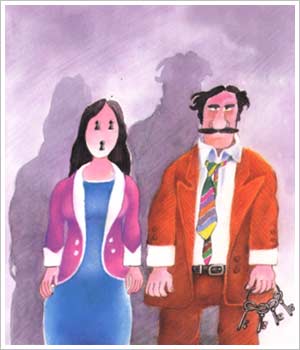
Sabriya

by Ali Farzat

It’s Damascus: bustling alleyways and courtyards crammed with silence. Sabriya is secretly in love with Adil. Her brother Sami is secretly in love with Nermin. Both loves are chaste and built on idealism, and both are doomed. Adil and Sami join the 1925-27 revolt against the French occupation. Sami is killed by the enemy. Nermine is badgered into marrying a wealthy old man, then ends up eloping with her hairdresser. Sabriya’s fiance Adil is killed, probably by Sabriya’s bullying brother Raghib who doesn’t like the idea of her marrying a baker’s son. Sabriya is left alone to care for her dying mother, then her dying father. Finally she kills herself, leaving her journal for her niece to read, and a message: “Do not let your life be in vain.”

Sabriya: Damascus Bitter Sweet” (in Arabic, “Dimashq Ya Basmat al-Huzn”, or “Damascus, O Smile of Sadness”) was published in Syria and then transformed into a controversial and wildly popular muselsel, or television series. (If the Egyptians are famous in the Arab world for films, the Syrians do muselselat, particularly period dramas). This elegantly-written, carefully-dramatised period novel is nostalgic but also very current in its concerns.

Ulfat Idilbi explicitly links the struggles for national rights and women’s rights. When Sabriya participates (wearing niqab) in a women’s demonstration against the French, she says: “For the first time I felt I was a human being with an identity and an objective, in defence of which I was ready to die.”
Continue reading “Sabriya”

The Meltdown in Iraq with Nir Rosen

Investigative journalist Nir Rosen discusses his recently released Aftermath: Following the Bloodshed of America’s Wars in the Muslim World on RT’s The Big Picture.

Haiti’s earthquake one year on

It is one year since Haiti suffered a huge earthquake. More than 200 000 Haitians died and more than a million were left homeless, most of whom still live in tent cities amidst the rubble. Unicef describes the past year as “probably the worst year in living memory for most Haitian adults” and children.

Continue reading “Haiti’s earthquake one year on”

Taliban can fight forever

Rahimullah Yusufzai: Negotiations must take place now, Taliban fighting for religion and country, can fight forever

Robert Meeropol, son of the executed Rosenbergs, on WikiLeaks

by Dennis Bernstein

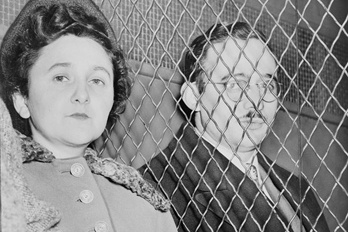
U.S. citizens Julius and Ethel Rosenberg were executed under the 1917 Espionage Act in 1953.

The U.S. Justice Department is now considering charging WikiLeaks’ founder Julian Assange with espionage under the 1917 Espionage Act. In a recent interview, syndicated on PacificaRadio’s Flashpoints show, I spoke to  Robert Meeropol, founder of the Rosenberg Fund For Children. Meeropol is the son of Julius and Ethel Rosenberg, the only U.S. citizens to be executed under the 1917 Espionage Act. In a strong defense of Wikileaks, Assange and Bradley Manning, Meeropol released a statement stating:

My parents were executed under the unconstitutional Espionage Act, here’s why we must fight to protect Julian Assange.

In the following interview he talks about the history of the 1917 espionage Act, the execution of his parents and some of the political “Echoes” from the 1950’s red scare days that are reverberating today. Meeropol also talks movingly about how his parents’ unwillingness to cave  in the face of government intimidation, even at the cost of their lives.

I think that resistance is inspirational.  When people resist, they inspire others and if you combined the resistance with the inspiration you end up building a movement of support.

DB: Let’s begin this way, Robert Meeropol.  The U.S. Congress is back in session, the Republicans are in charge of the House, and today they read the Constitution. Would that be relevant in your defense of Julian Assange?

Continue reading “Robert Meeropol, son of the executed Rosenbergs, on WikiLeaks”

Selling the First Gulf War

More than two decades after Iraq’s invasion of Kuwait, Al Jazeera takes a look at the media’s role in selling the Gulf War, the military’s attempts to control the story and the ’round-the-clock’ coverage that changed television news forever.

Continue reading “Selling the First Gulf War”

Once Upon a Time in Argentina: O’Grady’s Latest Fairy Tale

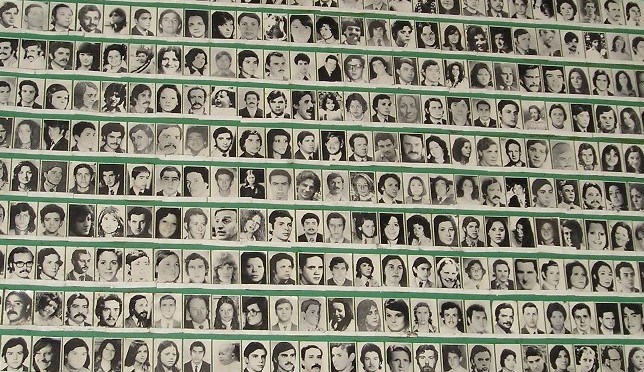
Argentina’s non-victims continue to steal the spotlight. (Photo: Pepe Robles)

by Kurt Fernández

“All history was a palimpsest, scraped clean and re-inscribed exactly as often as was necessary.” George Orwell, 1984

In her effort to whitewash the history of Argentina’s dirty war, Mary Anastasia O’Grady makes up a lot of stuff. The reader need go no further than the bold lie in her lead to dismiss her so-called op-ed as right wing propaganda.

O’Grady writes that “in Argentina today it is off limits to even mention in public the victims of the country’s left-wing terrorism of the 1970s”.

I’ve lived in Buenos Aires for the last three years and have spoken about the dirty war with Argentines from all walks of life. They are apparently unaware of the taboo O’Grady has fabricated. In fact, everyone talks about the victims of left-wing trade unions and political groups of the 1960s and 1970s. The subject is discussed ad nauseam in the ongoing human rights trials of military and police officials who carried out the state’s clandestine war against opponents. It is written about almost daily in newspapers. It is aired on television programs. Cab drivers, friends, anyone who talks about the days of the dirty war can be expected to mention the victims of O’Grady’s “band of Castro-inspired guerillas who sought to take power by terrorizing the nation”. Sympathy is sometimes expressed, but few stoop to using these victims to justify the atrocities of the military junta. There are exceptions. The dictator himself, Jorge Rafael Videla – who is serving a life sentence in prison for kidnapping, torture, murder, and trafficking in newborns – has an extremely soft spot in his heart for the victims of the guerillas. And he never fails to publicly defend his attempt to rid Argentina of the scourge.

Continue reading “Once Upon a Time in Argentina: O’Grady’s Latest Fairy Tale”

Nir Rosen at the New America Foundation

New America Foundation — On January 5, 2011, author Nir Rosen spoke at the New America Foundation about his new book, Aftermath: Following the Bloodshed of America’s Wars in the Muslim World, which covers his journey from the battlefields of Iraq, to the refugee camps of Lebanon, to the encampments of Taliban fighters in Afghanistan. His comments largely focused on the Iraq war, especially regarding an in-depth analysis of the Iraqi civil war going back to 2003. He spoke in year-by-year detail about the civil war between Sunni and Shia militias, the Iraqi police and army and the American military caught in the middle.