Press TV’s excellent reporter Safa Joudeh reports from Gaza.
Month: March 2011
United States of Israel
Sarah Palin is just the latest GOP politician to visit to Israel after a string of possible Presidential hopefuls to make a pilgrimage to the Holy Land in the past few months. Why is establishing your credentials in Tel Aviv before running for US president as vital as stumping in New Hampshire?
Syria Shakes
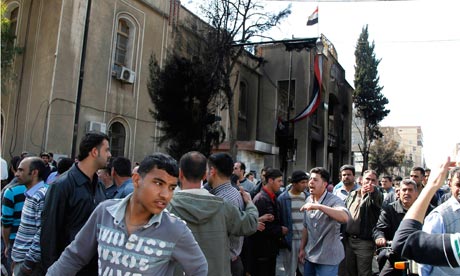
A few weeks ago fifteen children were arrested in the southern Syrian city of Dera’a for writing revolutionary slogans on walls. This led to a series of demonstrations calling for the children’s release, the sacking of local officials, and an end to the decades-long state of emergency. Last Friday security forces opened fire on protestors, killing five people. Predictably, state violence redoubled the people’s rage. A Ba’ath Party office was burned and a phone company belonging to the president’s corrupt cousin Rami Makhlouf was attacked. Inspired by Tahreer Square and Pearl Roundabout, protestors then set up tents beside Dera’a’s Omari mosque and stated their intention to stay until their demands were met. Last night security forces attacked the mosque, killing six people.
Prison of Terror
by Nafissa Assed
 On the 17th of March I headed to the airport, leaving Tripoli for safety reasons. The internet has been cut off in Libya since 3rd March, phone lines are very bad in all the cities, and some cities are totally isolated (no phone lines, no water, no electricity) – like Zawiya, Misurata, and now Benghazi’s too. God only knows what is coming next. After we lost the internet, Tripoli became a prison of terror.
Qaddafi’s thugs are celebrating all the time, and every day gunfire starts and stops all of a sudden, at any second. Out of a complete silence, we see cars passing by our building playing very loud music, songs for Qaddafi. At other times (usually between 2 and 4 am) we hear gunfire that gradually increases, with no celebrations or cars chanting his name around the streets.
Rory Stewart on the Libyan intervention
Rory Stewart offers by far the most astute analysis of the dilemmas Libya presents. Written for the London Review of Books, its reproduced here in full:
 Until yesterday, I thought we were at the end of the age of intervention. The complacency that followed the collapse of the Soviet Union had been shattered by the Balkan wars; despair was followed by the successful interventions in Bosnia and then Kosovo; then triumphal pride led us to disaster in Iraq and Afghanistan. Midway through the period, in 2000, it seemed we could intervene anywhere. By 2010, it felt as though we would not venture abroad again. What had begun with the irresistible victory of democracy, the free market and the United States, ended with occupation, financial crisis and American impotence.
It seemed doubly unlikely that we would ever intervene in a country like Libya. Even oil-less, Central Asian Afghanistan was perceived by many Muslims as the object of a crusading infidel occupation, driven by Israel and designed to establish bases or extract cheaper oil. Any move against Libya – an Arab, Muslim country, obsessed with its struggle against colonialism and dripping with oil – seemed bound to be perceived in the most hostile and sinister terms by its neighbours, by the developing world and by the Libyans themselves.
Nor did Libya appear to meet the criteria for intervention under international law. Gaddafi was the sovereign power, not the rebels, and he was not conducting genocide or ethnic cleansing. In Bosnia, by contrast, 100,000 people had died in a few weeks; and it was Bosnia itself – a sovereign, UN-recognised state – which formally requested the intervention. Kosovo was a less clear case, but the intervention targeted Milosevic, and followed the Balkan wars, which he had stoked, and the displacement of 200,000 people and clear evidence of ethnically-targeted atrocities. This interventionist worldview, which might have seemed in 1999 the quintessence of global governance and consensus, had, however, begun to seem a fading Western obsession. By 2011 Brazil, India and South Africa, as well as China, were on the Security Council. And none of them supported intervention.
Gaddafi bears responsibility
French-Lebanese scholar Gilbert Achcar on the no-fly zone in Libya:
Over at Al Jazeera, Marwan Bishara asks:
So who bears the responsibility for turning Libya into a war zone and an object of an international military intervention?
Could it be those who confronted a peaceful civil uprising for freedom with lethal force, and when it escalated into a full-fledged revolt, used aerial bombardments, heavy artillery to quell it?
Libya could have and should have gone Tunisia or Egypt’s path of change. But while their militaries conceded the need for regime change, in Libya the family-led powerful militias, financed and groomed to defend the regime’s “country estate”, sided with their pay masters.
While the Gaddafis continue to show images of pro-Gaddafi demonstrators in Tripoli to offset the images of widespread anti-Gaddafi/pro-change, in reality, Libya is not divided between two visions for their country.
Rather between a majority that seeks free and prosperous Libya, and a mostly small heavily-armed minority that runs or benefits from a corrupt rule.
The Quest to Dominate the Arab World
by Brenda Heard
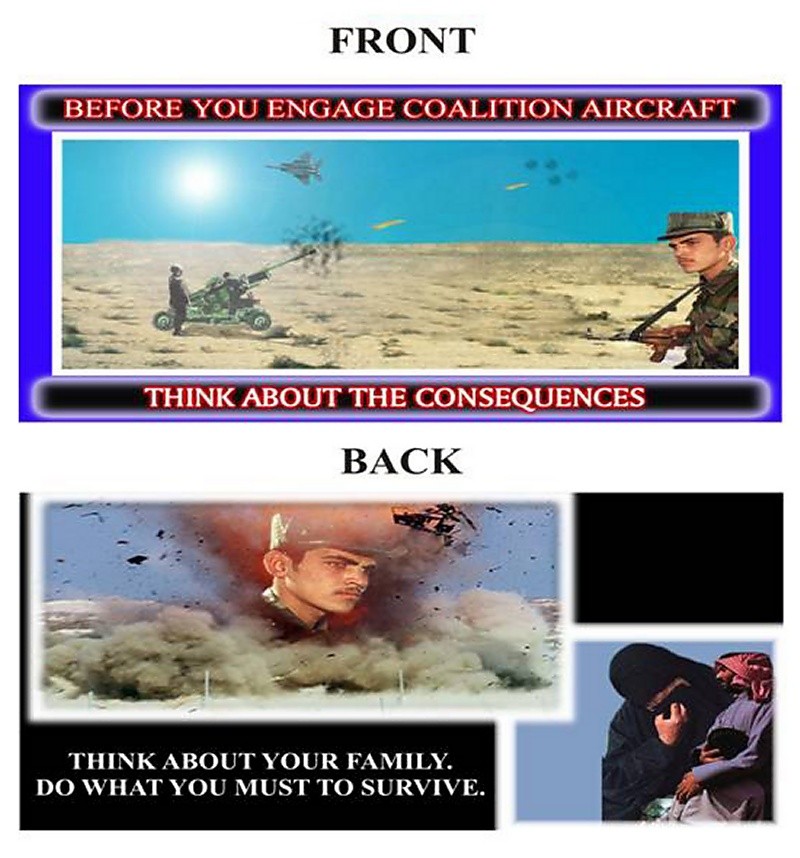
‘Shock and Awe’—the phrase is back in the headlines. As we have watched the bombs bursting onto Libya over the past two days, we cannot help but recall the ‘Shock and Awe’ bombing of Iraq eight years ago this week. The phrase that defined that assault was launched into popular usage in January 2003 with the pre-invasion tremors from America. Now, eight years later, the media is divided over whether we are witnessing another blast of ‘shock and awe’. Having lost much of its original meaning, the phrase has taken on two identities. When used by political-military pundits, it euphemistically suggests a quick and clean campaign to eliminate evil forces. When used by the general public, it has settled into a synonym for ‘wow’.
In their prologue to the 1996 report Shock and Awe: Achieving Rapid Dominance [1], Harlan Ullman and James Wade spoke of ‘a time when uncertainty about the future is perhaps one of the few givens’. Their solution? Control that future. America’s world supremacy in military power, coupled with its expanding technology industry, presented ‘an unusual opportunity’ to seize the power that had ‘tantalized and confounded’ war strategists throughout history: ‘destroying the adversary’s will to resist before, during, and after battle’.
As we now watch the global contest of wills playing out in the Middle East, it becomes painfully obvious that dominance, the end goal of ‘shock and awe’, will never be quick and clean. While the American stated objective of displacing Saddam Hussein was indeed met, eight years of angry and bloody chaos have darkened Iraq to an extent unforeseen in the sterile analyses of Ullman and Wade. And while the Americans cling to the strategic position they captured in Baghdad, the entire region has grown impassioned with resistance.
Now Syria?
Syriacomment‘s Joshua Landis on dramatic events in Syria:
Momentum is building for the opposition. The demonstrations are getting bigger with each day. They started out gathering between 100 to 300. Today’s demonstration was well over 1,000 in Deraa. The New York Times is reporting that 20,000 joined the funeral march in Deraa. The killing of four in Deraa is new. Many Syrians claim that this is the first time President Assad has drawn blood with the shooting of demonstrators. The Kurdish intifada of 2004 in the Jazeera ended with the death of many but that occurred following the successful constitutional referendum in Iraq and was blamed on external factors. To many Syrians, this time seems different.
Breaking Australia’s silence: WikiLeaks and freedom
‘Breaking Australia’s silence: WikiLeaks and freedom’ was a public forum held on 16 March 2011 at the Sydney Town Hall. The event was staged by the Sydney Peace Foundation, Amnesty, Stop the War Coalition, and supported by the City of Sydney.
Chaired by Mary Kostakidis, it featured speeches by John Pilger, Andrew Wilkie MP (the only serving Western intelligence officer to expose the truth about the Iraq invasion) and Julian Burnside QC, defender of universal human rights under the law.
Introducing Nafissa Assed
Our correspondent in Tripoli, who’s been sending us such stirring and terriying reports, is now safe in Morocco. She is finally able to renounce her anonymity. She wants me to tell you her name in capital letters, NAFISSA ASSED, daughter of a martyr, proud Libyan citizen. Read her self-description after the break.
 P U L S E