Infantile Leftism

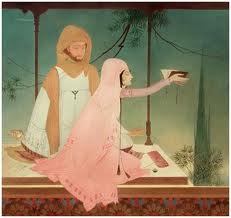
picture by Ali Farzat

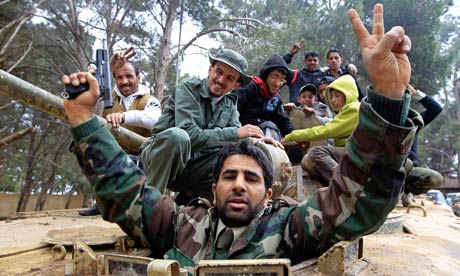
It certainly feels uncomfortable to watch American, British and French planes enforcing a no-fly zone over Libya, bombing Libya’s anti-aircraft defences and destroying Libyan tanks. Certainly the hypocrisy of the West and the Arab dictators is as galling as ever. There’s no chance of a no-fly zone over Palestine and Lebanon, nor over Saudi-occupied Bahrain. I can understand very well the fears of some that the West will overstay its welcome – although I think this is very unlikely indeed.

I am pleased, however, that the joint British-French-Lebanese (with Hizbullah in government in Lebanon) resolution for the no-fly zone has been adopted by the United Nations, that the massacres of the Libyan people may be minimised or stopped, that liberated Benghazi will probably not now fall to the tyrant.

If Britain, France and others are seeking influence in post-Qaddafi Libya by pleasing the Libyan people, that’s fine by me. Perhaps they fear their companies being banned from Libya as a punishment for supporting the dictator, and they are taking this opportunity to make amends. Again, fine. This is how things are done between strong, free countries which respect each other. It’s not the same as, for instance, Western powers arming and politically supporting the Saud family in return for military bases which are hated by the Saudi Arabian population.
Continue reading “Infantile Leftism”

A Tribe Called Libya

Our Tripolitanian witness is alive and well in an Arab country beyond Libya’s borders. Free to use the internet again, she has sent some old reports. This one is from March 7th.

Today is the 7th March 2011, one of the most horrible days that Libya has witnessed since the ‘Greatest Libyan Revolution’ began. Zawiya has seen the nastiest massacres. The city was attacked from 8 am until 9pm; in the morning there were over 1500 protestors in the city streets, and by the end of the day there was no one. Hundreds were brutally murdered by heavy machine guns, missiles, and tanks, others were seriously injured, and some were lucky enough to stay alive.

Continue reading “A Tribe Called Libya”

Tripolitanian Abnormality

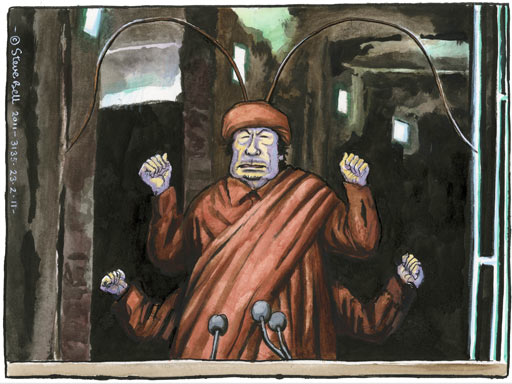
Steve Bell's Qaddafi

Our Tripolitanian witness is alive and well in an Arab country beyond Libya’s borders. Free to use the internet again, she has sent some old reports. The first is from early March.

Today I went out in my area, Ben Ashour, and all the shops were still closed in the main street. I stopped by the bakery for bread and I found a long line of people waiting; the bakery of my area gives each person a rationed number of loaves so each can have at least some bread by the end of the day. I also went to Fashloom, near my neighborhood, and I noticed a weird silence and only a few people walking in that area, the walls all clean of the anti-Qaddafi graffiti that had covered them earlier. I also noticed two cars belonging to Qaddafi’s thugs parked (and undoubtedly armed) in the corners of the tiny streets of Fashloom. Some thugs were dressed like civilians and yet I could tell who they were by their car. Others were wearing military outfits and standing alertly in front of their cars. A member of my family sadly confirmed to me that some families they know in Fashloom (and other areas) had buried their epic martyrs in the gardens of their houses, for they were scared the bodies would be taken away from them by Qaddafi’s thugs.

Continue reading “Tripolitanian Abnormality”

Gaddafi is the regime

Charles Glass has an excellent post on the London Review Blog, worth reproducing in full:

The Libyan dictator is resisting the popular forces ranged against him in ways that his counterparts in Tunisia and Egypt did not. In Tunis and Cairo, Zine Abedine Ben-Ali and Hosni Mubarak were the faces of military regimes. Colonel Muammar Gaddafi is not the face: he is the regime. The Egyptian and Tunisian army chiefs calculated that sacrificing their nominal commanders-in-chief would preserve their own positions without jeopardising the interests of their American benefactors. Playing the role of saviours of the nation, after years in which the officer class enriched itself and ordinary soldiers were made to repress dissent, the armies in Tunisia and Egypt emerged as arbiters of whatever order will follow the post-dictator era.

Since Gaddafi seized power in Libya with his co-conspirator Major Abdul Salam Jalloud in 1969, he has remade the military in his own image to enforce his rule. In this, he enjoyed the successive support of the CIA, the Soviet Union and the East German security services. In Egypt, the army had some legitimacy from the Nasser era, when a whole generation of junior officers (all of whom entered the army after its officer class was expanded beyond the pashas in the 1930s) supported the revolution of 1952. When Nasser died in 1970 and Sadat was assassinated in 1981, the army set ground rules for transition that preserved its position. Libya, since Gaddafi overthrew King Idris, has never faced a transition. Gaddafi is not contemplating one, which leaves his army no option but to retain him. If he goes, they are finished.

Continue reading “Gaddafi is the regime”

Srebrenica on the Mediterranean

Two days after Gaddafi promised that he’ll show ‘no mercy’, his troops are bombarding, some entering, Benghazi. The UN Security Council had passed a resolution declaring a no-fly zone over Libya. Thus far, the sky belongs to Gaddafi. There was a point where Gaddafi could have been thwarted, had his armoured columns been checked by the presence of hostile air power. No need to bomb them, just bomb the road ahead. Check their advance, send a message. Instead, the troops have been allowed to enter Benghazi. Now they cannot be attacked without inflicting high casualties on civilians. The UN forces will likely excuse themselves by claiming that tanks can’t be attacked because now they are in the city. Western forces are also reluctant because since 2003, Gaddafi has been a reliable economic parter and Libya has been a favoured destination for rendition flights. (Remember where Ibn al-Shaykh al-Libi died?)

The UN could still salvage the situation by threatening Gaddafi’s supply lines. But I fear we are about to see another Srebrenica. In that instance, the UN forces delayed intervention till the Serbs had encircled the enclave and then declined to intervene because they said it would put their own peacekeepers lives at risk. Meanwhile the slaughter continues.

Violence continues across Bahrain

Also see this article by Marc Lynch on the Bahraini government use of sectarianism as a counterinsurgency tool.

Bahrain’s largest opposition group has urged Saudi Arabia to withdraw its forces and called for a UN inquiry into the the government’s on-going crackdown.

Clashes between security forces and anti goverment protesters continue, spilling into villages across the country.

Our special correspondent, whom we are not naming for security reasons, filed this report.

Deadly crackdown in Yemen

Yemeni security forces have opened fire at a protest in the capital Sanaa, killing at least 30 people.

It is the highest death toll in a single day after weeks of demonstrations calling for Ali Abdullah Saleh, the Yemeni president, to stand down.

Witnesses say armed men opened fire from nearby buildings as protesters gathered in Sanaa’s University Square after Friday prayers

Al Jazeera’s Alan Fisher reports.

4. Ghazal from Ghalib

translated by M. Shahid Alam

Only a few come back to us in roses and tulips.
Many more lie buried, dust on their sleeping eyelids.

By day, the daughters of Pleiades play out of sight.
At night, they lift their veils in ravishing display.

My eyes pour blood on this night of savage partings:
two lamps I have lighted to sanctify love’s sorrow.

I will make them pay for the years of torment, if
by chance, these darlings play houris in paradise.

He shall have sleep, perfumed air, silken nights,
if you untie your jasmine-scented hair in his arms.

I have no use for your coy approaches to the divine.
Past your schools and creeds, we worship God alone.

If Ghalib were to keep this up (he cries inconsolably),
every man, woman, child will soon be leaving town.

first published in Prairie Schooner, Spring 2011

For more ghazals from Ghalib, click here.

M. Shahid Alam is professor of economics at Northeastern University. He is the author of Israeli Exceptionalism (Palgrave, 2009) and Challenging the New Orientalism (IPI, 2007). Visit his website at http://qreason.com. Write to him at alqalam02760@yahoo.com.