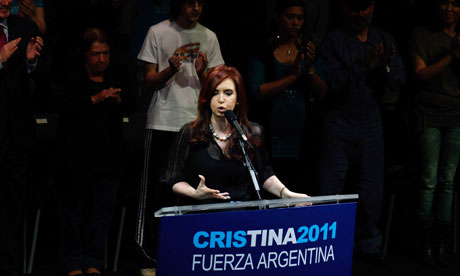
Cristina Kirchner and Argentina’s good fortune

(Photo: Marcos Brindicci, Reuters)

by Mark Weisbrot

This article was written for the Guardian’s Comment is free prior to Argentine President Cristina Fernández de Kirchner’s reelection yesterday.

Cristina Fernandez de Kirchner is expected to coast to re-election as president of Argentina on Sunday, despite having faced hostility from the media for most of her presidency, and from many of the most powerful economic interests in the country. So it seems a good time to ask why this might happen.

Yes, it’s the economy. Since Argentina defaulted on $95bn of international debt nine years ago and blew off the International Monetary Fund, the economy has done remarkably well. For the years 2002-2011, using the IMF‘s projections for the end of this year, Argentina has chalked up real GDP growth of about 94%. This is the fastest economic growth in the western hemisphere – about twice that of Brazil, for example, which has also improved enormously over past performance. Since President Fernandez or her late husband Nestor Kirchner, who preceded her as president, were running the country for eight of these nine years, it shouldn’t be surprising that voters will reward her with another term.

The benefits of growth don’t always trickle down, but in this case, the Argentine government has made sure that many did. Poverty and extreme poverty have been reduced by about two thirds since their peak in 2002, and employment has increased to record levels. Social spending by the government has nearly tripled in real terms. In 2009, the government implemented a cash transfer program for children that now reaches the households of more than 3.5 million children. It is probably the largest such program, relative to national income, in Latin America.

Continue reading “Cristina Kirchner and Argentina’s good fortune”

Cornel West on the Drone war

Cornel West speaks about inequality, injustice and America’s policy of routine extrajudicial killing.


A World United for Human Rights

by William A. Cook

“ … disregard and contempt for human rights have resulted in barbarous acts which have outraged the conscience of mankind, and the advent of a world in which human beings shall enjoy freedom of speech and belief and freedom from fear and want has been proclaimed as the highest aspiration of the common people …” — United Nations Universal Declaration of Human Rights.

Today the American people, in concert with their brothers and sisters around the world, proclaim the rights to which they are entitled by birth and citizenship, by Constitutional law and Proclamation, and by membership in the collective body of nations that has universalized recognition of these rights for all humanity. And today, in cities and hamlets across this nation, and in many nations around the world, people gather in peace to demand of their governments recognition of these rights that have been abrogated by the few and denied to many.
Citizens no longer control their government; they are slaves to it. Representatives no longer serve the citizen seeking their consent to govern, they are servants of the corporations and lobbies that control the economic system to which the citizen is enslaved. Presidents no longer lead, they are the obedient lackeys of their corporate overseers. Freedom of speech and belief and freedom from fear and want do not determine the needs of humans, economics of the market place supersedes all at the expense of the citizen and human rights. We exist in a corporate world of unending wars, of vengeance and recrimination, of fear as a commodity that imprisons the mind, of greed that destroys the resources of this planet without remorse, and of insatiable arrogance that harbors no concern for those it destroys.

Continue reading “A World United for Human Rights”

Freefall: Free Markets and the Sinking of the Global Economy

Award-winning economist, Joseph Stiglitz, author of Freefall: Free Markets and the Sinking of the Global Economy, lays out not only the course of the financial crisis which began in 2007, but its underlying causes, and shows why much more radical reforms are needed than are currently being contemplated if we are to avoid similar ‘systemic’ crises in the future. Showing why the bailout has been only marginally effective and how it could have been much more so, and outlines the enormous opportunity – not yet taken – to design a new global financial architecture.

The Wrong Occupation

by Kathy Kelly

October 20, 2011

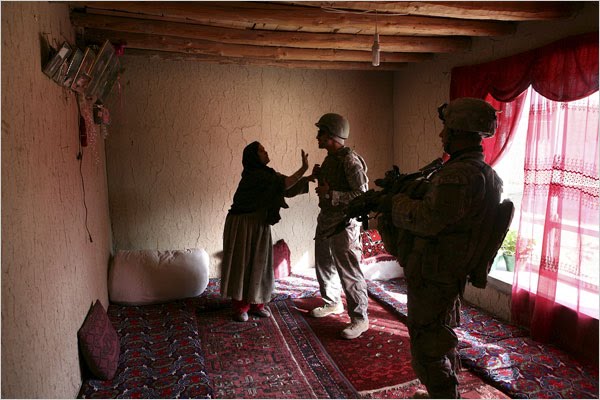
In Kabul, Afghanistan’s beleaguered capitol city, a young woman befriended me during December of 2010.  She was eager to talk about her views, help us better understand the history of her country, and form lasting relationships.  Now, she is too frightened to return a phone call from visiting westerners.  The last time I saw her, during the spring of 2011, she was extremely anxious because, weeks earlier, U.S. Joint Special Operations Commandos (JSOC) had arrested her brother-in-law. The family has no idea how to find him. Once, someone working for the International Commission of the Red Cross called the family to say that he was still alive and in the custody of the International Security Assistance Forces, (ISAF).  Numerous families in Afghanistan experience similar misery and fear after night raids that effectively “disappear” family members who are held incommunicado and sometimes turned over to Afghan National Police or the dreaded National Directorate of Security, (NDS).

An October 22, 2011 New York Times report about the findings of UN researchers who interviewed 324 Afghans detained by security forces, found that half of those who were in detention sites run by the NDS told of torture which included beatings, twisting of genitals, stress positions, suspension, and threatened sexual assault.  Of the 324 interviewed, 89 had been handed over to the Afghan intelligence service or the police by U.S./NATO international military forces.

Even though high commanders in the ranks of the U.S. JSOC acknowledge that 50% of the time the night raids and drone attacks “get” the wrong person, (Washington Post, September 3, 2011), the U.S. war planners have steadily escalated reliance on these tactics.

Consider the killing of three brothers in the Nemati family who lived in the Sayyidabad village in Afghanistan’s Wardak province.  Ismail, age 25, and Buranullah, age 23, had returned from their studies in Kabul to celebrate the start of Ramadan with their family in August of 2010. With their brother Faridullah, age 17, they went to the family guest room to study for exams.  They were joined by their younger brother, Wahidullah, age 13.

An initial U.S. military press release on August 12th, 2010, indicated that U.S. forces had captured an important Taliban figure nearby and had taken fire from the Nemati home where they believed Taliban fighters were being hosted as guests. Indeed, two Taliban fighters had stopped at the home two days earlier, asking for food.  Fearful of repercussions if they didn’t feed them, the family had given them food.

Continue reading “The Wrong Occupation”

Brzezinski on wealth inequality and the need for transparency

Smart analysis from one of Washington’s leading cassandras. Brzezinski opposed the Iraq war, has been warning against any confrontation with Iran, and has denounced the grotesque inequalities that beset the unregulated US economy.

Obama and the measure of Lincoln

In yet another insightful interview with Radio Open Source, Yale professor David Bromich analyzes the political failings of the US president Barack Obama. He observes:

David Bromwich

At a time of crisis you hope for something more than proficiency of maneuver. You hope for consistency of explanation and the kind of reassurance that can come to people in a democracy from actually learning from somebody who is leading them where they are headed. … It’s not beyond a capable president actually to give a lesson in history. What real leadership comes from is finding the principle and the action that goes with it on which people could agree though they don’t yet realize that they would agree, what they most care about it even though it hasn’t yet found words, what their longterm interests, not their present opinions are… [Leadership comes from] deciding what the commitments are, standing to them, and then repeating, phrase by phrase and precept by precept, what it is you believe and how B follows A and C follows B.

The Great Financial Crisis: Causes and Consequences

The following is a lecture by John Bellamy Foster, Editor of Monthly Review and Co-Author (with Fred Magdoff) of The Great Financial Crisis: Causes and Consequences.

[youtube  http://www.youtube.com/watch?v=zI6M0UBNDV4%5D

Why I “Assaulted” Defense Chief Leon Panetta

by 
Alli McCracken 

Alli McCracken being arrested by the police for protesting at the Congressional hearing

“Assault? Who — or what — did I assault?” I asked the police officer incredulously as I sat in his office at the police station, handcuffed to the wall. “Well, looks like it was Leon Panetta himself,” the officer responded as he flipped through a pile of paperwork.

Me? A 22-year-old mild-mannered peace activist, assaulted the Secretary of Defense? I had simply tried to tell him how I felt about the wars. 

On the morning of October 13th about 25 activists who are occupying Washington DC, as part of the nationwide occupations, went on a field trip to Congress. We wanted to attend the House Armed Services Committee hearing where Leon Panetta, the Secretary of Defense, and Martin Dempsy, Chairman of the Joint Chiefs of Staff, were testifying about “lessons learned by the Department of Defense over the preceding decade” and “how those lessons might be applied in the future in light of anticipated reductions in defense spending.” After all, these hearings are open to the public. And shouldn’t we have a say in where our money is being spent?

As a peace activist with the group CODEPINK for the past 10 months, I have done my fair share of sending letters and emails and delivering petitions to our government representatives, asking them to stop pouring trillions of our taxpayer dollars into the endless cycle of death, destruction and reconstruction halfway across the world. There are so many critical things that we could spend that money on here in America, such as education, healthcare, helping the homeless, the elderly, the disabled, the veterans.

Continue reading “Why I “Assaulted” Defense Chief Leon Panetta”

Whatever Happened to Women and Children First?

by Johnny Barber

“All wars, whether just or unjust, disastrous or victorious, are waged against the child.” — Eglantyne Jebb, founder of Save the Children, 1919.

In Kabul, the children are everywhere. You see them scrounging through trash. You see them doing manual labor in the auto body shops, the butchers, and the construction sites. They carry teapots and glasses from shop to shop. You see them moving through the snarled traffic swirling small pots of pungent incense, warding off evil spirits and trying to collect small change. They can be found sleeping in doorways or in the rubble of destroyed buildings. It is estimated that 70,000 children live on the streets of Kabul.

The big news story on CNN this morning is the excitement generated as hundreds of people line up to buy the newest iphone. I can’t stop thinking of the children sitting in the dirt of the refugee camp, or running down the path pushing old bicycle tires, or the young boy sitting next to his overflowing sacks of collected detritus. He has a deep infection on the corner of his mouth that looks terribly infected. These images contrast with an image of an old grandfather, dressed in a spotless all white shalwar kameez squatting on the sidewalk outside a huge iron gate, embracing his beautiful young grand daughter in a huge hug, each smiling broadly, one of the few moments of joy I have witnessed on the streets of Kabul.

In Afghanistan, one in five children die before their 5th birthday, (41% of the deaths occur in the first month of life). For the children who make it past the first month, many perish due to preventable and highly treatable conditions including diarrhea and pneumonia. Malnourishment affects 39% of the children, compared to 25% at the start of the U.S. invasion. 52% don’t have access to clean water. 94% of births are not registered. The children are afforded very little legal protection, especially girls, who are stilled banned from schools in many regions, used as collateral to settle debts, and married through arranged marriages as young as 10 years old. Though not currently an issue, HIV/AIDS looms as a catastrophic possibility as drug addiction increases significantly, even among women and children. Only 16% of women use modern contraception, and children on the streets are vulnerable to sexual exploitation. This is why the “State of the World’s Mothers” report issued in May 2011 by Save the Children ranked Afghanistan last, with only Somalia providing worse outcomes for their children.

Continue reading “Whatever Happened to Women and Children First?”