Pakistan and the Global War on Terror: An Interview with Tariq Ali

by Mara Ahmed, with Judy Bello

Tariq Ali and Mara Ahmad at Hamilton College, NY.

Mara Ahmed and I were given the opportunity to interview Tariq Ali when he spoke at Hamilton College in Upstate New York on November 11, 2009, during his recent speaking tour of the United States. Tariq, a native of Pakistan who lives in England, is a well known writer, intellectual and activist. He has traveled all over Southwest Asia and the Middle East while researching his books. Mara, who is working on a film highlighting the opinions of the Pakistani people regarding the current situation in Pakistan and the Western initiated ‘Global War on Terror’, had a lot of questions for Tariq about the internal state of Pakistan. I wanted to ask Tariq for his opinion about the effects of American foreign policy in Afghanistan and Pakistan, and what alternatives he thought might be available.

Mara: What is the role of Islamophobia in the Global War on Terror? Many American war veterans have described the wars in Iraq and Afghanistan as imperialistic, racist and genocidal. Your comments?

Tariq: Well, I think Islamophobia plays an important part in things, because it creates an atmosphere in which people feel, “Oh, we’re just killing Muslims, so that’s alright.” And this situation is becoming quite serious in the United States and in large parts of Europe, where people feel that the fact that a million Iraqis have died is fine because they’re not like us, they’re Muslims. So, Islamophobia is becoming a very poisonous and dangerous ideological construct which has to be fought against.

Continue reading “Pakistan and the Global War on Terror: An Interview with Tariq Ali”
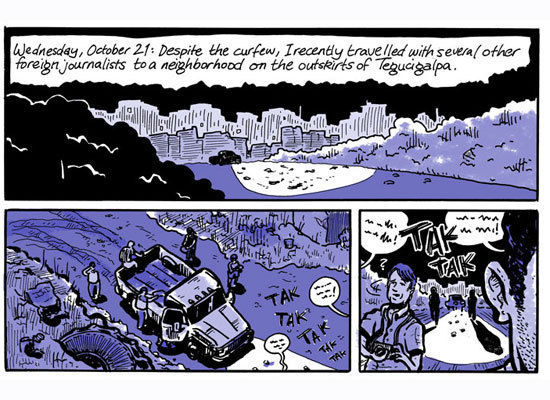
The Honduran Coup: A Graphic History

Media creativity in the aftermath of the 28 June coup against Honduran President Mel Zelaya has generally been limited to such things as CNN’s classification of the military coup as “military-led,” Honduran media classification of tomorrow’s illegitimate elections as a “fiesta cívica,” and the publication of articles in mainstream Honduran newspapers with titles like “Zelayista Guerrillas Train in Nicaragua.” This particular article, published by El Heraldo on 2 August, is accompanied by a photograph of a ragtag group of joggers—some of them barefoot, one in a cowboy hat, and one in all pink—and bears a caption announcing that “Manuel Zelaya’s followers have begun military exercises in fields in Nicaragua.”

More substantive creative endeavors have been undertaken by Dan Archer and Nikil Saval, who have put together a graphic history of the Honduran coup in two parts thus far. The latter part is based on Joseph Shansky’s piece “Smashing the Silence: Community Defiance in Honduras,” first published on PULSE, and can be viewed below (note: all annotations appear in the original version). The first part of the graphic history can additionally be viewed here, and information on other projects can be found on Archer’s website.

Continue reading “The Honduran Coup: A Graphic History”

Bay Area Premier of “My Name is Rachel Corrie”

by Charlotte Silver

On November 19, 2009, My Name is Rachel Corrie made its Bay Area premier at Stanford University.  Amanda Gelender, senior at Stanford University, produced a staged reading of the play as a part of her senior thesis at Stanford University. Amanda is my friend. She was also my college classmate and we worked together in several campus political organizations, including the student-led Israel divestment campaign.

I attended opening night and along with a sold-out audience was struck by the poignancy of the play and Amanda’s subtle and deeply moving performance. Rachel Corrie was a 23 year-old American woman who traveled to Gaza in 2003 during the Second Intifada. She was killed by a Caterpillar bulldozer driven by Israeli Defense Forces as she attempted to prevent the IDF from demolishing the home of a Palestinian family. My Name is Rachel Corrie consists entirely of words written by Corrie herself, recorded in diary entries and emails from Rachel’s early childhood until a few days before her death. Gelender breathes vivid life into Rachel’s words, which themselves reveal the keen sensitivity and eloquence of a poetic nature.

Amanda Gelender, the lead and visionary behind this production, had been waiting to obtain the rights for the play for nearly two years. But obtaining rights is not always the only hurdle to securing a production of Rachel. Since its London premier in 2005, several professional American and Canadian theaters have seen their efforts to mount a production of this one-woman show quashed by vigorous opposition from powerful forces.  The charge is always the same: the play is anti-Semitic. Gelender’s successful production reflects the changing tide that is occurring within the American public’s relationship to Israel and anti-Semitism.

Continue reading “Bay Area Premier of “My Name is Rachel Corrie””

The Pervert’s Guide To Cinema

You’ve got to hand it to Slovenian philosopher Slavoj Žižek. Who else could conceivably get away with saying something like “My gott, I’m tinking like Melahnie. You know what I’m tinking, now? I want to fack Mitch! No, shorry, shorry…I got dish … shpontaneoush confushion of direcshins”?!  Here’s a clip from his psychoanalytical and film criticism foray  into the cinematic canon entitled The Pervert’s Guide To Cinema.

Clip

Continue reading “The Pervert’s Guide To Cinema”

George Galloway at the War Crimes Conference

The inimitable George Galloway addresses the War Crimes Conference in Kuala Lumpur Malaysia on 28th October 2009. In three parts.

Part One

Continue reading “George Galloway at the War Crimes Conference”

Obama’s war in Afghanistan

Fault Lines brings together a panel of guests and a studio audience to discuss Obama’s war in Afghanistan. Hosted by Avi Lewis. Excellent interventions from Jeremy Scahill and Matthew Hoh.

Part two …

Continue reading “Obama’s war in Afghanistan”

Kathy Kelly on the cost of war abroad and at home

The wonderful Kathy Kelly gives an excellent, compelling presentation on the costs, monstrosities and sorrows of war at the First Presbyterian Church in Binghamton, NY.  She importantly provides the view on the ground from the perspective of Pakistani, Afghani and Palestinian villagers at the receiving end of hellish drones and shares her experiences in Gaza and Pakistan.

Two highly recommended clips — and if you have any “progressive” friends who breezily defend Obama’s being awarded the Nobel Peace Prize, please draw their attention to these videos and to an example of a two-time NPP nominee whose work would actually merit such recognition.

Kathy Kelly co-coordinates Voices for Creative Nonviolence, a campaign to end U.S. military and economic warfare, and co-founded Voices in the Wilderness, a group which had openly defied economic sanctions from 1996-2003 by bringing medicines to children and families in Iraq.

In two parts over the jump (courtesy Essential Dissent, h/t Tom Feeley –ICH)

Continue reading “Kathy Kelly on the cost of war abroad and at home”

Life in Hell: A Journalist’s Account of Life in Gaza – Mohammed Omer

In a recent presentation to the Palestine Center in DC, the courageous and talented Mohammed Omer interviews fellow Palestinians in Gaza trying to survive the crippling blockade. Continue reading “Life in Hell: A Journalist’s Account of Life in Gaza – Mohammed Omer”

Warlord as Nobel Laureate

from Mother Jones magazine

by William Blum

“It is forbidden to kill; therefore all murderers are punished unless they kill in large numbers and to the sound of trumpets.” — Voltaire

Question: How many countries do you have to be at war with to be disqualified from receiving the Nobel Peace Prize?

Answer: Five. Barack Obama has waged war against only Pakistan, Afghanistan, Iraq and Somalia. He’s holding off on Iran until he actually gets the prize.

Somalian civil society and court system are so devastated from decades of war that one wouldn’t expect its citizens to have the means to raise serious legal challenges to Washington’s apparent belief that it can drop bombs on that sad land whenever it appears to serve the empire’s needs. But a group of Pakistanis, calling themselves “Lawyers Front for Defense of the Constitution”, and remembering just enough of their country’s more civilized past, has filed suit before the nation’s High Court to make the federal government stop American drone attacks on countless innocent civilians. The group declared that a Pakistan Army spokesman claimed to have the capability to shoot down the drones, but the government had made a policy decision not to. (1)

Continue reading “Warlord as Nobel Laureate”

Saree Makdisi on the Goldstone Report

Saree Makdisi
Saree Makdisi

Phillip Adams speaks to the nephew of the late Edward Said, Professor Saree Makdisi, who will give the 2009 Edward Said Memorial Lecture in Adelaide. Professor Makdisi talks about the latest UN findings of war crimes in Gaza; what he describes as the bureaucratic occupation of the Palestinian territories; and his reasons for supporting a one-state solution. (thanks Michael)

Makdisi is Professor of English Literature at the University of California, Los Angeles; Edward Said Memorial Lecturer for 2009, and the author of Palestine Inside Out: Everyday Occupation (John Wiley, 2008)

See also
A Museum of Intolerance in Jerusalem for an excellent address by Saree Makdisi on the so-called Museum of Tolerance in Jerusalem.