Norman Mailer and Marshall McLuhan expound on violence, alienation and the electronic envelope. The clash of two great minds. (1968)
Author: alannahpriestley
Six Years After Katrina, The Battle for New Orleans Continues
by Jordan Flaherty
This article was published on The Root.
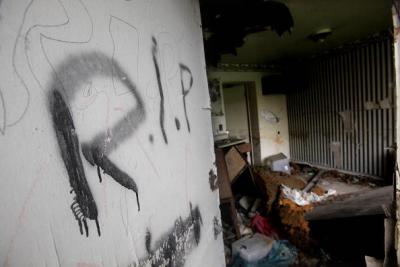
As this weekend’s storm has reminded us, hurricanes can be a threat to U.S. cities on the East Coast as well as the Gulf. But the vast changes that have taken place in New Orleans since Katrina have had little to do with weather, and everything to do with political struggles.
Six years after the federal levees failed and 80 percent of the city was flooded, New Orleans has lost 80,000 jobs and 110,000 residents. It is a whiter and wealthier city, with tourist areas well-maintained while communities like the Lower 9th Ward remain devastated. Beyond the statistics, it is still a much-contested city.
Politics continue to shape how the changes to New Orleans are viewed. For some, the city is a crime scene of corporate profiteering and the mass displacement of African Americans and the working poor; for others it’s an example of bold public-sector reforms, taken in the aftermath of a natural disaster, that have led the way for other cities.
Continue reading “Six Years After Katrina, The Battle for New Orleans Continues”
No Way to Honor Dr. King
by Medea Benjamin
 The ceremonies for the new Martin Luther King Jr. Memorial in Washington DC were kicked off on August 24 at an event billed as Honoring Global Leaders for Peace. But some of those honored are a far cry from King’s beloved community of the poor and oppressed. The tribute to peacemakers, organized by the MLK National Memorial Foundation, was mostly a night applauding warmakers, corporate profiteers and co-opted musicians.
The night started out with great promise when MC Andrea Mitchell mentioned Dr. King’s brilliant anti-war speech Beyond Vietnam as a key to understanding the real Dr. King. And sure, there were a few wonderful moments—a song by Stevie Wonder, a speech about nonviolence by the South African Ambassador and a quick appearance by Jesse Jackson in which he managed to spit out a call to “study war no more.”
But most of the evening’s speakers and guests of honor had little to do with peacemaking. One of the dignitaries thanked at the start of the program was Israeli Ambassador Michael Oren, representing a country that uses $3 billion a year in precious U.S. tax dollars to commit war crimes against Palestinians.
Then came a parade of representatives of corporations that want to cleanse their image by being associated with Dr. King. The first was General Motors VP Eric Peterson. His company took billions from government coffers to keep it afloat, then showed its “generosity” by donating $10 million of our tax dollars to the memorial. Mr. Peterson gave a speech paying tribute to the company’s first black board member, Rev. Leon Sullivan. Peterson claimed that the Sullivan Principles, principles that established a social responsibility code for companies working in South Africa, helped abolish apartheid. The truth is that the Sullivan Principles ended up being a cover for U.S. corporations—like General Motors–to continue doing business in racist South Africa instead of respecting the international divestment campaign.
The Andean Connection: Tracking the Drug War’s Coca Leaves and Failed Policies

by Benjamin Dangl
This article first appeared in The Indypendent.
Cocaine, the drug fueling the trade that’s left thousands dead in Mexico and Central America since 2007 and which 1.4 million Americans are addicted to, originates with two species of the coca plant grown in the South American Andes. Ninety percent of the U.S. market for cocaine is fed by Colombia, with the rest largely provided by Peru and Bolivia.
An estimated 310 to 350 tons of refined cocaine were trafficked out of Colombia last year, enough to make a rail of nose candy that would encircle the earth twice. Along with exporting cocaine northward, Colombia has become a laboratory for failed drug war policies that are finding their way to Central America and Mexico.
In July 2000 President Bill Clinton signed Plan Colombia (see note following article for more information) into law, initiating the anti-drug-producing and trafficking operation that has cost U.S. taxpayers more than $7.3 billion to date. U.S. military bases have been established in Colombia under the plan, as have extensive air patrols, pesticide spraying and surveillance. Because of the violence, some 2.5 million Colombians have been displaced.
“The lessons of Colombia are being ignored in many ways. You’ll have mainstream analysts saying Colombia is the model to win the drug war. If Colombia is winning then what are the Colombians trafficking?” drug war expert Sanho Tree, a fellow of the Institute for Policy Studies in Washington, D.C., told The Indypendent.
Continue reading “The Andean Connection: Tracking the Drug War’s Coca Leaves and Failed Policies”
Staying in Afghanistan
by Ross Eventon
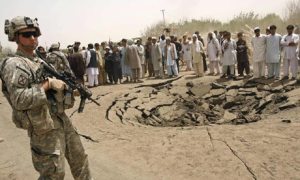
Reports that the US is determined to maintain a presence in Afghanistan will surprise no one except 99% of foreign policy analysts. Responding to the announcement that the US is in negotiations to maintain a presence until 2024, Mahdi Hassan, senior editor at the New Statesman, writes “the US-led invasions and occupations of both countries have been a dismal failure” because “the presence of western troops in Muslim lands has provoked more terrorism than it has prevented.”
Regardless, Obama escalated the conflict on coming to office. Citing research that outlines the primary goal of suicide terrorism is to end foreign military occupations, Hassan asks, “Why does an intelligent politician such as Barack Obama have such difficulty understanding this?”
The Afghan and Iraq invasions were launched on the expectation they would increase the terrorist threat to domestic populations, as they duly did. It is a remarkable example of extreme naivety or intellectual subservience that claims the US is concerned with reducing terror not be met with widespread ridicule.
As Julien Mercille, a lecturer at University College Dublin, points out in the journal Critical Asian Studies, the War on Drugs is equally vacuous.
The significance of taking Tripoli
Marwan Bishara talks about the significance of the rebels’s seizing Gaddafi’s compound in the Libyan capital.
Political Fear
Sasha Lilley of the highly erudite Against the Grain interviews Corey Robin, author of the brilliant Fear: The History of A Political Idea. Also check out Robin’s superb essay on Hannah Arendt, and his commentary on Barack Obama’s recent capitulation on the debt deal.
Fear dominates our society. Fear of crime, fear of the poor, fear of foreign terrorists, to which we might add fear of our government and fear of our bosses. For some liberal thinkers, fear serves a purpose. It’s supposed to pull us all together so we can find some kind of social solidarity in an atomized, alienated world. Corey Robin discusses the problems with that notion and talks about the places where fear truly lurks in our society.
Why Is the Military Spending Millions on Christian Contractors Bent on Evangelizing US Soldiers?
 Chris Rodda writes at AlterNet:
When the average American thinks of military spending on religion, they probably think only of the money spent on chaplains and chapels. And, yes, the Department of Defense (DoD) does spend a hell of a lot of money on these basic religious accommodations to provide our troops with the opportunity to exercise their religion while serving our country. But that’s just the tip of the iceberg when it comes to the DoD’s funding of religion. Also paid for with taxpayer dollars are a plethora of events, programs, and schemes that violate not only the Constitution, but, in many cases, the regulations on federal government contractors, specifically the regulation prohibiting federal government contractors receiving over $10,000 in contracts a year from discriminating based on religion in their hiring practices.
About a year ago, the Military Religious Freedom Foundation (MRFF) began an investigation into just how much money the DoD spends on promoting religion to military personnel and their families. What prompted this interest in DoD spending on religion was finding out what the DoD was spending on certain individual events and programs, such as the $125 million spent on the Army’s Comprehensive Soldier Fitness program and its controversial “Spiritual Fitness” test, a mandatory test that must be taken by all soldiers. The Army insists that this test is not religious, but the countless complaints from soldiers who have failed this “fitness” test tell a different story. The experience of one group of soldiers who weren’t “spiritual” enough for the Army can be read here. But the term “Spiritual Fitness is not limited to this one test. The military began using this term to describe a variety of initiatives and events towards the end of 2006, and this `code phrase’ for promoting religion was heavily in use by all branches of the military by 2007.
The Nisoor Square Shootings: an interactive comic by Dan Archer
 Following the 2009 coup in Honduras, comics journalist Dan Archer embarked on a three-part graphic history of the event, which we posted at PULSE.
Archer has recently put together an interactive comic on the subject of the 2007 Nisoor Square Shootings in Baghdad, for which he provides the following background:
“In late 2007, 17 Iraqi civilians were killed and at least 24 wounded after a convoy of Blackwater (the US military contractor) vehicles opened fire in Nisoor square, claiming their convoy had come under attack.
Charges were brought against the men, but subsequently—and controversially—dismissed. The case was re-opened in January 2011.”
Visit the Cartoon Movement website to view more background in comic form and for simple instructions on participating in Archer’s interactive timeline of the event—an innovative creation that incorporates various eyewitness testimony as well as other reports.
Click here to visit Archer’s website.
T.R.I.A.G.E.
John Butler, the genius behind The Ethical Governor, brings you T.R.I.A.G.E.
A sick and failing area is swiftly restored to sound financial health.
 P U L S E