Iran’s “Soft Power” Increasingly Checks US Power

by Flynt Leverett and Hillary Mann Leverett
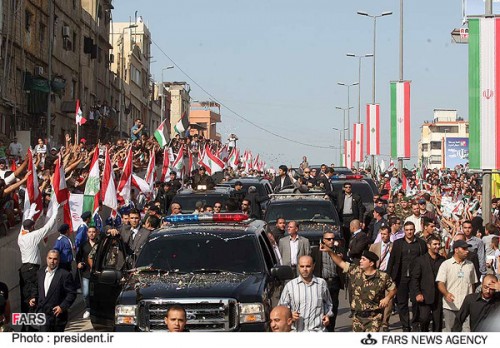
President Ahmadinejad greets cheering supporters in Beirut from an open motorcade.

Twenty years ago, Harvard’s Joseph Nye famously coined the term “soft power” to describe what he saw as an increasingly important factor in international politics—the capacity of “getting others to want what you want”, which he contrasted with the ability to coerce others through the exercise of “hard” military and/or economic power.  The question of soft power, when it comes to Iran, is contentious.  Most analysts seem prepared to acknowledge that the Islamic Republic’s soft power in the Middle East rose significantly in the first several years of this decade.  But many Western analysts now argue that Tehran’s regional soft power has declined over the last couple of years, following the election of Barack Obama as President of the United States, the fallout from the Islamic Republic’s June 2009 presidential election, and the imposition of new sanctions against Iran over its nuclear activities.

Others—including the two of us—argue that Iranian soft power remains strategically significant and is perhaps even still growing.  In this regard, we are struck by two developments today.  First, Iranian President Mahmoud Ahmadinejad traveled to Beirut—the first visit by an Iranian president to the Lebanese capital since President Mohammad Khatami went there in 2003.  Although White House spokesman Robert Gibbs said the visit demonstrated that Ahmadinejad was continuing his “provocative ways” and that Hizballah “values its allegiance to Iran over its allegiance to Lebanon”, the Iranian president received what the Christian Science Monitor’s Nicholas Blanford described as a “rapturous” welcome from tens of thousands of Lebanese who turned out to greet him on his drive into Beirut from the airport.  We include photographs of Ahmadinejad’s reception in Beirut today at the end of our text below.

During his trip to Lebanon, Ahmadinejad is scheduled to visit Dahiya, a heavily Shi’a southern suburb of Beirut, and tour southern Lebanon.  We would anticipate strongly positive and enthusiastic reactions from populations in both settings.  As Rami Khouri aptly put it today, see here, in The Daily Star,

If Ahmadinejad, as planned, goes to south Lebanon and visits Hizbullah-controlled villages near the Israeli border, we should expect political emotions to go through th roof in both the pro-Iranian and anti-Iranian camps.  This will not be a surprise, because Ahmadinejad overlooking the northern border of Israel in the company of his Hizbullah allies is a nightmare for most Israelis and many of their friends in the West, while for Hizbullah and its allies in the region this would be a prize-winning moment of defiance to be savored for a long time.

We do not believe that any Western leader—or even any Arab leader—could travel to Beirut today and move about in an open motorcade, as Ahmadinejad did, let alone do so and attract crowds of tens of thousands of eager well-wishers.  Security concerns alone would preclude such a scenario.  And this is the reality even though the United States and its European and Arab allies have put significant sums of money and political capital into trying to consolidate a “pro-Western” political order in Lebanon.

Continue reading “Iran’s “Soft Power” Increasingly Checks US Power”
But the Coffins Do Come In

by Mohammed Omer

IPS — GAZA CITY, Oct 13, 2010 – Samir Tahseen Al-Nadeem died after waiting 35 days for an exit permit for treatment for his heart condition. He was 26. The medicines he needed could not get in. But the coffins do.

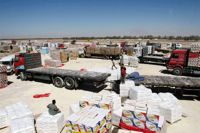
Goods waiting for months to be transferred to the Gaza Strip at the Israeli-controlled Karni crossing. (Photo: Mohammed Omer)

The health ministry now lists 375 deaths due to shortage of life-saving medicines. The medicines sit just outside the borders of the territory until most pass their expiry dates. But there are no expiry dates on about 10,000 coffins that have been donated for Gaza. The coffins do make it to those that eventually need them.

By the end of last month more than 70 percent of medicines donated for Gaza had been dumped because they were past their expiry date, the health ministry says. They were worth many millions of dollars. And they were worth many lives.

“Much of the donated medicines came from Arab states,” Dr Mounir Al- Boursh, director of the pharmaceutical department at the health ministry tells IPS. This added up to 10,300 tonnes of medicines worth 25 million dollars, he said.

Only about 30 percent of this could be used, he said; the rest either expired, or was inaccessible because of restricted distribution by the Israelis, who control what gets into Gaza.

It’s not easy to dump medicines safely either. Much of unused supply mixes with domestic waste, creating health hazards far from bringing relief. The World Health Organisation has had to “raise concern about the unsafe disposal of expired medication and other medical disposable material,” WHO spokesperson told IPS.

But the Gaza ministry has received 10,000 coffins, about 1,000 of them for children, Dr Boursh said. Such help, he said, “does not meet with the needs of the Gaza Strip.”

Continue reading “But the Coffins Do Come In”

Palestine liberation recalls anti-apartheid tactics, responsibilities and controversies

by Patrick Bondhttps://i0.wp.com/sabbah.biz/mt/wp-content/uploads/2007/04/4_9Mirror_on_Apartheid_Wall.jpg

On a full-day drive through the Jordan Valley late last month, we skirted the earth’s oldest city and the lowest inhabited point, 400 meters below sea level. For 10,000 years, people have lived along the river separating the present-day West Bank and Jordan.

Since 1967 the river has been augmented by Palestinian blood, sweat and tears, ending in the Dead Sea, from which no water flows out, it only evaporates. Conditions degenerated during Israel’s land-grab, when from a peak of more than 300,000 people living on the west side of the river, displacements shoved Palestinian refugees across to Jordan and other parts of the West Bank. The valley has fewer than 60,000 Palestinians today.

But they’re hanging in. “To exist is to resist,” insisted Fathi Ikdeirat, the Save the Jordan Valley network’s most visible advocate (and compiler of an exquisite new book of the same name). At top speed on the bumpy dirt roads, Ikdeirat maneuvered between Israeli checkpoints, through Bedouin outposts in the dusty semi-desert, where oppressed communities eke out a living from the dry soils.

Continue reading “Palestine liberation recalls anti-apartheid tactics, responsibilities and controversies”

Looting the Holy Land

Since 1967 countless artifacts have been unearthed and removed from the occupied West Bank and Gaza Strip. Many are displayed in Israeli museums and private collections, while others are sold to tourists. Al Jazeera searches through the evidence, unearthing the facts and exposing a power struggle in which every stone has meaning.

More Afghan Casualties of War in Laghman Province

On September 25 the NATO-led International Security Assistance Force (ISAF) claimed that they had killed at least 30 “insurgents” in Afghanistan’s eastern Laghman province with an air and ground assault. After widespread reports from villagers that the “insurgents” were actually civilians, consequent investigations are expected to reveal that the villagers were telling the truth.

Jewish activists confront the JNF

The JNF according to historian Ilan Pappe is Israel’s main agency of ethnic cleansing. For nearly a decade the Scottish Palestine Solidarity Campaign has been waging a lonesome fight against this pernicious outfit which, outrageously, enjoys tax-exempt charitable status in many Western countries. Now it is being confronted by some great Jewish activists both in the UK and the US. This latest protest took place in Atlanta where some activists were physically abused after trying to disrupt the JNF event. They deserve our support and encouragement. (via Mondoweiss)

For more on the JNF see the SPSC’s invaluable e-book.

FDA Prepares to Unleash Genetically Engineered Salmon on World

by Ken Kelley

GE salmon vs. Atlantic salmon (Photo: AP)

The U.S. Food and Drug Administration (FDA) is now reviewing a proposal by a Massachusetts company, AquaBounty Technologies, to sell genetically engineered salmon, which grow twice as fast as wild fish.   If approved, it would be the first transgenic animal to be allowed into the human food supply.

The fish, called AquAdvantage Salmon, were developed at AquaBounty’s hatchery in Prince Edward Island, Canada.  They are Atlantic salmon with an added growth hormone from the faster growing Chinook salmon. Engineers additionally inserted a gene from an eel-like fish called the ocean pout into the salmon, which activates the growth hormone and keeps the fish growing all year long.

Continue reading “FDA Prepares to Unleash Genetically Engineered Salmon on World”

Guinea pig nation: Pharmas use people as drug test fodder in India?

Remember The Constant Gardener? John le Carre’s superb novel, later filmed by Fernando Meirelles, was about Western pharmaceutical giants using Africans as guinea pigs for testing drugs before they are introduced into markets. Here it is in reality:

The world’s pharmaceutical giants stand accused of using people in India as guinea pigs for their new medical products – sometimes even without their consent. And Human rights groups say those who do know what’s happening, often don’t get a full explanation of the dangers they face.

23 Things They Don’t Tell You About Capitalism

We may like or dislike capitalism, but surely we all know how it works. Right? Wrong. Today, most arguments about capitalism are dominated by free-market ideology and unfounded assumptions that parade as ‘facts’. This lecture in which Ha-Joon Chang will talk about his new book 23 Things They Don’t Tell You About Capitalism| tells the story of capitalism as it is and shows how capitalism as we know it can be, and should be, made better.

Ha-Joon Chang is a professor in the faculty of politics and economics at Cambridge University where he has taught since 1990. In addition to numerous articles in journals and edited volumes, he has published seven authored books (three of them co-authored) and eight edited books (six of them co-edited). His most recent books include Bad Samaritans: Rich Nations, Poor Policies and the Threat to the Developing World (2007), Kicking Away the Ladder – Development Strategy in Historical Perspective (2002), which won the 2003 Myrdal Prize, Restructuring Korea Inc. (with Jang-Sup Shin, 2003), Globalization, Economic Development and The Role of the State (2003), and Reclaiming Development – An Alternative Economic Policy Manual (with Ilene Grabel, 2004). His writings have been translated into 13 languages.

Continue reading “23 Things They Don’t Tell You About Capitalism”

The People’s Lawyer: In Conversation with Colin Gonsalves

by Saffi Ullah Ahmad

Colin Gonsalves (Photo: Saffi Ullah Ahmad)

Colin Gonsalves is a senior advocate of the Supreme Court of India and a pioneer of public interest and human rights law. He has won over 200 mostly precedent setting cases against the Indian government and powerful corporations in favour of poor and marginalized groups. Gonsalves has been described as a champion of the exploited.

In 1989 Colin founded the human rights law network (HRLN), known today as a network of hundreds of lawyers and social activists whose aim has been to further the struggle for human rights and equality through making justice accessible to disadvantaged members of Indian society. Funded mainly through grants from various organisations, his growing army of lawyers regularly litigates on issues of women’s and minority rights, environmental damage, child labour, disability law, land confiscation, sexual harassment, prisoner abuse, human trafficking and the right to nutrition. Giants taken on by the HRLN include the likes of Enron. The HRLN now has a presence in over 20 Indian states where its centres provide pro bono legal services, undertake public interest litigation and run campaigns to spread awareness of human rights.  In addition to this organization Gonsalves also heads the Indian People’s Tribunal on Environment and Human Rights (IPT).

In 2001 Gonsalves began work on a case which in the face of ever increasing privitisation and withdrawal of food subsidies, aimed to force the central government to implement several food security schemes across the country. He argued that the Indian constitution’s reference to a ‘right to life’ encompasses the right to food, work and fair wages. Also highlighting that as a result of rampant malnutrition 3-5,000 Indians die every year of starvation, Gonsalves and his team of pro-bono lawyers were able to bring relief to over 300 million people following a series of court orders in their favour. The case won him and the HRLN acclaim from former Irish President and UN High Commissioner for Human Rights, Mary Robinson, among others.

Gonsalves has received honorary degrees and awards for his services from a plethora of educational institutions as well as legal and charitable organizations including the American Bar Association’s International Human Rights Award for his ‘extraordinary contribution to the causes of Human Rights rule of law and promotion of Access to Justice’ in 2004.

Gonsalves was recently in London to receive an honorary doctorate in Law from Middlesex University where I interviewed him.

Continue reading “The People’s Lawyer: In Conversation with Colin Gonsalves”