Ethan Bronner’s Conflict With Impartiality

by Alison Weir

Ethan Bronner, New York Times Jerusalem Bureau chief

Ethan Bronner is the New York Times Jerusalem bureau chief. As such, he is the editor responsible for all the news coming out of Israel-Palestine. It is his job to decide what gets reported and what doesn’t; what goes in a story and what gets cut.

To a considerable degree, he determines what readers of arguably the nation’s most influential newspaper learn about Israel and its adversaries, and, especially, what they don’t.

His son just joined the Israeli army.

According to New York Times ethics guidelines, such a situation would be expected to cause significant concern. In these guidelines the Timesrepeatedly emphasizes the importance of impartiality.

This is considered so critical that the Times devotes considerable attention to “conflict of interest” (also called “conflict with impartiality”) problems, situations in which personal interest might cause a journalist to intentionally or unconsciously slant a story.

Continue reading “Ethan Bronner’s Conflict With Impartiality”

Canada’s pandering to Israel

By Ian Williams (MEI)

In January, Canada stopped contributing to the United Nations Relief and Works Agency (UNRWA). It is the latest in a series of decisions that have seen Ottawa ‘out-Israeling’ Washington. It had previously stopped funding KAIROS (Canadian Ecumenical Justice Initiatives), an NGO that had been supporting human rights groups in Israel and the Occupied Territories. In each case, the government of Stephen Harper seemed to be responding to, or rather pandering to, rabidly pro-Israeli Jewish groups in Canada. Israel itself has certainly never encouraged an end to the funding of UNRWA, an institution that for decades has, in effect, been paying some of the bills for the occupation.

Although camouflaged internationally by a similar drift in British and Australian policy, Ottawa has moved far from its own earlier positions, and possibly farther than either London or Canberra. Indeed, the Obama administration’s muted criticisms of Israeli policy sound relatively ferocious compared with Canada’s gestures towards the administration of Binyamin Netanyahu.

Once upon a time, Canada was a paragon of international virtue: supportive of the UN and happily putting distance between itself and its southern neighbour on the Middle East. Then came Stephen Harper. Ottawa did not join the Iraq war, but that was more a function of strong Canadian public opinion and Harper’s parlous electoral position than any considered choice.

Continue reading “Canada’s pandering to Israel”

Remember Zinn by Organizing

by Ralph Nader

There are several memorial services and events being planned for Howard Zinn whom The New York Times called a “historian, shipyard worker, civil rights activist and World War II bombardier, when he passed away at age 87 late last month.”

His legion of friends, students, admirers and colleagues will be out in force reminding the country about his impact as a civic leader, motivational teacher, author of the ever more popular book A People’s History of the United States, and all around fine, compassionate, and level-headed human being.

Judging by similar gatherings for remembering other progressive activists and writers, the encomiums for Professor Zinn, who taught at Spelman College in the late fifties and early sixties (two of his students were Marian Wright Edelman and Alice Walker) and at Boston University until 1988, will be heartfelt, wide-ranging and inspiringly anecdotal.

Receptions will follow and those in attendance will return to their homes, hoping that what Howard Zinn spoke and wrote and how he acted will serve as an example for those who follow his public philosophy of being and doing.

Continue reading “Remember Zinn by Organizing”

President of Cant

By Tariq Ali

A year since the White House changed hands, how has the American empire altered? Under the Bush Administration it was widely believed, in both mainstream opinion and much of the amnesiac section of the left, that the United States had fallen under an aberrant regime, the product of a virtual coup d’état by a coterie of right-wing fanatics—alternatively, ultra-reactionary corporations—who had hijacked American democracy for policies of unprecedented aggression in the Middle East. In reaction, the election to the Presidency of a mixed-race Democrat, vowing to heal America’s wounds at home and restore its reputation abroad, was greeted with a wave of ideological euphoria not seen since the days of Kennedy. Once again, America could show its true face—purposeful but peaceful, firm but generous; humane, respectful, multi-cultural—to the world. Naturally, with the makings of a Lincoln or a Roosevelt for our time in him, the country’s new young ruler would have to make compromises, as any statesman must. But at least the shameful interlude of Republican swagger and criminality was over. Bush and Cheney had broken the continuity of a multilateral American leadership that had served the country well throughout the Cold War and after. Obama would now restore it.

Rarely has self-interested mythology—or well-meaning gullibility—been more quickly exposed. There was no fundamental break in foreign policy, as opposed to diplomatic mood music, between the Bush 1, Clinton and Bush 2 Administrations; there has been none between the Bush and Obama regimes. The strategic goals and imperatives of the us imperium remain the same, as do its principal theatres and means of operation. Since the collapse of the USSR, the Carter Doctrine—the construction of another democratic pillar of human rights—has defined the greater Middle East as the central battlefield for the imposition of American power around the world. It is enough to look at each of its sectors to see that Obama is the offspring of Bush, as Bush was of Clinton and Clinton of Bush the father, as so many appropriately biblical begettings.

Continue reading “President of Cant”

Berbera al Somali

by JKS Makokha

The body of the ancient sea city
bathes daily in the Gulf of Aden.
Memories from the Holy Books
of the wide open wounds of Job
loom large in you as you behold
scores upon scores of pot holes
afflicting the torn and tired lanes
criss-crossing the old Somali port.

Broken minarets tower the town
with houses made of coral stones
crumbling under memories of war
holding on to each other so close
like families of frightened refugees
sometimes separated from others
by shacks of nylon on dried sticks
under which shelters some citizens
drinking sugary tea with camel milk
or smoking with their kettles on fire
or cleaning russian rifles with jeep oil.

Herds of camels crowd around town
listening in silence as the gulf sings
or following their old thoughts slowly
in tune with their cud-filled mouths.
Underneath them doze lazy hounds
that sometimes snap at buzzing flies
or stand up, shake and eat their tails
spitting ticks into the scorched sand
before trotting off to unknown places.

Continue reading “Berbera al Somali”

She

She
sits on the smaller square gravestone
throwing tiny pebbles of fine firestone
at me as she recites Quranic quatrains
after a pause that follows each throw.

She
looks at the azure horizon in the West
whispering of the agony in her hearts
one under her breast another in womb
after my plea for a midnight flight fails.

She
draws mud circles on the graveyard soil
calling each by a hundred names of God
each an invocation for my safe passage
after night falls and death comes for us.

She
leaves me standing on the grave of hope
moving towards a distant cliff in the dark
to end the two lives and a love despised
after she opts for shame rather than him.

JKS Makokha is a Kenyan writer living in Berlin, Germany. He is the author of Reading M.G. Vassanji: A Contextual Approach to Asian African Fiction (2009).  His poetry has been published in the Atonal Poetry Review, African Writing, The Journal of New Poetry and the Postcolonial Text and Stylus Poetry Journal.

“One Thousand Tents for Haiti”

By Joe Shansky

As the extent of the destruction in Haiti becomes clearer, so do the priorities on the ground.  The majority of Haitians affected by the earthquake are now homeless, and the need for shelter is urgent.  There are many ways to help for those who cannot afford to donate money, and innovation has become a major theme in many of the smaller grassroots efforts.

One example is a US-based initiative whose mission lies in the name, “One Thousand Tents for Haiti”.  Created by Seattle activist Johnny Fernandes, the beauty of the project is that it is both simple and practical.  Anyone can participate.  The initial goal is to collect 1000 extra tents from around the US by the end of February to send to Haiti.

Continue reading ““One Thousand Tents for Haiti””

‘A Walk in the Park’

A worthwhile view from the BBC’s Panorama programme, apart from the predictable technique of “balance” that results in giving airtime to b/s hasbara. It’s still lights years ahead of what would air in the US and presents far more of the reality of Palestinian dispossession and israeli apartheid. In ‘A Walk in the Park’, Jane Corbin walks through the occupied streets and parks of Jerusalem (thanks Dave).

Part One


Continue reading “‘A Walk in the Park’”

Tough Minds and Tender Hearts

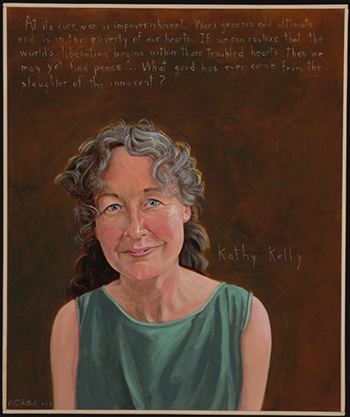
by Kathy Kelley

I spent Martin Luther King, Jr’s birthday in Washington, D.C. as part of the Witness Against Torture fast, which campaigns to end all forms of torture and has worked steadily for an end to indefinite detention of people imprisoned in Guantanamo, Bagram, and other secret sites where the U.S. has held and tortured prisoners.  We’re on day 9 of a twelve day fast to shut down Guantanamo, end torture, and build justice

The community gathered for the fast has grown over the past week.  This means, however, that as more people sleep on the floor of St. Stephen’s church, there is a rising cacophony of snoring.  Our good friend, Fr. Bill Pickard, suggested trying to hear the snores as an orchestra, when I told him I’d slept fitfully last night.

There is a young boy in Mir Ali, a town in North Waziristan, in Pakistan, who also lies awake at night, unable to sleep.  Israr Khan Dawar is 17 years old.  He told an AP reporter, on January 14th, that he and his family and friends had gotten used to the drones.  But now, at night, the sound grows louder and the drones are flying closer, so he and his family realize they could be a target.  He braces himself in fear of an attack.

Continue reading “Tough Minds and Tender Hearts”