Chris Hedges examines the boycott of the UN conference on racism explaining that “racism, an endemic feature of Israeli and American society, is not, we have decided, open for international inspection.”
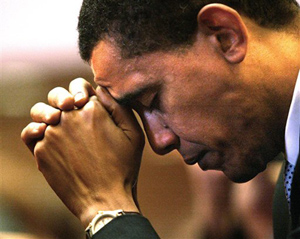
Barack Obama prays during services at Trinity United Church of Christ in Chicago in this 2004 photo. Obama resigned his 20-year membership in Trinity after controversial remarks by his longtime pastor the Rev. Jeremiah Wright threatened to derail his presidential candidacy.
Israel and the United States, which could be charged under international law with crimes against humanity for actions in Gaza, Iraq and Afghanistan, will together boycott the United Nations World Conference Against Racism in Geneva. Racism, an endemic feature of Israeli and American society, is not, we have decided, open for international inspection. Barack Obama may be president, but the United States has no intention of accepting responsibility or atoning for past crimes, including the use of torture, its illegal wars of aggression, slavery and the genocide on which the country was founded. We, like Israel, prefer to confuse lies we tell about ourselves with fact.
The Obama administration’s decision not to prosecute CIA and Bush administration officials for the use of torture because it wants to look to the future is easy to accept if you were never tortured. The decision not to confront slavery and the continued discrimination against African-Americans is easy to accept if your ancestors were not kidnapped, crammed into slave ships, denied their religion and culture, deprived of their language, stripped of their names, severed from their families and forced into generations of economic misery. The decision not to discuss the genocide of Native Americans is easy if your lands were not stolen and your people driven into encampments and slaughtered. The doctrine of pre-emptive war and illegal foreign occupation is easy to accept if you are not a Palestinian, an Iraqi or an Afghan.
The Durban II UN conference on racism has suffered a series of blows as the USA, Germany, Australia and the Netherlands joined Israel, Italy and Canada in boycotting the talks.
UN High Commissioner for Human Rights, Navi Pillay, has complained of a “disparaging media and lobbying campaign” against the UN conference on racism aimed at silencing criticism of Israel by those with “narrow, parochial interests” who demonstrate “reflexive partisanship.”
This can be seen in the UK where Denis MacShane MP (a member of Labour Friends of Israel) has pressured the government to withdraw if “attacks on Jews are made” and the Jewish Human Rights Coalition (JHRC) has called on the government to withdraw completely, with notable success as the UK is now only sending a delegation, with no senior official.
Gideon Levy writes that “it’s exactly three months since the much-talked-about war, and Gaza is once again forgotten. Israel has never taken an interest in the welfare of its victims. Now the world has forgotten, too.”
Alyan Abu-Aun is lying in his tent, his crutches beside him. He smokes cigarettes and stares into the tiny tent’s empty space. His young son sits on his lap. Ten people are crammed into the tent, about the size of a small room. It has been their home for three months. Nothing remains of their previous home, which the Israel Defense Forces shelled during Operation Cast Lead. They are refugees for a second time; Abu-Aun’s mother still remembers her home in Sumsum, a town that once stood near Ashkelon. Continue reading “Gaza, remember?”
The following short documentary is interesting not just for its look at Cuban healthcare and education but also due to its Japanese persepective.
Japan is one of the most equal and wealthy societies with more of a collectivist persepective than Western nations and has a good healthcare system. However the panelists on the following show believe there’s much to learn from Cuba (one of the worlds poorest countries thanks to a brutal US blockade).
I’ve also included some enlightening interviews with US medical students studying in Cuba.
The whip-smart and ever-sly Gore Vidal visited “Real Time” on Friday, giving his historical and sometimes hysterically funny take on the state of the United States. He also revisited a few key moments from his personal history, illustrated by some priceless archival footage found by Bill Maher’s crack research team. Is it too soon to make an Amelia Earhart joke? It’s not too late to make one about Sarah Palin, apparently.
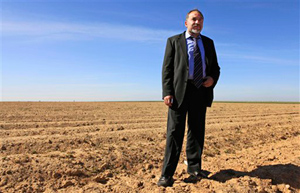
Israel’s new foreign minister, Avigdor Lieberman, stands in a field just outside the Gaza Strip. Lieberman’s right-wing Yisrael Beiteinu Party had an impressive showing in Israel’s recent election, campaigning with the slogan “Without loyalty, there is no citizenship.”
It was unthinkable, when I was based as a correspondent in Jerusalem two decades ago, that an Israeli politician who openly advocated ethnically cleansing the Palestinians from Israeli-controlled territory, as well as forcing Arabs in Israel to take loyalty oaths or be forcibly relocated to the West Bank, could sit on the Cabinet. The racist tirades of Jewish proto-fascists like Meir Kahane stood outside the law, were vigorously condemned by most Israelis and were prosecuted accordingly. Kahane’s repugnant Kach Party, labeled by the United States, Canada and the European Union as a terrorist organization, was outlawed by the Israeli government in 1988 for inciting racism. Continue reading “Israel’s Racist in Chief”
Authority and the Individual is a Reith lecture given by Bertrand Russell in 1948. The text of this lecture happens to be a favourite book of mine and I was glad that the BBC put the original audio online (even if it’s only the first two parts of the series). In his own words “The fundamental problem I propose to consider in these lectures is this: how can we combine that degree of individual initiative which is necessary for progress with the degree of social cohesion that is necessary for survival?”
Which is more important, freedom or order? In Authority and the Individual, the first of the BBC’s famous Reith lectures, Russell tackles what is still one of the most hotly debated issues of the twentieth century: the conflict between law, order and authority and the rights of each individual man and woman.
Mark Braund: for a global reserve currency to work, it must be backed by a resource we want people to use less, like carbon.
A paper written ahead of the recent G20 summit by Zhou Xiaochuan, governor of the Chinese central bank, caused quite a stir. Zhou called for the establishment of a global reserve currency, a step which would firmly tip the balance of economic power in the direction of emerging economies like China and India, but would also bring benefits to poorer nations in the developing world.
Manuel Pérez-Rocha writes that “Obama should begin by laying to rest the divisive Bush legacy embodied in the PPA — as well as the SPP, the Mérida Initiative and Plan Colombia. This would signal that the United States is turning from a bullying empire into a good neighbor, from foe to friend; and that the Monroe Doctrine is finally repealed. A first test to see whether the United States is making these changes will be at the forthcoming Summit of the Americas.”
Barack Obama’s rise to the U.S. presidency has left most Latin Americans suspended between skepticism and hope. That’s bound to make the V Summit of the Americas in Trinidad and Tobago, to be held on April 18 and 19, especially interesting.
A promising sign of meaningful change in U.S. foreign policy toward the hemisphere would be the official demise of the Security and Prosperity Partnership (SPP) of North America, whose apparent failure none of the three governments so far have dared to acknowledge. This creature of Bush’s imperial presidency was agreed to and announced with great fanfare by the U.S., Canadian and Mexican presidents in 2005. Since then, it has been an obscure process in which the executive powers of the governments, along with the CEOs of 30 of the largest corporations in the three countries — many of them military contractors — have extended the security perimeter of the United States to “ensure that North America is the safest and best place to live and do business.”

 Authority and the Individual is a
  P U L S E