Freedom of the press is guaranteed only to those who own one
Author: Idrees Ahmad
I am a Lecturer in Digital Journalism at the University of Stirling and a former research fellow at the University of Denver’s Center for Middle East Studies. I am the author of The Road to Iraq: The Making of a Neoconservative War (Edinburgh University Press, 2014). I write for The Observer, The Nation, The Daily Beast, Los Angeles Review of Books, The Atlantic, The New Republic, Al Jazeera, Dissent, The National, VICE News, Huffington Post, In These Times, Le Monde Diplomatique, Die Tageszeitung (TAZ), Adbusters, Guernica, London Review of Books (Blog), The New Arab, Bella Caledonia, Asia Times, IPS News, Medium, Political Insight, The Drouth, Canadian Dimension, Tanqeed, Variant, etc. I have appeared as an on-air analyst on Al Jazeera, the BBC, TRT World, RAI TV, Radio Open Source with Christopher Lydon, Alternative Radio with David Barsamian and several Pacifica Radio channels.
Terry Eagleton, John Edward Taylor Professor of English Literature at the University of Manchester, has been a Fellow of four Oxford and Cambridge colleges and has held the Thomas Warton Chair of English Literature at the University of Oxford. Professor Eagleton has authored scores of studies of literary, cultural, and political criticism and written plays for both stage and television in Britain and Ireland, as well as a screenplay for Derek Jarman’s film Wittgenstein. Terry Eagleton is a Fellow of the British Academy.
Faith and Fundamentalism: Is Belief in Richard Dawkins Necessary for Salvation?
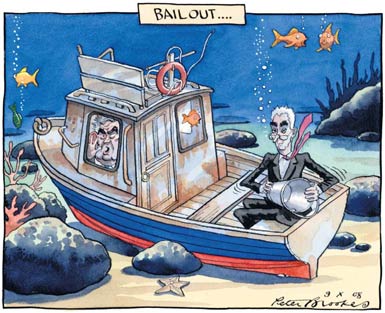
In an excellent, thorough investigation of the financial crisis in the last issue of the London Review of Books, John Lanchester had presented the scrapping of pensions in the public sector as a worst case scenario. Looks like it has already started to happen in the private sector with Barclays scrapping the pensions of its 17,000 employees. This does not, of course, affect the President Bob Diamond who last year raked in £21 m, nor does it affect the rest of the the 1,500 best paid employees. Here is Lanchester (however, let me warn that this piece is more than 14,000 words long, so you better have a good strong copy of coffee and plenty of free time before diving in; also, I’ve appended a reader’s letter correcting an accounting error made by the author):
It’s a moment of confusion and loathing that most of us have experienced. You’re in a shop. It’s time to pay. You reach for your purse or wallet and take out your last note. Something about it doesn’t feel quite right. It’s the wrong shape or the wrong colour and the design is odd too and the note just doesn’t seem right and . . . By now you’ve realised: oh shit! It’s the dreaded Scottish banknote! Tentatively, shyly – or briskly, brazenly, according to character – you proffer the note. One of three things then happens. If you’re lucky, the tradesperson takes the note without demur. Unusual, but it does sometimes happen. If you’re less lucky, he or she takes the note with all the good grace of someone accepting delivery of a four-week-dead haddock. If you’re less lucky still, he or she will flatly refuse your money. And here’s the really annoying part: he or she would be well within his or her rights, because Scottish banknotes are not legal tender. ‘Legal tender’ is defined as any financial instrument which cannot be refused in settlement of a debt. Bank of England notes are legal tender in England and Wales, and Bank of England coins are legal tender throughout the UK, but no paper currency is. The bizarre fact of the matter is that Scottish banknotes are promissory notes, with the same legal status as cheques and debit cards.
These feared and despised instruments, whose history has long been of interest to economists, come in three varieties from three issuing banks: the Bank of Scotland, the Royal Bank of Scotland and the Clydesdale Bank. Small countries with big ambitions but few natural resources need ingenious banking systems. The history of the Netherlands, Venice, Florence and Scotland show this – and so does the tragic recent story of Iceland. ‘In the 17th century, when English and European commerce was expanding by leaps and bounds,’ James Buchan wrote in Frozen Desire, ‘the best Scots minds felt acutely the shortage of . . . what we’d now call working capital; and Scots promoters were at the forefront of banking schemes in both London and Edinburgh, culminating in the foundation of the Bank of England in 1694 and the Bank of Scotland in 1695.’ The powers down south, however, came to think – or pretended to think – that the Bank of Scotland was too close to the Jacobites, and so in 1727 friends of prime minister Walpole set up the Royal Bank of Scotland.
Who can imagine that a Save Darfur coalition vocally including Al Sharpton (”we know when America comes together, we can stop anything in the world”), Mia Farrow, the US Conference of Catholic Bishops, Elie Wiesel (”Darfur today is the world’s capital of human suffering”), Nat Hentoff, Bob Geldof, George Clooney, Angelina Jolie, Harold Pinter, Oprah Winfrey, the gold-medal speed skater Joey Cheek, Tony Blair and Dario Fo might be profoundly shallow in its reading of the brutal warfare in Sudan five years ago… and just as wrong-headed in its drum beat for an American intervention?
Mahmood Mamdani can. We are talking here about his book Saviors and Survivors and his argument that the Darfur rescue campaign, which became a sacred cause of our civil religion, was not so much the moral alternative to Iraq, the Bush “war on terror,” and Cheney-think as it was a variation and extension of the same toolkit. I begin with a sort of confession that I may be a sample of Mamdani’s problem — having drenched myself in Nicholas Kristof’s New York Times columns and largely absorbed the common framework that Darfur was about Arabs slaughtering Africans, and that somebody had to something about it.
Saima is one of 37 refugees now sharing the house of a stranger. Their host, Rizwan Ali, 59, says: 'It would be easier to die than to ask displaced people to leave for the camps'
‘Locals sell all they have to help millions displaced by battles with the Taliban’, Andrew Buncombe reports. This is in stark contrast to how Punjab and Sindh reacted. Both have restricted entry of refugees into their territory. In the latter MQM organized two strikes, the first one with the support of the ruling PPP, and Pakhtun property was destroyed, two people burnt alive. It is already generating resentment in the NWFP with more and more coming to see this as a war on the Pukhtuns, as Rustum Shah Mohmand argues here. The response of the non-Pakhtun provinces to the refugee crises has done little to disabuse them. Meanwhile this displaced mass of humanity survives on the generosity of the type described in the caption above. I avoid indulging in any type of group chauvinism but for once, I’m proud of my people.
The language was already biblical; now the scale of what is happening matches it. The exodus of people forced from their homes in Pakistan’s Swat Valley and elsewhere in the country’s north-west may be as high as 2.4 million, aid officials say. Around the world, only a handful of war-spoiled countries – Sudan, Iraq, Colombia – have larger numbers of internal refugees. The speed of the displacement at its height – up to 85,000 people a day – was matched only during the 1994 genocide in Rwanda. This is now one of the biggest sudden refugee crises the world has ever seen.
The great Uruguayan writer Eduardo Galeano joins Democracy Now for an hour to discuss literature, politics and much more. (The rest of the videos are below)
Fresh Off Worldwide Attention for Joining Obama’s Book Collection, Uruguayan Author Eduardo Galeano Returns with “Mirrors: Stories of Almost Everyone”
We spend the hour with one of Latin America’s most acclaimed writers, Eduardo Galeano. The Uruguayan novelist and journalist recently made headlines around the world when Venezuelan President Hugo Chavez gave President Obama a copy of Galeano’s classic work,The Open Veins of Latin America. Eduardo Galeano’s latest book isMirrors: Stories of Almost Everyone. We speak to Galeano about his reaction to the Chavez-Obama book exchange, media and politics in Latin America, his assessment of Obama, and more.
Why The Photos Probably Do Show Detainees Sodomized and Raped. Naomi Wolf explains:
(MIA: I am not quite sure why this is being treated as new information when Seymour Hersh had reported on the videos of Iraqi children being sodomized soldiers five years back, and again three years later in his profile on Gen. Antony Taguba Hersh revealed that there were cases of rape, and that Taguba had seen ‘a video of a male American soldier in uniform sodomizing a female detainee’. It was likewise revealed in an earlier investigation that an investigator from the mercenary firm Titan Corp., named Adil Nakhla was charged with sodomizing an Iraqi boy).
TheTelegraphof London broke the news – because the US press is in a drugged stupor — that the photos Obama is refusing to release of detainee abuse depict, among other sexual tortures, an American soldier raping a female detainee and a male translator raping a male prisoner. The paper claims the photos also show anal rape of prisoners with foreign objects such as wires and lightsticks. Major General Antonio Taguba calls the images `horrific’ and `indecent’ (but absurdly agrees that Obama should not release them – proving once again that the definition of hypocrisy is the assertion that the truth is in poor taste).
Predictably, a few hours later the Pentagon issues aformal denial.
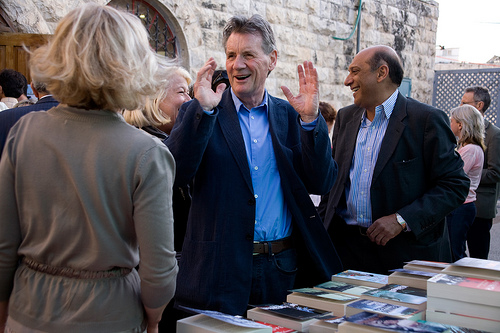
We’re now on the fourth day of Palfest. The skies have cleared, its as hot as I always thought it would be here, out here in lands I know only from the picture-books of the Bible.
So, its my first time in this part of the world – despite having been to over 90 countries, the Middle East has been a stranger to me.
When I left London I had a very clear idea of where or what Palestine consisted of. This trip has made me understand that though Palestine may not exist as a country on a map, it is a reality in the minds of 5 million people.
The fragile colonial construct named Pakistan is risking its own long term survival through its myopic policy in Malakand. The difficulties faced by the refugees from Swat are well known. But according to Rahimullah Yusufzai the reugees are now also the victims of ugly ethnic chauvinism. The far-right Sindhi nationalist Jeay Sindh Qaumi Mahaz (JSQM) and the Muhajir Qaumi Movement (which has renamed itself Muttahida Qaumi Movement in order to mask its narrow factional interests) have organized two major strikes against their migration into Sindh in search of sanctuary. The violence that accompanied the strikes saw Pakhtun property being torched by Sindhi-Muhajir mobs, and one 50 year old woman being burnt alive. The MQM is part of the ruling coalition (led by the fuedal Sindhi dominated PPP of Bhutto/Zardari) and according to Yusufzai the actions have more than the tacit support of the government since the PPP-led provincial government has been sending back many refugees from the border town of Kashmore. Poignantly, Yusufzai adds:
The ruling PPP cannot absolve itself of the blame for blocking the trucks and buses bringing the IDPs to Sindh at the border town of Kashmore and for insisting that they go back to their native NWFP or stay in not-yet-ready tented camps there in the middle of nowhere. It was an insensitive act that added insult to injury and contributed to the pain suffered by the IDPs and felt by all Pakhtuns. More pain was inflicted on the Pakhtun psyche by certain PPP leaders, including its blundering spokesperson Fauzia Wahab, when the IDPs were equated to the Afghan refugees. If this isn’t a slip of tongue, then it obviously means that many politicians and also other likeminded people from different walks of life in Punjab and Sindh have come to believe that the Afghan refugees too are primarily Pakhtuns and all of them need to be kept out of Pakistan’s two biggest provinces to avoid harm…The PML-N despite its praiseworthy relief work in support of the IDPs also damaged its growing reputation as a party sympathetic to the cause of smaller provinces by hesitating to allow setting up of IDPs camps in Punjab…The apathy of some of the Sindh- and Punjab-based political forces to the woes of the IDPs looks all the more glaring when one compares it to the unparalleled generosity shown by the common people all over the country.
Yusufzai contrasts this with the generosity shown the refugees in Mardan and Swabi, and ask why the refugees — 80 percent of whom are actually living with families and well-wishers — should be ‘a matter of concern for NWFP and the Pakhtuns only. ‘If that is the case, then one should be worried about the damage this attitude is causing to the concept of nationhood in the federation of Pakistan.’
From Colombian painter Fernando Botero's series depicting US abuse of Iraqi detainees.
Guantanamo, Abu Ghraib, and Bagram are well known. Less so the police detention centers where the innocents caught in the ‘war on terror’ dragnet were subjected to similar abuses. Inigo Thomas reveals:
In his remarks to the American Enterprise Institute last week, Dick Cheney said that inmates at Guantánamo should remain imprisoned on Cuba because they are too dangerous to be incarcerated in American jails. What about the Americans arrested and jailed under the terms of the war on terror? Should they be incarcerated on Cuba, or does Cheney suppose that Americans are, regardless of what they have done, inherently less dangerous than other people and therefore don’t need to be jailed at Guantánamo?
Nor – surely – can Cheney have forgotten that immediately after 9/11, hundreds of men were rounded up by the FBI and other police forces in the US and imprisoned in high security American jails: 760 in total, 184 of whom were considered especially interesting by the authorities. Just over half of them were interred at the Metropolitan Detention Center in Brooklyn, a former warehouse on the waterfront overlooking the harbour and the Statue of Liberty. The story was covered by the New York Times, but it was treated, mostly, as local news and carried in the ‘New York Region’ section of the paper.
By the now, it’s maddeningly familiar. A scary terrorist plot is announced. Then it’s revealed that the suspects are a hapless bunch of ne’er-do-wells or run-of-the-mill thugs without the slightest connection to any terrorists at all, never mind to Al Qaeda. Finally, the last piece of the puzzle: the entire plot is revealed to have been cooked up by a scummy government agent-provocateur.
I’ve seen this movie before.
In this case, the alleged perps — Onta Williams, James Cromitie, David Williams, and Laguerre Payen — were losers, ex-cons, drug addicts. Al Qaeda they’re not. Without the assistance of the agent who entrapped them, they would never have dreamed of committing political violence, nor would they have had the slightest idea about where to acquire plastic explosives or a Stinger missile. That didn’t stop prosecutors from acting as if they’d captured Osama bin Laden himself. Noted the Los Angeles Times: Continue reading “Yet Another Bogus ‘Terror’ Plot”





 P U L S E