Tablet and Pen

This review appeared in today’s Financial Times.

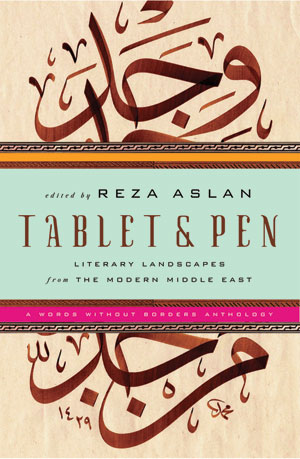
In his introduction to “Tablet and Pen – Literary Landscapes from the Modern Middle East”, Reza Aslan correctly argues that “from ‘the civilising mission’ to ‘the clash of civilisations’” the West has read the East primarily through a security prism, as something to be managed and contained. Apart from a couple of Nobel winners, an Egyptian feminist, and Sayyid Qutb, the region’s writing – and therefore the human dimension – is absent from our calculations.

With Saidean distaste for grand orientalist categories, Aslan argues the literatures grouped here are linked by themes of “imperialism, colonialism and Western cultural hegemony.” A straightforward civilisational definition might have been more logical; African, Indian and Caribbean writing has engaged the same preoccupations. But we know what Aslan means: these 20th Century poems, short stories, novel extracts and essays come from Pakistan, Iran, Turkey and the Arab world, the old Islamic heartland connected by common experience and similar cultural references.

The presence of the anthologiser is felt throughout – pleasantly so: Aslan’s introductions and chronologies give historical structure and social context to the pieces, and succeed in making this “not an anthology to be tasted in disparate bits but rather a single sustained narrative to be consumed as a whole.” It’s a weighty and physically beautiful book which is also compulsively readable.
Continue reading “Tablet and Pen”

Volcano of Rage

Max Rodenbeck writes for the New York Review of Books

In a totalitarian regime, you never know the mistakes that are made. But in a democracy, if anybody does something wrong, against the will of the people, it will float to the surface. The whole people are looking.
—Hosni Mubarak in an interview from Sandcastles: The Arabs in Search of the Modern World by Milton Viorst (Knopf, 1994)

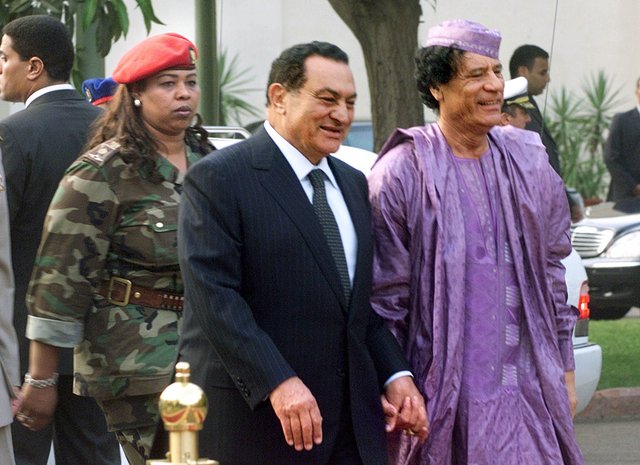
Late last March Muammar Qaddafi, whose official title is Brother Leader of the Great Libyan Arab People’s Jamahiriya, hosted a summit meeting of Arab heads of state. Leaders of the twenty-two Arab League member countries had gathered dozens of times since the first such meeting in 1964, but never before in Libya. Given Qaddafi’s penchant for rambling incoherence and his regime’s reputation for shambolic management, delegates rather dreaded the event, particularly since it was to be held not in the Libyan capital, Tripoli, but in Qaddafi’s bleak little hometown of Sirte, three hundred kilometers away.

Continue reading “Volcano of Rage”

Cockroach Rule

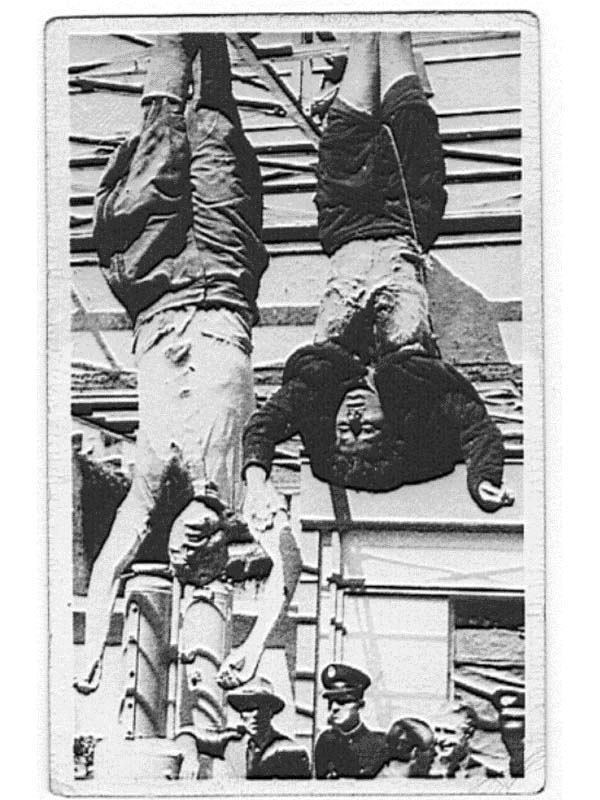
Mussolini and his mistress. April 1945

Our informant in Tripoli, last I heard, was at home, terrified, trying her best to remain calm amid the sound of heavy gunfire.

Tripoli is very hotly contested. Reports suggest eastern Libya, meanwhile, has become an anarchist’s paradise. Benghazi, Tobruk, al-Bayda and smaller towns and villages are in the hands of the people and revolutionary soldiers. Committees have been formed for neighbourhood protection, rubbish collection and traffic direction. The mood is peaceful, triumphant and fearless. Two war planes have been landed in Benghazi by pilots who refuse to bomb the people. Another crashed outside the city after its pilots parachuted out. Today the city of Misurata, in the west, has also been liberated.

Qaddafi’s regime has already collapsed. The army in Misurata, and in the Jebel al-Akhdar region, has joined the people. A statement by high-ranking officers asks all military personnel to head to Tripoli to remove Qaddafi. The Interior Minister and the Justice Minister have resigned, as have many diplomats. All prominent Libyan tribal and religious leaders have backed the revolution. At least a quarter of the country’s oil output has halted; a tribal leader in the east threatened to stop supplies to Europe if Qaddafi continued to kill – and indeed the pipeline to Italy is now dry.

Continue reading “Cockroach Rule”

How Many Martyrs?

Our thoughts and prayers are with the heroes and heroines and martyrs of Libya, and with our brave correspondent in Tripoli, now under fire. Communication is on and off, mainly off. Here is her most recent report. Since she sent it the phone lines have been cut entirely and the city’s electricity is also disconnected.

I live in the Ben Ashour area of Tripoli. Minutes ago my neighborhood was under severe aircraft attacks. Non-Libyan mercenaries are attacking the people. 60 brave Libyans from the army were executed because they refused to kill their own brothers who were going on totally peaceful, unarmed demonstrations.

I hear the nonstop gun machines all round the area of Ben Ashour. We are witnessing the second massacre today and the death toll is reaching 250 in Tripoli and increasing! At this very moment I’m seeing at least 4 jets flying around the city of Ben Ashour. Armed mercenaries are located in different areas of Tripoli, mainly: Ben Ashour, Fashloum, Soug Ejoumaa, Gergaresh.

I heard that the jets are targeting unarmed civilians randomly (women, kids, elders). It’s 8:30 pm now and the number of martyrs is over 250 and I heard confirmed information that the attacks will not stop before 3 am, and I’m grieving and wondering how many martyrs Libya will witness by the morning of 22th February.

Continue reading “How Many Martyrs?”

Massacre in Benghazi

An update from our freedom-loving friend in Tripoli.

Internet is restored in Libya after 6 hours offline. Kaddafi’s regime is circulating messages to people in Benghazi saying: ‘’Mercenaries in east Libya are killing people and water has been poisoned by unidentified source’’. Gaddafi is facing the fight of his life; not only he is violently responding to protesters, but he is taking advantages of those mercenaries coming from African poor countries – who barely understand or are aware of what’s going on inside Libya and tempt them with small amount of money to KILL Libyans. Around 100 martyrs were killed in 4 days only!

Today, I called my friend in Benghazi. She told me: ‘’We are hungry, no food supplies for us; people are dying more and more everyday, women and children are amongst the dead in the horrific Benghazi massacre, we are isolated from the media coverage.” She also told me that yesterday three tanks tried to roll in but the soldiers abandoned them and citizens burned them. And yesterday night, the hospitals announced 40 dead martyrs including children (one child died- 13 years old), and this morning saw the death of 15 martyrs. Hospitals are running out of medical supplies & are calling for urgent need of medical aid; gun shots barely stop, and helicopters are firing and throwing bombs on protestors. Yet beyond all this mess, she is proud that people in east Libya are doing their best to recover from the virus that has been ruling Libya for over 40 years.

Continue reading “Massacre in Benghazi”

Syria Speeding Up

Three weeks ago I wrote that Syria was not about to experience a popular revolution. Although I’m no longer sure of anything after the events in Tunisia and Egypt (and Libya, Algeria, Jordan, Yemen and Bahrain) – and although it’s made me unpopular in certain quarters – I’m sticking to my original judgement. No revolution in Syria just yet.

Until a month ago, I would have have agreed with Joshua Landis (quoted here) that many, perhaps a comfortable majority of Syrians were not particularly interested in ‘democracy.’ Before either I or Landis is accused of orientalism, let me say that human and civil rights are not identical with democracy. Any Syrian who knows he’s alive wants his (or her) human and civil rights respected, but many fear that ‘democracy’ would lead to sectarian fragmentation. This is an entirely logical fear: the ‘democracies’ to the west and east of Syria – Lebanon and Iraq – are strife-torn sectarian democracies. Sectarian identification remains a problem in Syria. A freedom-loving Alawi friend of mine was put off the failed ‘day of rage’ facebook group because he found so many anti-Alawi comments posted there. Other Syrians were put off when they realised that many of the posts came from Hariri groups in Lebanon.

Continue reading “Syria Speeding Up”

Blood in Libya

bread, freedom, human dignity

A report from a friend in Tripoli. She must remain nameless.

I’m here and safe for now, al-hamdullah. There is no internet in Libya, and maybe there will be no electricity in the coming days. I uploaded software late at night to get the internet, and very few have access to this software.

The death toll in Benghazi is growing, almost 80 are dead just in 3 days. It’s getting dirty here and the media coverage is too little. We are not getting the international attention and I am afraid if the Libyan protesters are ignored, this murderer will seal Libya off from the world and ruthlessly kill any protest before they even have the chance to begin.

Yesterday, I left work and I went to Sahat el-Ghadra, where all his thugs were supporting him. They got all kids out of schools and forced them to carry posters of his pictures and everyone to hang the stupid Libyan flag inside their cars and … the number of flags around Tripoli are more than the number of bloody flags you can see in the US.

Continue reading “Blood in Libya”