The Editor: In these parlous times it becomes imperative to distinguish between legitimate and illegitimate solidarity. The following is based on principle and respect for the Iranian people, and its demand for transparency and accountability is one we share even if our own reading of the elections is different.(Also see Khatami and Moussavi‘s statements on the elections which have been translated by our good friend Naj).
The aim of the following appeal is to declare our support for the Iranian movement in its call for a new election and our opposition to any violent intervention on the protesters. We do so as independent academics and not as representatives of our many respective governments. We do so in the hope that the historical appreciation and respect of higher learning in most of traditional Iran will make our voice of solidarity heard within Iran.
Iranians participate in the democratic process
June 21, 2009 — A week ago, Friday June 12, Mahmoud Ahmadinejad was declared the winner of the Iranian presidential election. Immediately after, all other candidates, Mir-Hossein Moussavi, Mehdi Karroubi, and even the conservative Mohsen Rezaei, disputed the official results. So did some people who started several demonstrations to express their anger. More news fueled the suspicion of fraud at an unprecedented scale. On Monday June 15, and to the amazement of the world, millions of people – of all ages, classes, and backgrounds – were in the streets of Tehran demanding another election in what was the biggest demonstration since the revolution in 1979. A week later, despite the threats and beatings issued and ordered by the government, millions of people are still demonstrating, and the movement is growing and spreading to other cities.
One slide of the photo essay Prof. Robinson sent to his students
The Anti-Defamation League and the Israel advocacy group “Stand With Us” are leading an aggressive, direct campaign to pressure UCSB administrators and faculty to investigate and discipline Professor of Sociology William I. Robinson for having introduced materials critical of Israel in a course on global affairs. The UCSB academic senate opened an official inquiry alleging “academic misconduct” and “anti-semitism”, following complaints by two students in response to an email Robinson sent out to his class during Israel’s war on Gaza. The email consisted of an article published in the Kansas City Jewish Chronicle by Judith Stone, who had recently returned from the occupied territories (the editor responsible was fired the next day), a photo essay which juxtaposed Nazi atrocities against Jews in WWII and Israeli atrocities against Palestinians in Gaza and the following commentary:
If Martin Luther King, Jr. Were alive on this day of January 19, 2009, there is no doubt that he would be condemning the Israeli aggression against Gaza along with u.s. military and political support for Israeli war crimes, or that he would be standing shoulder to shoulder with the Palestinians. I am forwarding some horrific, parallel images of Nazi atrocities against the Jews and Israeli atrocities against the Palestinians. Perhaps the most frightening are not those providing a graphic depiction of the carnage but that which shows Israeli children writing “with love” on a bomb that will tear apart Palestinian children.
Who can imagine that a Save Darfur coalition vocally including Al Sharpton (”we know when America comes together, we can stop anything in the world”), Mia Farrow, the US Conference of Catholic Bishops, Elie Wiesel (”Darfur today is the world’s capital of human suffering”), Nat Hentoff, Bob Geldof, George Clooney, Angelina Jolie, Harold Pinter, Oprah Winfrey, the gold-medal speed skater Joey Cheek, Tony Blair and Dario Fo might be profoundly shallow in its reading of the brutal warfare in Sudan five years ago… and just as wrong-headed in its drum beat for an American intervention?
Mahmood Mamdani can. We are talking here about his book Saviors and Survivors and his argument that the Darfur rescue campaign, which became a sacred cause of our civil religion, was not so much the moral alternative to Iraq, the Bush “war on terror,” and Cheney-think as it was a variation and extension of the same toolkit. I begin with a sort of confession that I may be a sample of Mamdani’s problem — having drenched myself in Nicholas Kristof’s New York Times columns and largely absorbed the common framework that Darfur was about Arabs slaughtering Africans, and that somebody had to something about it.
Great initiative from my friend David Whyte, Ann Singleton and Steve Tombs. They decry the insidious way in which academics are being used to monitor foreign students and staff (thanks Moa).
We are among the growing number of academics across the UK voicing our concern about being drawn into playing a key role in an ever-tightening system of immigration control. Many of us are now being asked to implement procedures and checks related to immigration status on both our colleagues and our students. The creeping imposition of such practices raises questions about the legal responsibilities and contractual requirements of university and college staff, the methods the UK is using to police immigration, and the compromising of what remains of academic freedom in Britain.
In February 2008, the Government introduced major changes to UK immigration policies and laws, seeking to consolidate a plethora of immigration-control measures. The main plank of these changes was the introduction of a points-based system (PBS) under which potential employers of migrant workers from outside the European Union must be approved and licensed by the Government before workers are granted permits to take up employment. Thus, universities and colleges must now be licensed as “approved education providers” to bring non-EU students into the UK to study. In addition, before they are admitted to the country, these students must hold a visa giving them permission to enter for the purposes of study at the approved institution, and prove that they have enough money to pay their fees and maintain themselves in the UK.
A year or so ago, I read a news story where a well-known IR scholar explained the silence of many academics about the Iraq war by saying that “I don’t think all the academics in the world could have had much impact on American public opinion…I don’t think academics matter.”
Even if true in this particular case, this is a self-fulfilling world-view. If you basically believe that what scholars write and say doesn’t really matter for major national policy decisions, you’re unlikely to write or say anything that might actually shape those decisions. And for many academics, that’s ok with them.
As Laura Rozen noted earlier this week, my colleague Joseph Nye offered a candid and critical assessment of the growing gap between academia and the policy world in a Washington Postcolumn on Monday. Joe’s own career demonstrates that it is still possible combine serious scholarship, government service, academic leadership, and public commentary, but his warnings that this combination is becoming rarer is almost certainly correct. Michael Desch makes some related points in a recent article in Notre Dame Magazine, noting that the policy world is increasingly indifferent (or hostile) to academic advice. Together, the portrait they paint is more than a little disturbing.
Nora Barrows-Friedman, Senior Producer and co-host of the excellent Flashpoints Radio, on direct action across the international spectrum (I am one of the people mentioned in this article). This article first published in Arabic in al-Haq al-Awda.
Linking arms through metal tubes and jamming the doorways with steel bicycle locks, dozens of pro-justice activists blocked the entrance to the Israeli consulate in downtown San Francisco on January 15th — Martin Luther King Jr.’s birthday — at the height of Israel’s siege on Gaza, on a day when its military killed at least forty Palestinian men, women and children in a series of attacks that also decimated several mosques, schools and an UNRWA building. 24 hours before, in Los Angeles, protesters chained themselves to their local Israeli consulate and unfurled a banner reading “The Israeli consulate has been closed for war crimes.”
As Israel’s destruction of Gaza raged on, carried out by the Middle East’s only nuclear superpower against an entrapped, occupied and virtually defenseless population, so did countless actions across the world. Protests, marches and demonstrations were called by the usual peace and justice organizations — hundreds of thousands came to express their dissent in major international cities — but smaller, more direct actions were being taken with little to no media fanfare. And some of these quieter operations, activists say, have begun to make an impact.
She isn’t her usual eloquent self here, but Naomi Wolf is on the money all the same. I think the recent student occupations across UK have set a precedent. And the overly bureaucratized and unrepresentative irrelevance that is the NUS is already being mobilized to eliminate the last vestiges of student democracy. This must be resisted.
Naomi Wolf, author of The End of America, argues that bureaucracy has killed effective protesting because mass social protests in the U.S. now have a feeling of “Disneyland activism.”
As the student occupation at the University of Manchester enters its 27th day, preparations are underway for a national demonstration to take place this Wednesday, March 4, 2pm at the University’s Student Union.
Given Vice-Chancellor Alan Gilbert’s persistent refusal to discuss the students’ demands, the rally will be a crucial test of strength for the growing pro-Palestinian student movement in the UK, which has already scored several victories.
For frequent updates and more information about the occupation visit the students’ blog.
A national demonstration has been called in support of the student occupations. It’s crucial that we have as much representation from different Universities, Colleges and Schools as possible.
We in Manchester have been in occupation for almost four weeks now, yet the University has so far refused to negotiate with us. The University still invests in the arms trade, leading to some students having to disrupt a DSTL stall (an agency of the MoD) at an official graduate recruitment fair.
The Vice Chancellor Alan Gilbert has threatened expulsion for students who are involved.
In the following article Mark Steel pokes fun at the absurdity of neoliberal student life while commenting on the recent success of the occupations movement.
One of the many upsetting aspects to being in your forties, is hearing people your own age grumbling about “young people” the way we were grumbled about ourselves.
Old friends will complain, “Youngsters today have no respect like we did”, and I’ll think: “Hang on. I remember the night you set a puma loose in the soft furnishings section of Pricerite’s.”
A vibrant and wonderful student movement has flowered a the Strathclyde University which has scored two major victories for peace and justice within this month. We at PULSE salute all the students, in particular Strathclyde Stop the War, Action Palestine, and the Strathclyde University Muslim Students Association (SUMSA) for their indispensable work. In today’s excellent guest editorial, Kim Bizzarri, who has himself lead from the front, reports on these successes and the prospects for future.
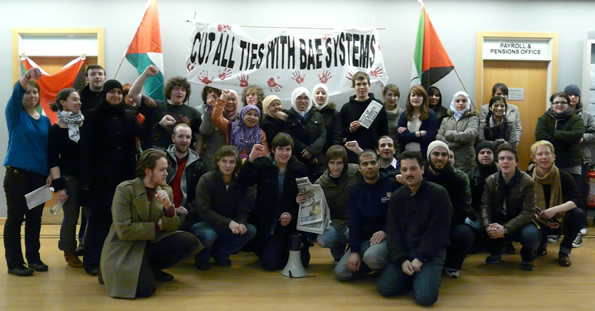
GLASGOW, February 21 – Students at Strathclyde University won the vote on Thursday to cut the university’s ties with arms manufacturer BAe Systems which supplied components used by the Israeli military in the recent massacre of Palestinian civilians in Gaza.
Students win majority support in historic AGM
The vote, which took place in relation to a motion submitted by a group of students to their Union’s General Meeting (AGM) – the student’s highest decision-making body – won with an overwhelming majority of the over 200 students who queued in the union’s corridors and stairs to participate in the event. Such a high student attendance had been unprecedented in any previous AGM, most of which failed in the past 10 years to even reach quorum.
Despite attempts by the Union’s administration to dilute the substance of the motion and have it voted upon by the conservative Student Representative Council (SRC) – who had already rejected a similar popular motion two years earlier given the uncomfortable position it placed the University vis-à-vis its corporate funders – the fervent group of passionate students were successful in galvanising sufficient support amongst their fellows to turn the motion into student policy.
Within weeks of occupying the McCance Building – heart of the University’s administration – the original 60 students involved in the occupation have already gained the support of a sizable number of their fellow students.



 P U L S E