Robert Greenwald and McChesney discuss Afghanistan
Robert Greenwald is a producer, director and political activist. Greenwald is the founder and president of Brave New Films. Under Greenwald’s direction, Brave New Films has produced a series of short political videos, including the Fox Attacks and Real McCain campaigns. Robert Greenwald’s Brave New Foundation is currently producing Rethink Afghanistan, a groundbreaking documentary being released online in real-time; the film features experts from Afghanistan, Pakistan and the U.S. discussing the United States’ flawed strategy in Afghanista
Yesterday five British soldiers were shot dead by an Afghan policeman. Just as they keep promising that they’ve reached ‘decisive turning points’ in their battle with the Afghan resistance, British military officials immediately vowed that the ‘rogue’ policeman would be caught. Today the Taliban reports that the policeman is safe with them, and that he’s been greeted with flowers.
Our glorious patriotic press responds. Amusingly, the Daily Mail headline wrings its hands and squawks, “What kind of war IS this?” Because some people aren’t playing by the rules, you see. Instead of sitting quietly in their villages waiting for the drone attack, or perhaps sending their kids out to accept sweets and modernity from a rosy-cheeked English lad, some barbarians are actually shooting back at the invaders. How very unBritish. (To be fair to the Mail – which has never been fair to anyone – it does seem to be taking an anti-war stance today). Other sections of the media worry about the ‘loyalty’ of Afghan troops, as if love for foreign occupiers is a realistic standard of loyalty. Still others, even more clever, psychoanalyse the policeman, wondering if an argument with his commander pushed him to a moment of madness. But it really isn’t that complicated, as anybody who disabuses themselves of imperialist delusion can see. Very simply, people don’t like foreigners striding around their streets and fields with guns and assumptions of superiority. Afghans will kill British troops as surely as Britons would kill Afghan troops if they occupied this country.
POLITICS: U.S. in Pakistan’s Mind: Nothing But Aversion
Analysis by Muhammad Idrees Ahmad
With Nato supply convoys passing through the FATA region, US military hardware frequently falls into the hands of insurgents.
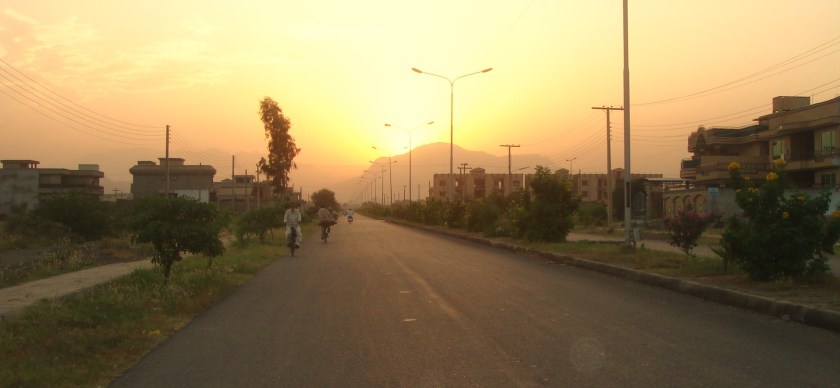
PESHAWAR, Pakistan, Oct 30 (IPS) – To the west of Peshawar on the Jamrud Road that leads to the historic Khyber Pass sits the Karkhano Market, a series of shopping plazas whose usual offering of contraband is now supplemented by standard issue U.S. military equipment, including combat fatigues, night vision goggles, body armour and army knives.
Beyond the market is a checkpoint, which separates the city from the semi-autonomous tribal region of Khyber. In the past, if one lingered near the barrier long enough, one was usually approached by someone from the far side selling hashish, alcohol, guns, or even rocket-propelled grenade launchers. These days such salesman could also be selling U.S. semi-automatics, sniper rifles and hand guns. Those who buy do it less for their quality—the AK-47 still remains the weapon of choice here—than as mementos of a dying Empire.
The realisation may be dawning slowly on some U.S. allies, but here everyone is convinced that Western forces have lost the war. However, at a time when in Afghanistan the efficacy of force as a counterinsurgency tool is being increasingly questioned, there is a newfound affinity for it in Pakistan.
I leave Kamra (*) in Punjab at 7pm in a rickety old bus without air-conditioning. A pleasant wind rushes through the open windows: the late summer evening has mercifully sucked the humidity out of it. People who can’t afford air-conditioned transportation escape the infernal elements by travelling at night. And the passengers are mostly a destitute lot. When a man in the seat in front gets up I notice that his sādr — a cotton shawl used by Pakhtun men variously as a turban, windbreaker or bedspread — covers the long rip running down the back of his kameez. Next to that rip is an older tear crudely stitched together.
In two hours we are in Peshawar. For a third of each day the city has no electricity. It’s lights out as we arrive. I get off a stop early and decide to walk — though I have been advised against walking in western clothes outside the city centre. A pharmaceutical company salesman was killed a short while back for arriving at a hospital wearing pants, shirt and tie. But I feel safe despite my hiking outfit, backpack and sandals: I haven’t been in Peshawar long enough to think of it as anything but the city I grew up in. Wetook our safety for granted.
Robert Fisk, Richard Murphy and Azzam Tamimi discuss the Nobel Peace Prize to Barack Obama. Does he deserve the prize? And what has he achieved? Or was the award granted in the hope he would succeed in the future?
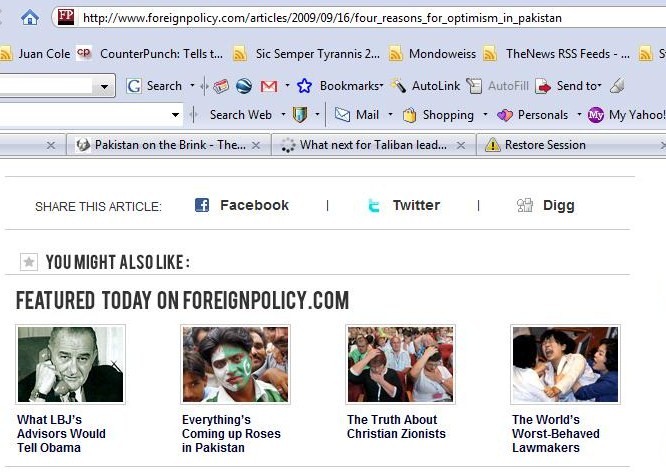
'Everything is coming up roses in Pakistan' -- ForeignPolicy.com
The day that I arrived in Pakistan mid-September, the frontpage story on Foreign Policy magazine’s ‘Af-Pak Channel’ carried the exuberant headline ‘Everything’s coming up roses in Pakistan’. In the next four days the frontier capital of Peshawar would be hit by five rocket attacks. The week after there would be a car bombing. And things have only gotten worse since.
There was much triumphalism about the Pakistani army’s decisive action in Swat. Some were even encouraged to claim ownership of the war; it wasn’t an American war anymore, they said, it was ‘our’ war. The Pakistani liberal elite exhorted the military to press on and carry out similar actions in the Federally Administered Tribal Agencies (FATA). The militants seemed demoralized; it was was time to finish the job. It was not to be.
A British artist made these impressive propaganda posters during the Afghan war against the Soviet occupation. They were also printed as postcards. The picture to the right was sent out as a christmas card by Agency Afghan Press in the UK, prompting London’s Evening Standard to wonder, jokingly, if the three figures represented Joseph, Mary and Jesus. The picture to the left was made for Gulbedeen Hekmatyar’s Hizb-i-Islami, which then had a London office. The pictures raised no horrified eyebrows in the UK – of course not: the Afghan people and the Thatcher and Reagan administrations were all on the same side, for freedom, against godless Soviet communism interfering with a traditional culture. Today, however, Hekmatyar is fighting the NATO occupation of his country, and were a British artist to dare paint an Afghan mujahid, with Qur’an in one hand and kalashnikov in the other, standing on an American flag, underneath a calligraphed ‘Allahu Akbar’, he would quite probably be charged under anti-terror legislation.
The Guardian reports on British campaigning in Afghanistan, specifically an “operation” which “took nearly 3,000 British troops, many engaged in gun battles, to capture an area the size of the Isle of Wight.” I do wonder what meaning the verb ‘capture’ has here.
The article relays stories told by “British officials” and a couple of named officers, stirring stories which involve “a risky air attack” and a “Taliban drugs bazaar.” Twenty two British soldiers have been killed in Helmand province this month alone, so I expect our officials are thinking very hard indeed about the stories they tell. The recent adventure is called ‘Operation Panther’s Claw’, and is hoped to be “a decisive turning point in the eight-year conflict.”
We shall see. In the meantime, what seems a potentially decisive sign is the language and direction of this Taliban ‘code of conduct’. It demonstrates not only a higher stage of organisation than at any time since the movement’s 2001 defeat, but also a leap forward in ethics and political understanding.
On suicide bombing, the code says
(These) attacks should only be used on high and important targets. A brave son of Islam should not be used for lower and useless targets. The utmost effort should be made to avoid civilian casualties.
You know that things for the Western occupation of Afghanistan have reached a pretty pass when the most devastating indictment of its failures comes from a former colonial manager. Here is Rory Stewart in the London Review of Books (the world’s best publication by far ) presenting what may be the most trenchant critique of the of the US-UK occupation of Afghanistan, but as can be expected from someone who had earlier played a key role in managing the UK occupation of Southern Iraq, he limits it to the handling of the occupation.
We are accustomed to seeing Afghans through bars, or smeared windows, or the sight of a rifle: turbaned men carrying rockets, praying in unison, or lying in pools of blood; boys squabbling in an empty swimming-pool; women in burn wards, or begging in burqas. Kabul is a South Asian city of millions. Bollywood music blares out in its crowded spice markets and flower gardens, but it seems that images conveying colour and humour are reserved for Rajasthan.
Barack Obama, in a recent speech, set out our fears. The Afghan government
is undermined by corruption and has difficulty delivering basic services to its people. The economy is undercut by a booming narcotics trade that encourages criminality and funds the insurgency . . . If the Afghan government falls to the Taliban – or allows al-Qaida to go unchallenged – that country will again be a base for terrorists who want to kill as many of our people as they possibly can . . . For the Afghan people, a return to Taliban rule would condemn their country to brutal governance, international isolation, a paralysed economy, and the denial of basic human rights to the Afghan people – especially women and girls. The return in force of al-Qaida terrorists who would accompany the core Taliban leadership would cast Afghanistan under the shadow of perpetual violence.
When we are not presented with a dystopian vision, we are encouraged to be implausibly optimistic. ‘There can be only one winner: democracy and a strong Afghan state,’ Gordon Brown predicted in his most recent speech on the subject. Obama and Brown rely on a hypnotising policy language which can – and perhaps will – be applied as easily to Somalia or Yemen as Afghanistan. It misleads us in several respects simultaneously: minimising differences between cultures, exaggerating our fears, aggrandising our ambitions, inflating a sense of moral obligations and power, and confusing our goals. All these attitudes are aspects of a single worldview and create an almost irresistible illusion.
 Robert Greenwald of Brave New Films speaks about Afghanistan on Bob McChesney’s excellent Media Matters.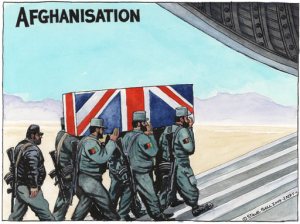


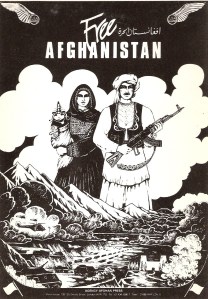 A British artist made these impressive propaganda posters during the Afghan war against the Soviet occupation. They were also printed as postcards. The picture to the right was sent out as a christmas card by Agency Afghan Press in the UK, prompting London’s Evening Standard to wonder, jokingly, if the three figures represented Joseph, Mary and Jesus. The picture to the left was made for Gulbedeen Hekmatyar’s Hizb-i-Islami, which then had a London office. The pictures raised no horrified eyebrows in the UK – of course not: the Afghan people and the Thatcher and Reagan administrations were all on the same side, for freedom, against godless Soviet communism interfering with a traditional culture. Today, however, Hekmatyar is fighting the NATO occupation of his country, and were a British artist to dare paint an Afghan mujahid, with Qur’an in one hand and kalashnikov in the other, standing on an American flag, underneath a calligraphed ‘Allahu Akbar’, he would quite probably be charged under anti-terror legislation.
 P U L S E