Pakistan: Between Drones and Deus

Yesterday I appeared on Dori Smith’s excellent Talk Nation Radio, which runs on Pacifica, to discuss the situation in Pakistan. Among other things I discussed the devastation wrought by the US drone war, the folly of seeking military solutions for political problems, the deteriorating situation in Afghanistan, and the murder of Salman Taseer.

To date there have been 215 drone attacks, including 3 on 1 January 2011 in North Waziristan which killed 19 people. In 2010, there were 116 strikes, over twice as many as in 2009. The total deaths from the drones number over two thousand. According to reports in  The News and Dawn about 98 percent of the victims are civilians, a figure confirmed by David Kilcullen, the former senior advisor on counterinsurgency to Gen. David Petraeus. According to the Brookings Institution the drones kill at a ratio of  1 militant for every 10 civilians. According to Frontier Constabulary men I spoke to last year, the drones once in a while do get their targets but their victims are largely civilians.

Continue reading “Pakistan: Between Drones and Deus”

David Bromwich on Obama, the Establishment President

David Bromwich is the Sterling Professor of English at Yale, and easily the most astute observer of Barack Obama’s performance and character. He has written some of the most insightful articles on the Obama presidency in which he subjects Obama’s oratory and style to close textual and formal analysis, and highlights the various traits that are symptomatic of his approach to politics. In this wide ranging discussion with Christopher Lydon of the excellent Radio Open Source (based at Brown University’s Watson Institute) Bromwich brings his formidable analytical skills to bear on Obama’s langauge, the difference between his improptu and scripted speech, his attempts at humour, and what it reveals about the man. He also makes an interesting comparison between Obama’s style and that of former presidents such as Lincoln, Reagan and Kennedy.

War in the Borderlands

Derek Gregory is professor of geography at the University of British Columbia, and author of excellent The Colonial Present: Afghanistan, Palestine, and Iraq. He discusses the evolving character of conflicts in the borderlands of former empires and the blurring of the conceptual borders of war itself.

Nir Rosen on the aftermath of America’s wars

Nir Rosen, is a fellow at NYU’s Center on Law and Security, and one of the best war reporters in the world.    Aftermath: Following the Bloodshed of America’s Wars in the Muslim World is his account of the impact of US wars in the Middle East and Central Asia. In this interview he speaks to Glenn Greenwald of Salon about his book.

And here is the transcript:

Glenn Greenwald: My guest today on Salon Radio is Nir Rosen who I think is unquestionably one of the best war journalists and commentators in the country probably in the world. He is a freelance writer photographer, film-maker, and he is currently a scholar associated with the New York University Center on Law and Security, and he has just written a book that I finished reading actually today entitled Aftermath: Following the Bloodshed of America’s Wars in the Muslim World. It’s really an amazing book. It describes the impact of multiple American wars on families and people in various countries including Iraq, Afghanistan, Lebanon, and other countries where Nir has spent a great amount of time. I’m really excited to talk about this book. Thanks so much for taking the time to talk to me today.

Nir Rosen: Thanks for reading the book.

Continue reading “Nir Rosen on the aftermath of America’s wars”

We Want You Out

An open letter from the Afghan Youth Peace Volunteers and Afghans for Peace

As the Obama administration releases its December review of the U.S. war effort in Afghanistan, the Afghan Youth Peace Volunteers, along with Afghans for Peace, have issued a review of their experiences.  To express support for their letter, click here.

To all the leaders of our world, the leaders of the US-led coalition, the Afghan government, the ‘Taliban/Al-Qaeda’ and regional countries,

We are intolerably angry.

All our senses are hurting.

Our women, our men and yes shame on you, our children are grieving.

Your Afghan civilian-military strategy is a murderous stench we smell, see, hear and breathe.

President Obama, and all the elite players and people of the world, why?

America’s 250-million-dollar annual communications budget just to scream propaganda on this war of perceptions, with its nauseating rhetoric mimicked by Osama and other warlords, is powerless before the silent wailing of every anaemic mother.

We will no longer be passive prey to your disrespectful systems of oligarchic, plutocratic war against the people.

Your systems feed the rich and powerful. They are glaringly un-equal, they do not listen, do not think and worst, they do not care.

Continue reading “We Want You Out”

Ostrich America?

by Chase Madar

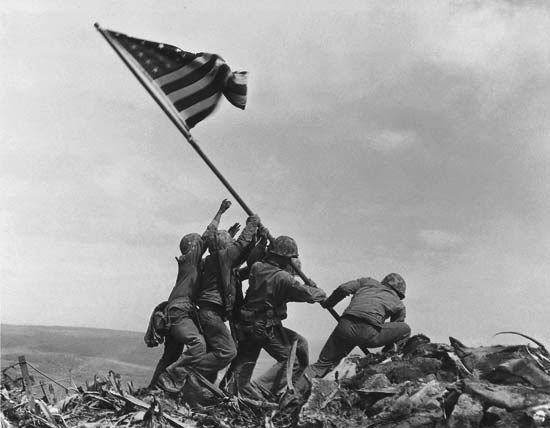
Famous photograph of the US isolating itself in Iwo Jima. (Photo: Joe Rosenthal, 1945)

Of all the received ideas that clog America’s foreign-policy discourse, none is more at variance with reality than the threat of isolationism. We have never been more engaged with every corner of the world, yet we have never been lectured more often about the consequences of “retreating within our borders.” The more countries we attack—Pakistan, Somalia, Yemen—the more dire warnings we get about national introversion. The specter of isolationism has never looked healthier.

A case in point was George W. Bush’s 2006 State of the Union address, a venue he used to tell a spine-chilling tale. With his foreign policy exploding all around him, Bush warned against an even more disastrous alternative: there were those who would “tie our hands” and have us “retreat within our borders.” From the tenor of his talk, he seemed to think that Americans were about to burn down both the Pentagon and Department of State, beat defense intellectuals into postal workers, and force every house in the land to set up a little steel foundry in the back yard—just like in the Great Leap Forward—while learning to live on grubs and wild mountain honey.

Of course, this is absurd: as many pointed out in response to this scaremongering, there are no isolationists in America—not in either political party, not in the media, and not in the academy. (The i-word is often used as a synonym for unilateralism. Here I am assigning only its most common meaning: a tendency to ignore security threats beyond territorial borders and disengage diplomatically, politically, and economically from the rest of the world.) Nevertheless, the menace of a return to geopolitical autarky is carted out whenever our sclerotically narrow foreign-policy consensus gets an unwelcome jolt. This habit of mind did not end with the exit of George W. Bush.

Continue reading “Ostrich America?”

Hunger and Anger in Afghanistan

by Kathy Kelly

(Photo: Paul Casier)

The Obama administration has announced the imminent release of a December Review which will evaluate the U.S. troop presence in Afghanistan.  The military has yet to disclose what the specific categories for evaluation will be.  Yet many people in Afghanistan might wish that hunger along with their anger over attacks against civilians could top the list.

In Afghanistan, a nation where 850 children die every day, about a quarter of the population goes hungry. The UN says that 7.4 million Afghans live with hunger and fear of starvation, while millions more rely on food help, and one in five children die before the age of five. 

 “Do you think we like to live this way?” an Afghan man asked me, last October, as he led us toward a primitive tent encampment on the outskirts of Kabul. “Do you see how we live?  The cold and the rain are coming.  How will we protect our children?”  He flicked his forefinger on a weather-beaten blanket covering a tent.  The blanket immediately ripped. 

Continue reading “Hunger and Anger in Afghanistan”

Open letter from Afghan Youth to our World Leaders

Dear Mr Obama, Mrs Clinton, Mr Petraeus, Mr Rasmussen, and all our world leaders,
 
We are Afghans and we ask the world to listen.
 
Like yourselves, we couldn’t live without the love of our family and friends.
 
We were hurt by your criticism of Mr Karzai for voicing the people’s anguished pleas, “Stop your night raids.”
 
Please, stop your night raids.
 
If you could listen, you would have heard 29 NGOs in Afghanistan describe how we now have “Nowhere to Turn”.
 
If you could listen, you would also have heard Mr Karzai and the 29 NGOs express concern over your Afghan Local Police plan; the world will henceforth watch our militia killing the people, your people and our people, with your weapons and your money.
 
If you could listen, you would have heard the sound of your drones crystallizing the nights of hatred among the Afghan, Pakistani and global masses.

Continue reading “Open letter from Afghan Youth to our World Leaders”

BBC charity committed to promoting UK Government propaganda in Afghanistan

by Tom Mills

In August the right-wing pressure group the Tax Payers’ Alliance revealed that the charitable wing of the BBC World Service, the BBC World Service Trust, had received £205,000 under the Foreign Office’s counter-terrorism programme.  The money was provided to fund the Trust’s Afghan Woman’s Hour programme, which is broadcast every week in Dari and Pashto.  Naturally the Tax Payers’ Alliance took this as evidence of wasteful government expenditure.  What it overlooked though is the more worrying fact that a charity closely affiliated to the BBC was knowingly participating in a government propaganda project.

The BBC World Service Trust was set up in 1997 to train journalists and other media workers in the developing world and the former Soviet Union.  It launched Afghan Woman’s Hour in January 2005 with the stated intention of empowering Afghan women and promoting their participation in Afghan society.  The project was headed by Rachel Ellison, the BBC’s then International Project Director, who received an MBE for her work.  Ellison now runs a Corporate Coaching and Media Consultancy with clients including HSBC, the Foreign Office and the investment bank Goldman Sachs which funds business training programmes for Afghan women.

Continue reading “BBC charity committed to promoting UK Government propaganda in Afghanistan”