In a recent presentation to the Palestine Center in DC, the courageous and talented Mohammed Omer interviews fellow Palestinians in Gaza trying to survive the crippling blockade. Continue reading “Life in Hell: A Journalist’s Account of Life in Gaza – Mohammed Omer”
Category: Gaza
Chomsky: Palestine and the region in the Obama era
Tariq Ali and Noam Chomsky speak in London on the Israel-Palestine question. I think Tariq’s suggestions are eminently sensible, whereas once again Chomsky’s analysis leaves me underwhelmed. I don’t think he has anything of value to contribute to this debate any more. Worse, he is telling Palestinians that UNGAR 194 is no longer useful and that they should forgo the right of return. Curiously, he still continues to insist that Israel is merely a pawn in the belligerent US designs against Iran. I also found it disingenuous that while he has remained consistent in his opposition to BDS, his argument hasn’t. While in the past he would insist that everything Israel does was at the behest of the US, hence its the imperial patron that needs to be boycotted, now he says public opinion is not ready for it.
Saree Makdisi on the Goldstone Report

Phillip Adams speaks to the nephew of the late Edward Said, Professor Saree Makdisi, who will give the 2009 Edward Said Memorial Lecture in Adelaide. Professor Makdisi talks about the latest UN findings of war crimes in Gaza; what he describes as the bureaucratic occupation of the Palestinian territories; and his reasons for supporting a one-state solution. (thanks Michael)
Makdisi is Professor of English Literature at the University of California, Los Angeles; Edward Said Memorial Lecturer for 2009, and the author of Palestine Inside Out: Everyday Occupation (John Wiley, 2008)
See also
A Museum of Intolerance in Jerusalem for an excellent address by Saree Makdisi on the so-called Museum of Tolerance in Jerusalem.
Resigning from Cohen and Amnesty

Renowned Irish composer and novelist Raymond Deane on the reasons why he has chosen to resign from Amnesty International. We encourage readers to follow Deane’s example.
When I first – and belatedly – began fretting about human rights and political injustice in the wake of the 1990-91 Gulf War, I joined Amnesty International and started writing letters and cards to political prisoners and to a variety of Embassies.
Although I was subsequently drawn deeply into activism of a more explicitly political nature – particularly on the Israel/Palestine issue – I retained my Amnesty membership out of residual respect for the organisation, but also because I wished to be in a position to say “as an Amnesty member myself, I completely disagree with the organisation’s stance on…” (fill in the dots as appropriate).
A Flavour to the Ghetto

Writer Alice Walker was part of the Code Pink delegation to Gaza shortly after the December/ January massacre. She responded to her experience, and connected it to the civil rights struggle in America, in an essay on her blog called “Overcoming Speechlessness: A Poet Encounters ‘the horror’ in Rwanda, Eastern Congo and Palestine/Israel.”
Rolling into Gaza I had a feeling of homecoming. There is a flavor to the ghetto. To the Bantustan. To the “rez.” To the “colored section.” In some ways it is surprisingly comforting. Because consciousness is comforting. Everyone you see has an awareness of struggle, of resistance, just as you do. The man driving the donkey cart. The woman selling vegetables. The young person arranging rugs on the sidewalk or flowers in a vase. When I lived in segregated Eatonton, Georgia I used to breathe normally only in my own neighborhood, only in the black section of town. Everywhere else was too dangerous. A friend was beaten and thrown in prison for helping a white girl, in broad daylight, fix her bicycle chain.
But even this sliver of a neighborhood, so rightly named the Gaza Strip, was not safe. It had been bombed for 22 days. I thought of how, in the US perhaps the first use of aerial attacks on US soil, prior to 9/11, was the bombing and shooting from biplanes during the destruction by white mobs of the black neighborhoods in Tulsa, Olklahoma in 1921. The black people who created these neighborhoods were considered, by white racists, too prosperous and therefore “uppity.” Everything they created was destroyed. This was followed by the charge already rampant in white American culture, that black people never tried to “better” themselves.
You can read Walker’s whole piece at Electronic Intifada which first published it.
Conversations with History: Amira Hass
Harry Kreisler interview with the brilliant Amira Hass:
Memory, Inequality and Power: Palestine and the Universality of Human Rights

A month before the invasion of Iraq and less than a year before he tragically passed away, a frail Edward Said delivered this honorary lecture at UC Berkeley. It is Said’s most foreceful and passionate denouncement of Israel’s systematic destruction of Palestinian nationhood I have come across so far, a testament to a tireless voice of reason and humanism that is sorely missed in the academe and far beyond.
Amnesty International: Impunity for war crimes in Gaza and southern Israel a recipe for further civilian suffering
 Impunity for war crimes in Gaza and southern Israel a recipe for further civilian suffering
2 July 2009
Israeli forces killed hundreds of unarmed Palestinian civilians and destroyed thousands of homes in Gaza in attacks which breached the laws of war, Amnesty International concluded in a new report published on Thursday. Operation ‘Cast Lead’: 22 days of death and destruction, is the first comprehensive report to be published on the conflict, which took place earlier this year.
“Israel’s failure to properly investigate its forces’ conduct in Gaza, including war crimes, and its continuing refusal to cooperate with the UN international independent fact-finding mission headed by Richard Goldstone, is evidence of its intention to avoid public scrutiny and accountability,” said Donatella Rovera, who headed a field research mission to Gaza and southern Israel during and after the conflict.
Lift the Closure – Give Life a Chance
To commemorate the second anniversary of the crippling blockade of Gaza, dozens of Israeli NGOs have produced this short but powerful video clip:
Gaza: 1.5 million people trapped in despair
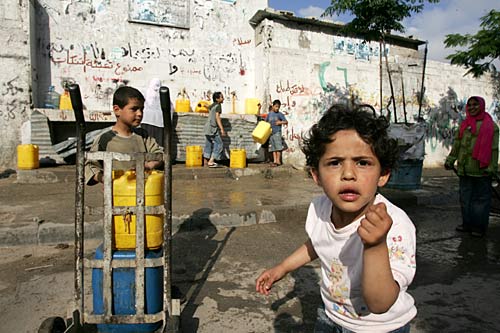
Today the International Red Cross released a report detailing the catastrophic results of Israel’s brutal war on Gaza. As the siege which has crippled Gazans for the past two years continues, the Red Cross found seriously ill patients facing difficulty obtaining the treatment they needed; children suffering from deep psychological problems and people whose homes and belongings were destroyed during the conflict unable to recover.
The report in full reads:
During the 22 days of the Israeli military operation, nowhere in Gaza was safe for civilians. Hospitals were overwhelmed with casualties, including small children, women and elderly people. Medical personnel showed incredible courage and determination, working around the clock to save lives in extremely difficult circumstances. Meanwhile, daily rocket attacks launched from Gaza put thousands of residents at risk in southern Israel. Medical workers in Israel provided care for the traumatized population and treated and evacuated casualties.
Many people in Gaza lost a child, a parent, another relative or a friend. Israel’s military operation left thousands of homes partly or totally destroyed. Whole neighbourhoods were turned into rubble. Schools, kindergartens, hospitals and fire and ambulance stations were damaged by shelling and have to broker deals with financiers for support.
This small coastal strip is cut off from the outside world. Even before the latest hostilities, drastic restrictions on the movement of people and goods imposed by the Israeli authorities, particularly since October 2007, had led to worsening poverty, rising unemployment and deteriorating public services such as health care, water and sanitation. Insufficient cooperation between the Palestinian Authority in Ramallah and the Hamas administration in Gaza had also hit the provision of essential services. As a result, the people of Gaza were already experiencing a major crisis affecting all aspects of daily life when hostilities intensified in late December. Continue reading “Gaza: 1.5 million people trapped in despair”
 P U L S E