Israeli forces killed hundreds of unarmed Palestinian civilians and destroyed thousands of homes in Gaza in attacks which breached the laws of war, Amnesty International concluded in a new report published on Thursday. Operation ‘Cast Lead’: 22 days of death and destruction, is the first comprehensive report to be published on the conflict, which took place earlier this year.
“Israel’s failure to properly investigate its forces’ conduct in Gaza, including war crimes, and its continuing refusal to cooperate with the UN international independent fact-finding mission headed by Richard Goldstone, is evidence of its intention to avoid public scrutiny and accountability,” said Donatella Rovera, who headed a field research mission to Gaza and southern Israel during and after the conflict.
Jonathan Cook reports about the collusion of Israeli doctors in the torture of Palestinians based on evidence presented in a new joint report by the Public Commitee Against Torture in Israel (PCATI) and Physicians for Human Rights-Israel. This comes in the wake of a petition signed by 725 physicians from 43 countries who are demanding that the current president of the World Medical Association Yoram Blachar be removed from office, claiming that the Israel Medical Association which he heads has ignored evidence that doctors working in detention facilities are allowing torture. In return, Blachar has recruited the help of Hadassah – the Women’s Zionist Organization of America – to launch a couter-campaign to discredit the work of the human rights NGOs. (See also the recent report by PCATI which documents the torture and physical abuse of prisoners held by Israeli security forces.)
Israel’s watchdog body on medical ethics has failed to investigate evidence that doctors working in detention facilities are turning a blind eye to cases of torture, according to Israeli human rights groups.
The Israeli Medical Association (IMA) has ignored repeated requests to examine such evidence, the rights groups say, even though it has been presented with examples of Israeli doctors who have broken their legal and ethical duty towards Palestinians in their care.
Khan Younis. Public taps for drinking water, May 2009.
Today the International Red Cross released a report detailing the catastrophic results of Israel’s brutal war on Gaza. As the siege which has crippled Gazans for the past two years continues, the Red Cross found seriously ill patients facing difficulty obtaining the treatment they needed; children suffering from deep psychological problems and people whose homes and belongings were destroyed during the conflict unable to recover.
The report in full reads:
During the 22 days of the Israeli military operation, nowhere in Gaza was safe for civilians. Hospitals were overwhelmed with casualties, including small children, women and elderly people. Medical personnel showed incredible courage and determination, working around the clock to save lives in extremely difficult circumstances. Meanwhile, daily rocket attacks launched from Gaza put thousands of residents at risk in southern Israel. Medical workers in Israel provided care for the traumatized population and treated and evacuated casualties.
Many people in Gaza lost a child, a parent, another relative or a friend. Israel’s military operation left thousands of homes partly or totally destroyed. Whole neighbourhoods were turned into rubble. Schools, kindergartens, hospitals and fire and ambulance stations were damaged by shelling and have to broker deals with financiers for support.
This small coastal strip is cut off from the outside world. Even before the latest hostilities, drastic restrictions on the movement of people and goods imposed by the Israeli authorities, particularly since October 2007, had led to worsening poverty, rising unemployment and deteriorating public services such as health care, water and sanitation. Insufficient cooperation between the Palestinian Authority in Ramallah and the Hamas administration in Gaza had also hit the provision of essential services. As a result, the people of Gaza were already experiencing a major crisis affecting all aspects of daily life when hostilities intensified in late December. Continue reading “Gaza: 1.5 million people trapped in despair”
Today marks the second anniversary of the criminal siege of Gaza. Here is a statement signed by over 40 NGOs, humanitarian and UN organizations denouncing Israel’s blockade:
We, United Nations and non-governmental humanitarian organisations, express deepening concern over Israel’s continued blockade of the Gaza Strip which has now been in force for two years.
These indiscriminate sanctions are affecting the entire 1.5 million population of Gaza and ordinary women, children and the elderly are the first victims.
The amount of goods allowed into Gaza under the blockade is one quarter of the pre- blockade flow. Eight out of every ten truckloads contains food but even that is restricted to a mere 18 food items. Seedlings and calves are not allowed so Gaza’s farmers cannot make up the nutritional shortfall. Even clothes and shoes, toys and school books are routinely prohibited.
9 June 2009, Waziristan — In Jayne Anne Phillips’ Lark and Termite, the skies over Korea, in 1950, are described in this way:
“The planes always come…like planets on rotation. A timed bloodletting, with different excuses.”
The most recent plane to attack the Pakistani village of Khaisor (according to a Waziristan resident who asked me to withhold his name) came twenty days ago, on May 20th, 2009. A U.S. drone airplane fired a missile at the village at 4:30 AM, killing 14 women and children and 2 elders, wounding eleven.
For those who refuse to accept the brutal reality on the ground, the Human Sciences Research Council of South Africa has produced a new detailed legal report which confirms “that Israel is practicing both colonialism and apartheid in the Occupied Palestinian Territories (OPT).” The study was commissioned to “test the hypothesis posed by Professor John Dugard in the report he presented to the UN Human Rights Council in January 2007, in his capacity as UN Special Rapporteur on the human rights situation in the OPT:
Israel is clearly in military occupation of the OPT. At the same time, elements of the occupation constitute forms of colonialism and of apartheid, which are contrary to international law. What are the legal consequences of a regime of prolonged occupation with features of colonialism and apartheid for the occupied people, the Occupying Power and third States?
On the specific question of colonialism the report unambiguously states that:
“Five issues, which are unlawful in themselves, taken together make it evident that Israel’s rule in the OPT has assumed such a colonial character: namely, violations of the territorial integrity of occupied territory; depriving the population of occupied territory of the capacity for selfgovernance; integrating the economy of occupied territory into that of the occupant; breaching the principle of permanent sovereignty over natural resources in relation to the occupied territory; and denying the population of occupied territory the right freely to express, develop and practice its culture” (pp. 15-16). Furthermore, “Israel’s annexation of East Jerusalem is manifestly an act based on colonial intent” (ibid.).
Concerning the charge of apartheid, the report states:
By examining Israel’s practices in the light of Article 2 of the Apartheid Convention, this study concludes that Israel has introduced a system of apartheid in the OPT (p. 17)
The tireless and wonderful Kathy Kelly is visiting refugee camps in Pakistan with Dan Pearson. Here is her first dispatch (Mahmood Mamdani recently told me that apparently Arundhati Roy is also in Swat these days):
In Pakistan’s Swabi district, a bumpy road leads to Shah Mansoor, a small village surrounded by farmland. Just outside the village, uniform size tents are set up in hundreds of rows. The sun bores down on the Shah Mansoor camp which has become a temporary home to thousands of displaced Pakistanis from the Swat area. In the stifling heat, the camp’s residents sit idly, day after day, uncertain about their future. They spoke with heated certainty, though, about their grievances.As soon as we stepped out of the car, men and children approached us. They had all arrived from Mingora, the main city of Swat, 15 days prior. One young man, a student, told us that bombing and shelling had increased in their area, but, due to a government imposed curfew, they weren’t allowed to leave their homes. Suddenly, the Pakistani Army warned them to leave within four hours or they would be killed. With the curfew lifted long enough for them to get out of Mingora, they joined a mass exodus of people and walked for three days before reaching this camp.
And here’s one more on Obama’s speech in Cairo. Adam Morrow and Khaled Moussa Al-Omrani of IPS give an overview of what human rights activists in Cairo think of “the speech no other president could make” as Jonathan Freedland put it in his typically deferential commentary in the Guardian. As opposed to seeing the speech as “sensitive, supple and sophisticated” (Freedland), opposition journalist and reform campaigner Abdel-Halim Kandil argues that “Obama’s visit was a show of support for both the dictatorial Egyptian regime and the criminal policies of Israel regarding the Palestinians…It represents an acknowledgement of Egypt’s role in serving U.S. and Israeli policy objectives, while totally overlooking the regime’s dismal record on human rights and political reform.” For more on this, see Ann’s analysis of the spectrum of responses to the speech posted below.
Egyptian officials are lining up to praise U.S. President Barack Obama’s address to the Islamic world delivered in Cairo Thursday. But local campaigners for political reform say the speech was disappointingly light on the issues of democracy and human rights.
“Obama spoke very briefly and in very general terms on these two subjects,” opposition journalist and reform campaigner Abdel-Halim Kandil told IPS. “Despite the hype, Obama’s speech was little more than an exercise in public relations.”
For Obama’s Cairo speech to have any resonance among Arabs, writes Robert Fisk, he would have to deliver his lecture from Gaza and not one of the world’s worst human rights violators, Egypt.
Maybe Barack Obama chose Egypt for his “great message” to Muslims tomorrow because it contains a quarter of the world’s Arab population, but he is also coming to one of the region’s most repressed, undemocratic and ruthless police states. Egyptian human rights groups – when they are not themselves being harassed or closed down by the authorities – have recorded a breathtaking list of police torture, extra-judicial killings, political imprisonments and state-sanctioned assaults on opposition figures that continues to this day.
The sad truth is that so far did the US descend in moral power under George W Bush that Obama would probably have to deliver his lecture in the occupied West Bank, even Gaza, to change the deep resentment and fury that has built up among Muslims over the past eight years. This, of course, Obama will not do. So Egypt, sadly, it has to be, though he will see nothing of the squalor and fear in which Egyptians live. Continue reading “Robert Fisk: Police state is the wrong venue for Obama’s speech”
Israeli soldiers in the occupied West Bank. (Mamoun Wazwaz/MaanImages)
The weekly UN Office for the Coordination of Humanitarian Affairs (OCHA)reports really ought to be obligatory reading for anyone wishing to grasp the comprehensive brutality of the Israeli occupation. According to its latest report, the dispossession of Palestinian land and resources, house demolitions, arbitrary IDF raids and detentions, and settler violence are sharply on the rise. “During April four Palestinians, including two boys, were killed by [the Israeli army] and another 145 were injured by Israeli soldiers and settlers. The number of Palestinians injured rose by 40 percent compared with the 2008 monthly average,” the report says. A further 391 children (including 6 girls) have been incarcerated by the occupation forces, a 20 percent increase between December 2008 and February 2009.
Commenting on the humanitarian situation in Gaza, the report states that “April saw the lowest number of truckloads entering per month into Gaza (2,656) since the beginning of 2009. This number represents an 18% decrease compared to the monthly average during the first quarter of the year (3,228) and only one-quarter the amount of truckloads that entered Gaza in May 2007 (10,921), one month before the Hamas take-over and the beginning of the blockade.”
Here’s Mel Frykberg‘s (IPS) summary of the findings:
RAMALLAH, May 28 (IPS) – “I heard voices, I turned around to look, and saw a group of Israeli settlers assaulting my brother Hammad,” says Abdallah Wahadin, 82, a Palestinian farmer from Beit Ummar near the southern West Bank city of Hebron.
“Three of them surrounded me, while a fourth threw a rock at the back of my head. Lots of blood ran down onto my clothes. Other settlers then joined them,” Wahadin told the Israeli rights group B’Tselem.
 Impunity for war crimes in Gaza and southern Israel a recipe for further civilian suffering
 presented in a new joint report by the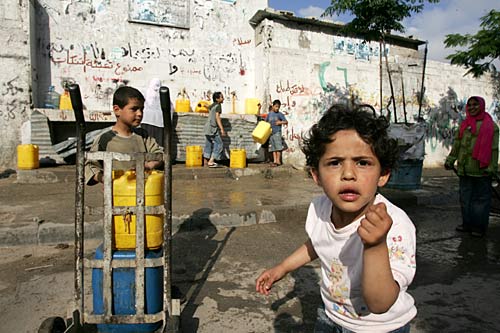


 P U L S E