TIME Columnist Joe Klein discusses his 10-day trip to Iran to cover the election. It is interesting to note that even mainstream journalists like Joe Klein are offering much more sober and nuanced analysis than people like Juan Cole (and Pepe Escobar who basically reproduces as original analysis whatever he reads on Cole’s blog) who have opted for partisan, emotive propaganda.
The only independent nationwide poll in Iran prior to the election was conducted by the New America Foundation and Terror Free Tomorrow. In the light of the developments since division has emerged among the various analysts at NAF. Yesterday NAF organized a forum where the two camps debated their respective positions. I have yet to watch the whole thing, so I’ll watch it with you all and post comments latter. However, I didn’t like the fact that Steve Clemons posted on his Facebook page a rather silly piece by a woman disparaging Flynt Leverett. (You can find stats on the elections here.)
Iran’s recent elections have sparked riots in the streets of Tehran and intense debate in the media and policy communities around the globe. Join us as some of the world’s leading experts share their varied views on how to interpret current events in Iran, and what they mean for US policy toward Iran going forward.
The Editor: In these parlous times it becomes imperative to distinguish between legitimate and illegitimate solidarity. The following is based on principle and respect for the Iranian people, and its demand for transparency and accountability is one we share even if our own reading of the elections is different.(Also see Khatami and Moussavi‘s statements on the elections which have been translated by our good friend Naj).
The aim of the following appeal is to declare our support for the Iranian movement in its call for a new election and our opposition to any violent intervention on the protesters. We do so as independent academics and not as representatives of our many respective governments. We do so in the hope that the historical appreciation and respect of higher learning in most of traditional Iran will make our voice of solidarity heard within Iran.
Iranians participate in the democratic process
June 21, 2009 — A week ago, Friday June 12, Mahmoud Ahmadinejad was declared the winner of the Iranian presidential election. Immediately after, all other candidates, Mir-Hossein Moussavi, Mehdi Karroubi, and even the conservative Mohsen Rezaei, disputed the official results. So did some people who started several demonstrations to express their anger. More news fueled the suspicion of fraud at an unprecedented scale. On Monday June 15, and to the amazement of the world, millions of people – of all ages, classes, and backgrounds – were in the streets of Tehran demanding another election in what was the biggest demonstration since the revolution in 1979. A week later, despite the threats and beatings issued and ordered by the government, millions of people are still demonstrating, and the movement is growing and spreading to other cities.
Neda Soltani was killed by the Basij. This is cowardly and despicable. I hope the perpetrators are brought to justice and dealt with severely. It was reported the other day that some of the Basijis were being arrested. I hope that is true.
Death — by Harold Pinter
Where was the dead body found?
Who found the dead body?
Was the dead body dead when found?
How was the dead body found?
Who was the dead body?
Who was the father or daughter or brother
Or uncle or sister or mother or son
Of the dead and abandoned body?
Was the body dead when abandoned?
Was the body abandoned?
By whom had it been abandoned?
Was the dead body naked or dressed for a journey?
What made you declare the dead body dead?
Did you declare the dead body dead?
How well did you know the dead body?
How did you know the dead body was dead?
Did you wash the dead body
Did you close both its eyes
Did you bury the body
Did you leave it abandoned
Did you kiss the dead body
It appears Robert Fisk — who I have often referred to as the greatest living journalist — is trying to redeem himself for the overly credulous reporting in his last article (for which he was chided here yesterday). “It’s said that the cruel ‘Iranian’ cops aren’t Iranian at all. They’re Hizbollah militia”. These and other equally silly rumors Fisk lays to rest in this return to his usual uncompromising journalism.
Protesters attacked by the Basij
At around 4.35 last Monday morning, my Beirut mobile phone rang in my Tehran hotel room. “Mr Fisk, I am a computer science student in Lebanon. I have just heard that students are being massacred in their dorms at Tehran University. Do you know about this?” The Fisk notebook is lifted wearily from the bedside table. “And can you tell me why,” he continued, “the BBC and other media are not reporting that the Iranian authorities have closed down SMS calls and local mobile phones and have shut down the internet in Tehran? I am learning what is happening only from Twitters and Facebook.”
Patrick Doherty, Deputy Director of the American Strategy Program at the New America Foundation, discusses the Iranian government crackdown that reinforces the perception of electoral fraud, the popular Iranian discontent with autocracy, the dearth of legitimate polling in Iran that increases uncertainty and how Ahmedinejad’s tough negotiating with the U.S. is seen by some as the Persian equivalent of Nixon going to China.
Hamid Dabashi is one of our truly valued friends, a man of integrity, courage and extraordinary genius. I consider him the true heir to Edward Said’s indefatigable spirit. Like us, he is clearly inspired by the determination of those protesting in Iran’s streets. However, unlike us, he appears somewhat cavalier in his dismissal of the preferences of the part of the population which voted for Ahmadinejad, even though he concedes that they may indeed be the majority. (See by comparison Seumas Milne’s comments on this subject).
(CNN) — In a recent article published both in the Washington Post and the Guardian, Ken Ballen and Patrick Doherty reported that according to their “nationwide public opinion survey of Iranians three weeks before the vote … Ahmadinejad [was] leading by a more than 2-to-1 margin — greater than his actual apparent margin of victory in Friday’s election.”
That may or may not be the case, but the abiding wisdom of Aesop’s fable of “The Boy Who Cried Wolf” or its Persian version, “The Lying Shepherd,” has now made any such Monday-morning quarterbacking an academic exercise in futility.
The assumption that the government has rigged the election has become a “social fact” that millions of Iranians believe. On the basis of that belief, they have put their lives on the line, with reported casualties of dozens injured and at least one, perhaps up to nine, people killed.
Robert Fisk witnesses the courage of one million opposition protesters.
A demonstrator who was shot during a protest in the streets of the capital Tehran today
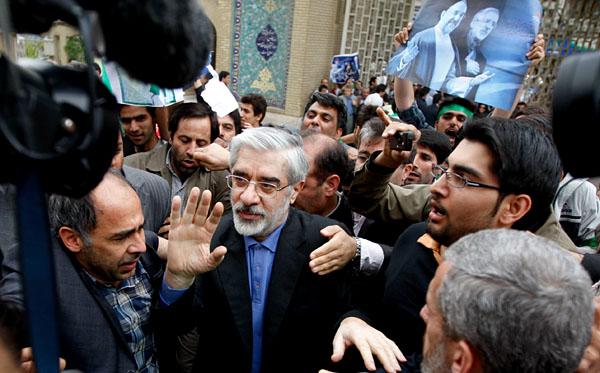
It was Iran’s day of destiny and day of courage. A million of its people marched from Engelob Square to Azadi Square – from the Square of Revolution to the Square of Freedom – beneath the eyes of Tehran’s brutal riot police. The crowds were singing and shouting and laughing and abusing their “President” as “dust”.Mirhossein Mousavi was among them, riding atop a car amid the exhaust smoke and heat, unsmiling, stunned, unaware that so epic a demonstration could blossom amid the hopelessness of Iran’s post-election bloodshed. He may have officially lost last Friday’s election, but yesterday was his electoral victory parade through the streets of his capital. It ended, inevitably, in gunfire and blood.
I imagine that many PULSE readers, like me, hope that Iran is able to preserve the anti-imperialist character of its revolution while ridding itself of the more oppressive aspects, such as dress codes, morality police, and harassment of intellectuals. In these elections, Mousavi certainly seemed the more intelligent and diplomatic of the candidates. The commander of the Revolutionary Guard’s announcement even before votes were counted that a ‘popular revolution’ would not be tolerated seems to suggest that the election results have in fact been rigged. Yet nothing is clear. Mousavi’s campaign was aimed at the merchant class and the liberal bourgeoisie – no more than a third of the population. And Mousavi received about a third of the votes.
Abbas Barzegar believes Ahmedinejad won the election fair and square, and that Iranian and Western commentators indulge in wishful thinking when they find this incredible. “Observers,” he writes, “would do us a favour by taking a deeper look into Iranian society, giving us a more accurate picture of the very organic religious structures of the country, and dispensing with the narrative of liberal inevitability.”
I have been in Iran for exactly one week covering the 2009 Iranian election carnival. Since I arrived, few here doubted that the incumbent firebrand President Mahmoud Ahmedinejad would win. My airport cab driver reminded me that the president had visited every province twice in the last four years – “Iran isn’t Tehran,” he said. Even when I asked Mousavi supporters if their man could really carry more than capital, their responses were filled with an Obamasque provisional optimism – “Yes we can”, “I hope so”, “If you vote.” So the question occupying the international media, “How did Mousavi lose?” seems to be less a problem of the Iranian election commission and more a matter of bad perception rooted in the stubborn refusal to understand the role of religion in Iran.
Here’s Jim Lobe’s (IPS) analysis of yesterday’s meeting between Obama and Netanyahu:
While reaffirming the “special relationship” between their two countries, U.S. President Barack Obama and Israeli Prime Minister Benjamin Netanyahu appeared unable to bridge major differences in their approaches to Iran and Israeli-Palestinian peace efforts following their White House meeting here Monday.
And while Obama repeatedly stressed the importance of a two-state solution to the Israeli-Palestinian conflict, Netanyahu never uttered the phrase or alluded to the possibility of a Palestinian state during a 30-minute press appearance with the U.S. president after their meeting in the Oval Office.
While Obama said he may be prepared to impose additional sanctions against Iran early next year if diplomatic efforts to persuade it to curb its nuclear programme fail to make progress, he refused to set what he called “an arbitrary deadline.” Israeli officials had pressed Washington for an early October deadline.



 P U L S E