Category: Israel Lobby
What Israel and the lobby really fear about Iran
by M.J. Rosenberg
 The internet has been burning up with responses to Jeffrey Goldberg‘s Atlantic cover story on the likelihood that either Israel or the United States will preempt development of an Iranian nuclear bomb by attacking its atomic sites.
Goldberg does not flat-out endorse bombing Iran. Rather, after numerous conversations and briefings with US and Israeli officials, he concludes that there is at least a 50-50 chance that bombs will fly in a year or so.
Goldberg himself does not take a position on whether bombing is warranted or justified. But, given the way he frames the article and his personal closeness, to Prime Minister Binyamin Netanyahu – who speaks in apocalyptic terms of the existential danger a nuclear Iran poses to Israel – it is clear that Goldberg sees no alternative to preventing an Iranian nuke, by whatever means necessary. And that includes war.
Continue reading “What Israel and the lobby really fear about Iran”
One More War, Please
by David Bromwich
 Will the summer of 2010 be remembered as the time when we turned into a nation of sleepwalkers? We have heard reports of the intrusion of the state into everyday life, and of miscarriages of American power abroad. The reports made a stir, but as suddenly as they came they were gone. The last two weeks of July saw two such stories on almost successive days.
First there was “Top Secret America,” the three-part Washington Post report by Dana Priest and William M. Arkin on the hyperextension of private contracts, government buildings, and tax-funded expenditures in the secret surveillance economy. Since 2001, the new industries of data mining and analysis have yielded close to a million top secret clearances for Americans to spy on other Americans. Then at the end of July came the release of 90,000 documents by Wikileaks, as reported and linked by the New York Times, which revealed among other facts the futility of American “building” efforts in Afghanistan. We are making no headway there, in the face of the unending American killing of civilians; meanwhile, American taxes go to support a Pakistani intelligence service that channels the money to terrorists who kill American soldiers: a treadmill of violence. Both findings the mainstream media brought forward as legitimate stories, or advanced as raw materials of a story yet to be told more fully. This was an improvement on the practice of reporting stories spoon-fed to reporters by the government and “checked” by unnamed sources also in government. Yet, as has happened in many cases in the mass media after 2001 — one thinks of David Barstow’s story on the “war experts” coached by the Pentagon and hired by the networks — the stories on secret surveillance and the Afghanistan documents were printed and let go: no follow-up either in the media or in Congress.
We seem to have entered a moral limbo where political judgment is suspended and public opinion cannot catch its breath.
Obama Must Bring Back that Magic to the Middle East
Mosaic Intelligence Report: 2010 is far from over, yet the Middle East has witnessed a series of close encounters with major wars. What are Arabs afraid of? And why is Barack Obama’s popularity sinking fast?
Also see Jim Lobe’s analysis of the Brookings/Zogby ‘Arab Public Opinion Poll’.
Not another war for Israel, intelligence professionals warn
Col. (ret.) Ann Wright warns against the United States waging another war for Israel. Reproduced below is a memo Wright co-signed with Veteran Intelligence Professionals for Sanity (VIPS) warning Obama against such a war.
by Veteran Intelligence Professionals for Sanity
We write to alert you to the likelihood that Israel will attack Iran as early as this month. This would likely lead to a wider war.
Israel’s leaders would calculate that once the battle is joined, it will be politically untenable for you to give anything less than unstinting support to Israel, no matter how the war started, and that U.S. troops and weaponry would flow freely. Wider war could eventually result in destruction of the state of Israel.
This can be stopped, but only if you move quickly to pre-empt an Israeli attack by publicly condemning such a move before it happens.
We believe that comments by senior American officials, you included, reflect misplaced trust in Israeli Prime Minister [Benjamin] Netanyahu.
Continue reading “Not another war for Israel, intelligence professionals warn”
Edge Man: Tony Judt (1948-2010)
 Tony Judt, a towering intellect, a moral giant, and a master of prose, has passed on. He did what only the greatest of thinkers do: he constantly evolved. More significantly, he never succumbed to orthodoxies, he was always on the edge. And that is what gave his writing its distinctive freshness. In his last years, he also outgrew his middle-of-the-road liberalism to adopt principled, at times radical, positions on war and capitalism. He fought successfully to erase the gap between passion and principle. The Zionism of his youth had led him to volunteer for the Israeli forces in 1967; he was disillusioned after realizing that the Israeli soldiers he worked with were ‘right-wing thugs with anti-Arab views’ or ‘just dumb idiots with guns.’
Judt’s disenchantment turned him into one of the most courageous and eloquent critics of the Jewish State. But unlike some luminaries of the left, he also had the moral courage to re-examine his own easy assumptions. A year after his first public statement on Israel-Palestine, in which he had called for a two-state solution, Judt acknowledged its unviability and issued a call for a single binational state in Palestine. In the Chronicle of Higher Education, Evan Goldstein describes the essay’s impact.
According to Benny Morris, a professor of history at Ben-Gurion University of the Negev and author of One State, Two States: Resolving the Israel/Palestine Conflict (Yale University Press, 2009), Judt’s essay placed the one-state idea “squarely and noisily on the table of international agendas.” The Forward described it as “the intellectual equivalent of a nuclear bomb on Zionism.” Within weeks, The New York Review had received more than 1,000 letters to the editor. Suddenly, says Robert Boyers, editor of the quarterly Salmagundi and an observer of the liberal intellectual scene, Judt was a major voice weighing in on the Middle East. Indeed, if the death of Judt’s friend the literary critic Edward Said, in 2003, left a “yawning void” in the national conversation about Israel, Palestine, and the Palestinians, as Judt has suggested, then it is Judt himself who has filled that void.
In 2006, he was the only mainstream figure to come to the defence of Mearsheimer & Walt after they published their groundbreaking London Review essay. He later joined John Mearsheimer in a debate organized by the London Review of Books in which they argued against apologists for the lobby. In the same year an event organized by Network 20/20 at which Judt was slated to speak was cancelled following pressure from the ADL and AJC. This prompted Mark Lilla and 114 writers and intellectuals to write a letter of protest to the ADL. He also spoke eloquently in a must-see Dutch documentary on the lobby (in which he also recounts the Network 20/20 incident). Later, he would join Mearsheimer, Tariq Ali and others to stand up for Norman Finkelstein who was being unjustly denied tenure under Israel lobby pressure. He also wrote a burning indictment of Israel’s crime in the same year, calling it the ‘country that wouldn’t grow up.’
Israel’s PR War
Escalating criticism of Israel led its security establishment to declare a pr war on “delegitimization” (more excellent reports by Lia Tarachansky here).
After Israel’s major attack on Gaza in December 2008, it has faced criticism around the world. This criticism escalated after the publication of the Goldstone Report in 2009 that found evidence of war crimes in the attack. This year, Israel’s security establishment declared a full out PR war on criticism that it identifies as “delegitimization” of Israel. Israel’s most influential think tank, the Reut Institute, developed the strategy for how to fight this PR war. It published a massive report in preparation for this year’s Herzeliya conference entitled “Building a political firewall: against Israel’s delegitimization” which advocated that the Israeli intelligence agencies establish special units to collect information on critics of Israel. The report also advocates the establishment of pro-Israel networks in “hubs of delegitimization” which it named as London, Paris, Madrid, Toronto, and the Bay Area. The Real News’ Lia Tarachansky spoke to Morton A. Klein, the president of the Zionist Organization of America who talks about how American lobby groups help Israel fight its PR war.
Palestine Reading – FiveBooks Interview
Five Books is a website which asks writers, academics and othersuch to list recommended books on a given topic. The Five Books Israel-Palestine week features interviews with interesting figures like Steve Walt. And me. Here’s a video interview of me making several of my favourite points:
Israel: Strategic Asset or Liability?
The following is a transcript of Ambassador Chas Freeman, Jr.‘s remarks, which begin around 17:00.
Why Jeff Goldberg Is Losing It
by M.J. Rosenberg
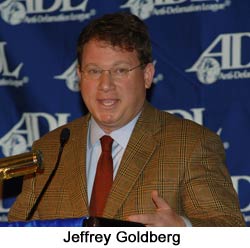
For two days, the Atlantic’s Jeff Goldberg has been calling Stephen Walt, John Mearsheimer and other critics of Bibi Netanyahu “anti-Semites.” Nothing new about that. For Goldberg, a major AIPAC neocon, all critics of Israeli policies are anti-Semites by definition. (See this good piece on Goldberg).
But why is he obsessing about Walt so much now?
It is because, in August, Goldberg is coming out with his big Atlantic piece calling on the United States to bomb Iran so that Israel does not have to.
But Goldberg has a problem. As an American who chose to serve in the Israeli army (he was a guard at a Palestinian prison camp), he fears that Stephen Walt and John Mearsheimer — who accused the Likud lobby of promoting war with Iraq in their groundbreaking bestseller — will point out that Goldberg is just about the least credible advocate for war with Iran.
 P U L S E