Active Non-violence in Palestine and Israel

By David Hartsough

When some people think of Palestine and Israel, they often picture Palestinians as suicide bombers and terrorists while the Israeli military are seen as bombing whole neighborhoods in Palestine. The violence and counter-violence and endless war has created a hopelessness about any peaceful future for the Holy Land.

However, during a month-long stay in Palestine and Israel recently, I found something else. I found something very positive and hopeful and perhaps the key to a peaceful resolution of this tragic conflict — and a possible path toward a peaceful future for both peoples.

I found that violence is not the whole story. Endless checkpoints, 26-foot high walls, and the great fear and mistrust between many Israelis and Palestinians are grimly persistent features of life there. But there is also an alternative to this cycle of destruction being forged on both sides. There is a larger story beyond the script of retaliatory violence – a story of a growing nonviolent movement that both Palestinians and Israelis are building. It is this larger story that I would like to share.

Continue reading “Active Non-violence in Palestine and Israel”

Russell tribunal says sanction Israel

Russell Tribunal on Palestine concludes the EU should sanction Israel until violations stop.

Finkelstein in Prague

Last week, Norman Finkelstein delivered a series of lectures in Prague as part of his European speaking tour. Finkelstein was initially invited to speak at the prestigious Czech Academy of Sciences but had his invitation revoked less than 24 hours prior to his scheduled talk, allegedly at the behest of the Prime Minister’s office. A similar fate befell Finkelstein’s appearance in Munich and Berlin, where the Heinrich Boll and Rosa Luxembourg Foundations cancelled the events, following “a concerted campaign by neoconservative and pro-Israeli pressure groups, such as Honestly Concerned and BAK Shalom, known for their unconditional support of Israeli policies and the defamation of critics as anti-Semites.”

Here is Finkelstein’s lecture at Casa Gelmi in Prague, organised by the Czech pro-Palestinian group ‘Friends of Palestine’.

Continue reading “Finkelstein in Prague”

Taher, a UCI protester originally from Gaza, writes that heckling Oren was right

Taher Herzalla is a third-year political science major at UC Riverside and was part of the “Irvine 11” that protested Michael Oren’s recent address. Taher is himself originally from Gaza and has been directly affected by the hafrada regime’s brutality. He had this piece published in the Orange County Register: be sure to write to the editor or leave a quick comment to thank them for publishing it. Check out their blog, Stand with the Eleven and spread their Stand With the Eleven action flyer.

Today, our American civil rights movement is praised worldwide for its humanism, righteousness, and courage. But, it was not always this way.

The same leaders we now hold in high esteem were once labeled as rabble-rousers for their principled and unpopular stands. It is no surprise then, that those who stand today against one of the greatest injustices of our time are similarly labeled. I am in a worldwide movement advocating for the indigenous Palestinian population and opposing the apartheid policies of Israel. The United Nations has condemned Israeli actions with more resolutions than any other nation.

I know the pain of Israel’s brutal military tactics firsthand. Three members of my immediate family were killed in Gaza last year during “Operation Cast Lead,” in which more than 1,400 Palestinians were killed and more than 5,300 wounded.

Continue reading “Taher, a UCI protester originally from Gaza, writes that heckling Oren was right”

Europe’s Alliance with Israel

by David Cronin

Avigdor Lieberman meets Javier Soalan who has described Israel as a 'member of the European Union without being a member of its institutions.'

One of the pitfalls of specialising in European politics, as I have for the past 15 years, is that certain assumptions become hardwired in your brain.  For a long time, my critical faculties shut down when I heard senior EU representatives speak of the Middle East. I happily accepted the official narrative that they were striving for a just resolution to the conflict between Israel and the Palestinians and that it would be foolish to park the so-called peace process in a “blood-soaked lay-by”, in the words of former EU commissioner Chris Patten.

Israel’s attacks on Lebanon in 2006 and on Gaza just over a year ago illustrated how naive and gullible I had been. In the first instance, Tony Blair blocked the EU from formally calling for a ceasefire because he wanted Israel to be given whatever space it perceived necessary to fight Hezbollah (Israel’s slaughter of Lebanese civilians in that 33-day war elicited no more than statements of “regret” from London).

It is true that the Union did urge a halt to the violence that Israel inflicted on Gaza’s 1.5 million inhabitants in late 2008 and early 2009. Yet by describing that attack as “disproportionate”, key EU representatives implicitly approved the Israeli version of events – that everything had been provoked by the missiles Hamas was firing on the southern Israeli towns of Ashkelon and Sderot. “Gaza was a crisis waiting to happen,” Marc Otte, the Union’s Middle East envoy, told me. “Do you think the Palestinians could continue to launch rockets on Israel without Israel reacting?”

Continue reading “Europe’s Alliance with Israel”

‘Gaza is an open-air prison’

John Holmes, the United Nation’s humanitarian chief, has revisited the Gaza Strip, a year after Israel’s assault on the territory ended.

He told Al Jazeera that it was disappointing how little has changed since the war and that there has been no real possibility of reconstruction, mainly because of Israel’s siege of the Strip.

He said the blockade resulted in misery for the Palestinians.

“They’re living in a kind of open-air prison. They’re still suffering this kind of collective punishment they’ve been suffering for three years now.”

Dissident Jews: Unwanted in Germany?

by Raymond Deane

Norman Finkelstein

A European country that scapegoats a Semitic people, persecutes defenders of human rights by stripping them of employment, and denies freedom of speech to Jews: surely a description of Germany during the Third Reich?

Yes, but unfortunately also a description of Germany at the outset of the 21st century.

In the wake of German Chancellor Merkel’s craven speech to the Israeli Parliament (the Knesset) two years ago, I wrote: “a penance is being paid for Germany’s past crimes… by the Palestinians to whose plight Merkel is so indifferent…. By scapegoating the victims of its former victims, Germany is compounding its past crimes.”  (Scapegoat upon Scapegoat, Electronic Intifada, 20 March 2008).

Just one year later I described the case of Hermann Dierkes,  forced to resign his position as representative of Die Linke (The Left Party) on Duisburg city council after tentatively advocating a boycott of Israeli goods. I commented: “It appears that freedom of speech, supposedly one of the proudest acquisitions of post-Fascist Germany, is readily suppressed when exercised to advocate positive action against the racist, politicidal institutions and actions of the Zionist state.” (A public stoning in Germany, Electronic Intifada, March 2009).

Continue reading “Dissident Jews: Unwanted in Germany?”

The Unstated Script

William A. Cook provides an overview of the state of affairs of the zionist affairs of state, in a piece entitled The Unstated Script of the Wiesel Open Letter to President Obama. It is a good summary but by no means definitive: one could add theft of Palestinian tax credits, water, fertile top soil, religious sites, harvesting of human organs, daily humiliations, and much much more …

Let’s draw up the bill of particulars that is hidden from the world, the subtext, the unsaid prayer no one in this American government wants revealed and certainly no one in Israel wants displayed publicly.

What is the true nature of this state of Israel that … is now seeking to enlist the governments of the world against its perceived “existential” enemy, Iran?

* It is a state without mercy, a state without morals, a state premised on racism, a state built on deception and lies;

* a state defiant of international law, the Universal Declaration of Human Rights, and the Geneva Conventions that apply to occupying powers;

* a state, unlike North Korea or Iran, the other identified Axis of Evil states, that has invaded neighboring states and occupies them;

Continue reading “The Unstated Script”

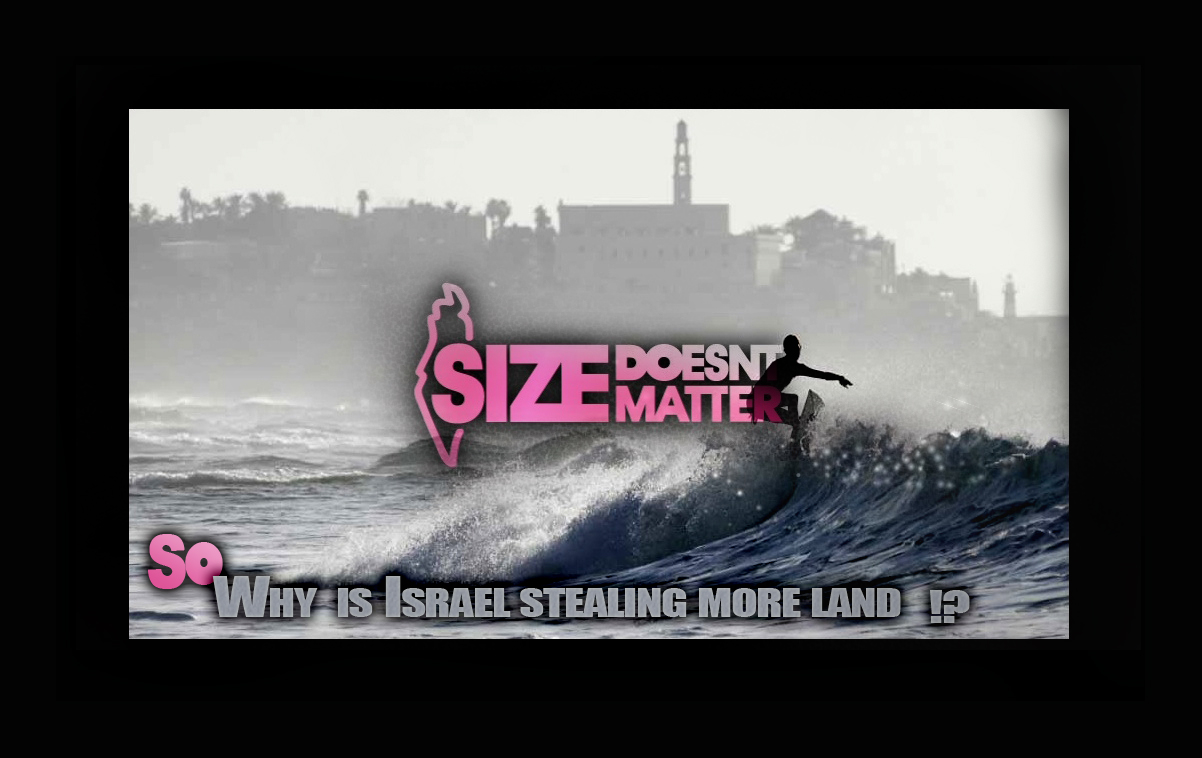
Size doesn’t matter?

By Dalia Elcharbini: Visual Artist

Continue reading “Size doesn’t matter?”

The Second Battle of Gaza: Israel’s Undermining Of International Law

by Jeff Halper

The Israeli attack on Gaza in December 2008/January 2009 was not merely a military assault on a primarily civilian population, impoverished and the victim of occupation and besiegement these past 42 years. It was also part of an ongoing assault on international humanitarian law by a highly coordinated team of Israeli lawyers, military officers, PR people and politicians, led by (no less) a philosopher of ethics. It is an effort coordinated as well with other governments whose political and military leaders are looking for ways to pursue “asymmetrical warfare” against peoples resisting domination and the plundering of their resources and labor without the encumbrances of human rights and current international law. It is a campaign that is making progress and had better be taken seriously by us all.

Since Ariel Sharon was indicted by a Belgian court in 2001 over his involvement in the Sabra and Chatila massacres and Israel faced accusations of war crimes in the wake of its 2002 invasion of the cities of the West Bank, with its high toll in civilian casualties (some 500 people killed, 1,500 wounded, more than 4,000 arrested), hundreds of homes demolished and the urban infrastructure utterly destroyed, Israel has adopted a bold and aggressive strategy: alter international law so that non-state actors caught in a conflict with states and deemed by the states as “non-legitimate actors” (“terrorists,” “insurgents” and “non-state actors,” as well as the civilian population that supports them) can no longer claim protection from invading armies. The urgency of this campaign has been underscored by a series of notable setbacks Israel subsequently incurred at the hands of the UN. In 2004, at the request of the General Assembly, the International Court of Justice in The Hague ruled that Israel’s construction of wall inside Palestinian territory is “contrary to international law” and must be dismantled—a ruling adopted almost unanimously by the General Assembly, with only Israel, the US, Australia and a few Pacific atolls dissenting. In 2006 the UN Commission of Inquiry concluded that “a significant pattern of excessive, indiscriminate and disproportionate use of force by the IDF against Lebanese civilians and civilian objects, failing to distinguish civilians from combatants and civilian objects from military targets.” together with the harsh criticism of the UN’s Goldstone report on Gaza accusing the Israeli government and military again of targeting Palestinian civilians and causing disproportionate destruction, has made this campaign even more urgent.

Continue reading “The Second Battle of Gaza: Israel’s Undermining Of International Law”