Pakistan has been battling a growing problem of drug addiction in the country. Most users rely on local NGOs for treatment and rehabilitation, but these are often weighed down by a lack of funds. Now, a leading charity has shut down after a dispute with the government cut off vital support for thousands of people. Al Jazeera’s Hashem Ahelbarra reports.
In related news, President Zardari told reporters the newly acquired F-16s from the US will not upset the regional balance of power.
In the wake of Benazir Bhutto’s assassination as violent attacks ripple throughout Pakistan and tensions escalate with the West, WITHOUT SHEPHERDS offers a rare glimpse into real life in the shadow of the war on terror. From the streets of Karachi to the Afghan border, the film crosscuts between six people wrestling with a country in turmoil and defiantly standing for change: a cricket star building a new political party, a trucker crossing dangerous territory to feed his family, a supermodel pushing feminism through fashion, a subversive Sufi rocker using music to heal, a female journalist working behind Taliban lines, and an ex-mujahid seeking redemption. Together their stories give context to a crisis that has dangerous consequences for the region and the world and unveil the progressive face of this misunderstood country.
A poverty-stricken Pakistani woman and her child wait in an impoverished locality of Khori Garden for free distribution of food items at the same place where earlier a stampede killed 20 women and children queuing for food handouts in an impoverished district of financial capital Karachi. (RIZWAN TABASSUM/AFP/Getty Images)
On June 16, in Lahore, a rickshaw driver, his wife, and three children took poison, driven to despair by extreme poverty. Only the wife survived. On June 17, another young man committed suicide pushed over the edge by poverty and unemployment. On June 18, the Pakistani information minister Qamar Zaman Kaira advised people who are killing their children because of dire poverty to instead hand them over to the Baitul Mal (the Islamic treasury which serves as a social support system). Today in Raheem Yar Khan, a woman in her early thirties jumped in front of an approaching train along with her three children, ages 2 to 7. All died on the spot…
In related news, Pakistan received a shipment of the first three of its order of 18 new F-16 fighter jets from the United States. It has also received over $10 billion in military aid since 2002. It’s to keep Pakistanis safe, you see.
The Electronic Intifada has published a damning report by journalist Asa Winstanley which shows that the Palestinian Authority attempted to neutralize a United Nations Human Rights Council resolution condemning Israel’s deadly attack on the Gaza Freedom Flotilla which killed nine Turkish citizens, including a dual US-Turkish citizen, and injured dozens of others aboard the Mavi Marmara in international waters. The Electronic Intifada has published one of the several UN and Palestinian Authority documents that were obtained by Winstanley. Here are highlights from the report:
The Electronic Intifada (EI) today publishes one of the documents it obtained, containing proposed amendments to a draft Human Rights Council (HRC) resolution. Annotations to the resolution indicate the Palestinian Authority (PA) stood with European Union (EU) countries against Turkey’s calls for robust action to hold Israel accountable.
The PA’s apparent collusion to shield Israel will recall for many its efforts to undermine UN action on the Goldstone report last October.
Apparently written by a European delegate, the document’s amendments would have seriously diluted Turkey’s original wording. The most damaging change would have removed the call for an independent UN investigation under HRC auspices. The document was provided to EI by a source who described how it was obtained inside the UN Office at Geneva, and asked to remain anonymous.
Turkey rejected the EU-PA amendments, and the final resolution on 2 June declared that the council “Decides to dispatch an independent international fact-finding mission to investigate violations of international humanitarian and human rights law resulting from the Israeli attacks” (“The Grave Attacks by Israeli Forces against the Humanitarian Boat Convoy,” United Nations Human Rights Council, Fourteenth session, A/HRC/14/L.1, Adopted on 2 June 2010).
The language in the final resolution was very similar to the January 2009 HRC resolution which led to the Goldstone report, the independent investigation that detailed war crimes committed during Israel’s 2008-09 invasion of Gaza.
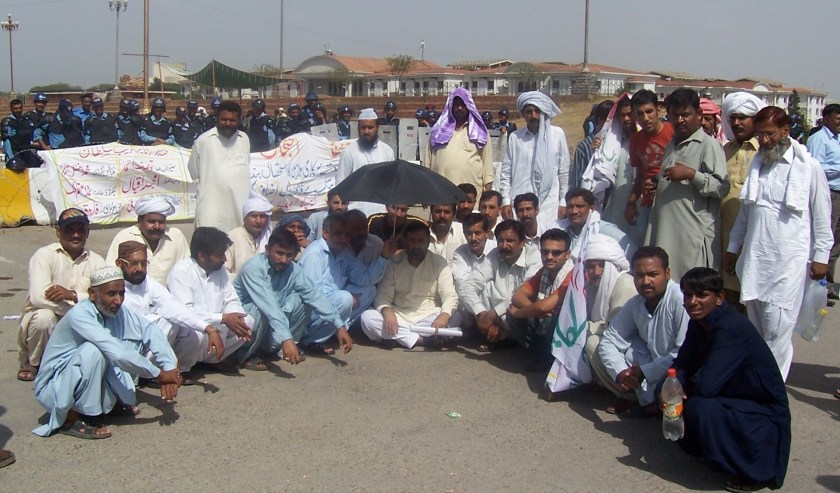
All Pakistan Clerks Association Protest at Parliament in Islamabad
“The military is the muscle that protects the ruling elite from the wrath of the people,” says Pakistani political analyst Dr. Mubashir Hassan. “Right now, people are out on the street; blocking roads, attacking railway stations, etc. If you read the papers, it seems as though a general uprising has started all over Pakistan.”
Dr. Hassan says that sporadic outbursts of anger in Pakistan won’t coalesce into a people’s revolution anytime soon. The demonstrators are too disorganized. But, the sheer volume of daily protests shows that many sectors of Pakistani society have pressing needs and priorities that do not include enlistment as foot soldiers in a proxy force for the United States’ War on Terror.
Dr. Hassan, a co-founder of the People’s Party of Pakistan, is a respected scholar and statesman. Last year, when we met with him, he had just returned from a visit, in the U.S., with Professors Noam Chomsky and Howard Zinn, his contemporaries in seeking to build just and fair social structures. Last month, in Lahore, he spoke with us about U.S. interference in the region and changing dynamics in Pakistan.
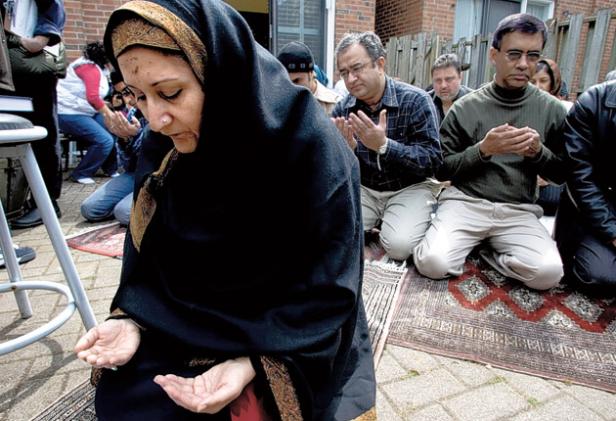
Raheel Raza leads a group of Muslims in prayer in Canada
By Huma Dar
On Thursday, June 10, 2010, Jerome Taylor, the Religious Affairs Correspondent of The Independent posted an article headlined, “First Woman to Lead Friday Prayers in UK.” Two-thirds of the way down this article, we find that:
“Ms Raza’s appearance in Oxford is a repeat of a similar prayer session in 2008 which was led by Amina Wadud, an American-born convert and Muslim feminist. But this is the first time a Muslim-born woman will lead a mixed prayer service in Britain.”
News organizations need to be careful about their sources. They appear to report as fact claims made by any entity that calls itself an ‘institute’ or a ‘foundation’. This otherwise commendable report from Russia Today on the murderous US drone attacks is no exception. Like many other media outlets (including, oddly, Democracy Now and Al Jazeera) it reports as fact a dubious report produced by the New America Foundation (NAF), a leading cheerleader for the wars in Afghanistan and Pakistan, which has transmuted the drones 98% failure rate into a 67% success rate. None of these media outlets it appears has taken a minute to study the report’s methodology or question the motivations of the organization behind it. The conflicts of interest are serious.
The NAF report is based exclusively on English language media reports, which rely solely on official claims. The officials, both American and Pakistani, for their reasons have an interest in inflating the success rate. Two studies produced by Paksitan’s The News and Dawn (the latter a supporter of the war) show that that the actual success rate is near 2 percent. This estimate has also been endorsed by David Kilcullen, the former senior advisor on counterinsurgency to Gen. David Petraeus. (In response NAF’s ‘Afpak Channel’ published this airy assessment by Christine Fair challenging Kilcullen which relies on yet another ‘institute’, the ‘Aryana Institute’, a sectarian paper organization which actually claims that Pakistanis are thrilled by drone attacks!)
NAF’s ‘Afpak Channel’, which produced the report, discredited itself long ago with its overly rosy assessment of the situation in Afghanistan and Pakistan. And while it has been featuring commentary which is frequently at odds with reality, it has been reluctant to publish anything that might undercut its sanguine support for the war. It sat on a grim assessment of developments in Afghanistan by IPS’s excellent investigative journalist Gareth Porter before informing him that it won’t be published. Its Twitter frequenlty features juvenile commentary, breathlessly sanguine about US successes in Afghanista and Pakistan. Over all, it is a highly questionable source. I’d urge journalists to show more caution.
June 2, 2010, Islamabad — “Our situation is like a football match. The superpower countries are the players, and we are just the ball to be kicked around.” This sentiment, expressed by a young man from North Waziristan, has been echoed throughout many of our conversations with ordinary people here in Pakistan and in Afghanistan. Most are baffled that the United States, with the largest and most modern military in the world, can’t put a stop to a few thousand militants hiding out in the border regions between Pakistan and Afghanistan.
Just about everyone we have spoken with, Pashtuns included, has little to no sympathy for the Taliban or their tactics. Many people have lost limbs, homes and loved ones to the brutal assaults of suicide bombers or the indiscriminate violence of IEDs. Yet, people expressed frustrated confusion over uncertainties regarding U.S. government goals in relation to the Taliban. Some believe that the United States might be working with the ISI (Pakistani Intelligence Services) or at least not working against them, to enable continued Taliban resistance. If there is no resistance, according to this view, a military presence in the region cannot be justified. Nor can a so-called humanitarian presence further flood the Pakistani and Afghan economies with millions of dollars in aid that most often lines the pockets of the politicians, elite bureaucrats, and United States corporations involved in construction and security.
Islamabad–Abir Mohammed, a refugee from Bajaur, says that the battles which raged in his home province since 2008 have dramatically changed his life. We met him in a crowded Islamabad café where he politely approached customers, offering to shine their shoes. He isn’t accustomed to shoeshine work. But, he needs to earn as much money as possible before reuniting with family members who await him, near Peshawar, in a tent encampment for displaced people.
Formerly, he lived with his wife, his five children, his mother and four brothers in a home near the Afghanistan border. “We were very satisfied with our life,” says Abir Mohammed. “My brothers and I cultivated wheat crops and maintained orchards.” His land is full of rich soil. “But, in these days,” says Abir, “due to disasters and lack of water and electricity, there is no chance of cultivating crops.”
The devastation could not be more heartbreaking. From one end to the other, the whole tribal area presents the spectacle of a war zone. Houses blown up, villages decimated, infrastructure no more.
Add Dir, Buner and Swat to that. Vast swaths are in ruins in Maidan, in the Dir region. Whole villages in Buner have disappeared. Matta and the adjoining areas in Swat present a picture of a powerful cyclone having devastated the whole area.
Between Khar and Nawagai, in what once was a most fertile area, villages on both sides of the road have been razed to the ground.
Many of the returning IDPs of Bajaur and Dir could not determine where their villages had once stood, to say nothing of their homes. They had to make return journeys to their camps.
In Qaudahari, in the Safi area of Mohmand, the situation is no better. The wreckage of a war is everywhere, with houses and villages having ceased to exist.
Bara, in Khyber Agency, an area once administered by an Assistant Political Agent, presents the picture of a ghost town.



 The devastation could not be more heartbreaking. From one end to the other, the whole tribal area presents the spectacle of a war zone. Houses blown up, villages decimated, infrastructure no more.
 P U L S E