A worthwhile Russia Today interview with Nazareth resident, journalist and author, Jonathan Cook.
Vodpod videos no longer available.
Continue reading “Israel not a democracy: Jonathan Cook interview”
A worthwhile Russia Today interview with Nazareth resident, journalist and author, Jonathan Cook.
Vodpod videos no longer available.
Continue reading “Israel not a democracy: Jonathan Cook interview”
A recent address by Mustafa Barghouti in Canada, in two parts. Born in Jerusalem in 1954, Dr Barghouti is a leader of the Palestinian National Initiative founded in 2002 and a member of Palestinian Legislative Council as well as a former Minister of Information in the unity government in 2007. The full transcript from these Real News Network clips appears over the fold. Also check out Dr Barghouti’s excellent 2008 address to the American Arab Anti-Discrimination Committee (ADC) National Convention and his recent piece in FP, The Slow Death of Palestinian Democracy.
Part One
Continue reading “The rising non-violent movement in Palestine: Mustafa Barghouti”
Recorded in 2001 during the second intifada, Netanyahu is captured on film bragging about destroying Oslo whilst visiting Israelis on a ‘condolence call’ in the occupied Palestinian West Bank. Israel’s Channel 10 recently broadcast the video, which records Netanyahu’s unguarded comments about his first term as prime minister from 1996-99, including a boast that America can “easily be moved”.
Gideon Levy notes in ‘Tricky Bibi‘: “No more claims that the Palestinians are to blame for the failure of the Oslo Accords. Netanyahu exposed the naked truth to his hosts at Ofra: he destroyed the Oslo accords with his own hands and deeds, and he’s even proud of it. After years in which we were told that the Palestinians are to blame, the truth has emerged from the horse’s mouth.”
Also check out John Cole’s ‘Flying the flag‘ cartoon in The Times-Tribune.
Translation by Dena Shunra (via Richard Silverstein):
Bibi:…The Arabs are currently focusing on a war of terror and they think it will break us. The main thing, first of all, is to hit them. Not just one blow, but blows that are so painful that the price will be too heavy to be borne. The price is not too heavy to be borne, now. A broad attack on the Palestinian Authority. To bring them to the point of being afraid that everything is collapsing…
Woman: Wait a moment, but then the world will say “how come you’re conquering again?”
Netanyahu: the world won’t say a thing. The world will say we’re defending.
Woman: Aren’t you afraid of the world, Bibi?
Netanyahu: Especially today, with America. I know what America is. America is something that can easily be moved. Moved to the right direction.
Continue reading “The Real Bibi: Netanyahu Brags About Manipulating US, Sabotaging Oslo Accords”
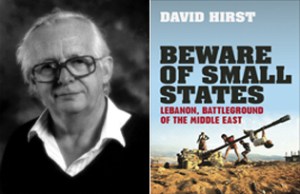 My interview with David Hirst, author of Beware of Small States, reviewed here, was done on behalf of the indispensable Electronic Intifada.
Veteran Middle East correspondent David Hirst, author of the seminal work on the Palestinian plight The Gun and the Olive Branch, has a new release: Beware of Small States, an equally important book on Lebanon’s complex tragedy. The Electronic Intifada contributor Robin Yassin-Kassab interviewed Hirst on his work and views.
Robin Yassin-Kassab: You did your national service in Cyprus and Egypt just before the 1956 Suez War. What effect did your first experience of the Middle East have on you? Why did you end up spending your life in the Middle East, particularly in its more violent corners? Have kidnappings and bannings discouraged you?
David Hirst: Yes, I was one of the last generation of British 18-year-olds obliged to do two years of military service. Politically speaking, it had virtually no effect on me; I was an immature youth from a thoroughly apolitical middle class background, and knew next to nothing about international affairs, and hardly knew, for example, the difference between Arabs and Israelis. But — unusually for a mere private soldier — I sought and secured permission to use a fortnight’s leave to travel round Syria, Iraq, Jordan and Lebanon. I enjoyed the experience. After three years at Oxford, I could not think of a career to embark on. Remembering the American University of Beirut, I wrote and asked them if there were any kind of introductory course about the Middle East that I could follow there. There was. With a vague idea of staying there for a couple of years or so, I found myself drifting into journalism, and, taking to it, I ended up staying fifty.
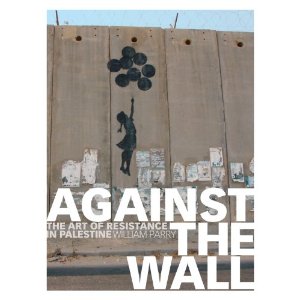 This is the question posed by photojournalist William Parry at the start of his new book Against the Wall: The Art of Resistance in Palestine (Pluto Press, May 2010), in which he documents graffiti artwork on the West Bank Wall and the stories of Palestinians whose lives are affected by said monstrosity.
Below is the introduction to the book, which has been endorsed by political cartoonist Joe Sacco, among others.
Check back early next week for a selection of images from Against the Wall.
***
In December 2007, the celebrated and famously elusive British street artist, Banksy, and a London-based organisation called Pictures on Walls, relocated their annual ‘squat art concept store’ called Santa’s Ghetto from London to Bethlehem and invited 14 other international street artists to join him to work with Palestinian artists. The concept was simple: the artists would make artwork available for sale by auction to the public – but those wanting to buy an original work of art by Banksy or the others had to physically go to Bethlehem, witness Israel’s occupation and checkpoints, and bid in person. The artists also used the opportunity to utilise the Wall as a giant billboard for their own political messages with some massive, stunning images – wall spaces throughout the city were also populated with work that challenged or subverted understandings about the reality faced by Palestinians under occupation. Within a few short weeks, Santa’s Ghetto had raised over $1 million from art sales for local charities and brought Bethlehem and the Wall to the world’s attention in a way that transcended language and engaged millions who wouldn’t ordinarily take an interest in Israel’s illegal occupation of Palestine. Just as important, it sent a message to the people of Palestine: you are not alone in your struggle.
Continue reading “Is the spray can mightier than the sword?”

Roger Waters and David Gilmour reunite to help young Palestinian refugees at an event organized by Jemima Khan. Rolling Stone reports:
For the first time in five years, the two driving forces behind Pink Floyd, Roger Waters and David Gilmour, reunited onstage at a benefit in England over the weekend. The unannounced team-up went down before the 200 attendees of the Hoping Foundation benefit in Oxfordshire, which raised money for young Palestinian refugees. The duo’s four-song set included Phil Spector’s “To Know Him Is To Love Him” (a Floyd sound-check staple according to the blog on Gilmour’s website) and the band’s classics “Wish You Were Here,” “Comfortably Numb” and “Another Brick in the Wall, Part 2.”
The Saturday night set marks the first time Waters and Gilmour have shared the stage since Pink Floyd’s reunion performance at 2005’s Live 8 in London. The duo’s Hoping Foundation performance helped raise £350,000. At the benefit, Gilmour and Waters — who swapped his bass for an acoustic guitar — were joined by keyboardists Harry Waters and Jonjo Grisdale, drummer Andy Newmark, guitarist Chester Kamen and bassist Guy Pratt, who ironically replaced Waters in the Gilmour-led, Division Bell-era Pink Floyd.
by Jeremy Hammond
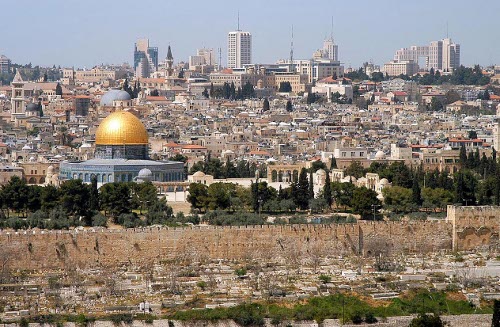
Here’s the Washington Post on the Israeli occupation of Jerusalem, emphasis added:
Ever since the administration was blindsided by Israel’s March 9 announcement that it intends to build 1,600 housing units in a disputed area of Jerusalem, U.S. officials have pressed Israel to take actions to encourage Palestinians to attend indirect talks, including canceling the project, making concrete gestures such as a prisoner release and adding substantive rather than procedural issues to the agenda for talks. Some U.S. requests have not been made public.
“Disputed”? This description implies that Israel and the Arabs both have some kind of legal claim over Jerusalem. But the fact of the matter is that Jerusalem is not by any means “disputed”. This is simply false. It is a simple and uncontroversial point of fact under international law that Israel has no legal claim to Jerusalem, that Jerusalem is rather undisputed Palestinian territory, and that Israel’s occupation of the city is illegal, in violation of both the Fourth Geneva Convention and numerous U.N. Security Council resolutions.
Israel today controls Jerusalem because it invaded and occupied the West Bank in 1967. Subsequently, the United Nations Security Council passed resolution 242, which emphasized “the inadmissibility of the acquisition of territory by war”, emphasized that member states have a commitment to abide by the U.N. Charter, and called for the “Withdrawal of Israeli armed forces from territories occupied” during the June 1967 war.
In May 1968, the Security Council passed resolution 252, which declared Israel’s annexation of Jerusalem “invalid” and called upon Israel “to rescind all such measures already taken and to desist forthwith from taking any further action which tends to change the status of Jerusalem”.
Obama’s pandering was all about concern over losing campaign contributions from wealthy Jewish donors in the upcoming elections, says Finkelstein.
Israeli President Benjamin Netanyahu, suffering on the global front after a string of setbacks, is meeting with US President Barack Obama in Washington to discuss a range of thorny issues. Norman Finkelstein, author of “A Farewell to Israel: The coming break-up of American Zionism”, shares his view on US-Israeli ‘unbreakable’ bond.
And the world continues to tolerate all this…
As a Libyan backed aid ship sails for the Gaza Strip, another group of international activists has been defying the blockade, but this time on the land. Foreigners acting as human shields have been helping farmers in Gaza harvest their crops. About 30 per cent of Gaza’s arable land is on the border with Israel and the area has been declared a buffer zone by the Israeli army. Palestinian farmers risk being shot with live fire for working their fields.
Nicole Johnston reports from Bani Salah.
 P U L S E