Nakba day – يوم النكبة Yawm al-Nakba 2010

By Mazin Qumsiyeh

Today is the day we actually commemorate Nakba Day, 14 May 1948, the date the state of Israel was declared.  However, it is not the beginning of our Nakba (catastrophe) nor its end.  Over 200 villages were ethnically cleansed in the six months before 14 May 1948.  This simple fact illustrate that it is not the founding of the militarized state of Israel that began the Nakba but that it was a pivotal moment in it.  After that date, the wave of ethnic cleansing was being done in a name of a nation-state established by and for Jews from Europe and not just the terrorist underground Jewish militias. The ethnic cleansing accompanying the foundation of this apartheid Jewish state and its maintenance meant the destruction of 530 villages and towns and meant that in the past 9 years alone over 10,000 homes were destroyed in the West Bank (including occupied Jerusalem), Gaza, and the Negev.

Today 7 million of the 11 million Palestinians around the world are refugees or displaced people.  The Israeli population according to the Israeli central bureau of statistics is 7,510,000 of which 5,984,500 are “Jews and others” (presumably the others are Druze, Russian non-Jews, and similar categories) and 1,525,500 Palestinian Arabs (1).  The population of Palestinians in the West Bank and Gaza is 4 million allowed to live on areas A & B, small parts of the 22% of Palestine occupied since 1967 (2).  The total area allowed for Palestinian use is 2.5% of the area of pre-1967 Israel (3) plus areas A & B of the West Bank .  In total this comes to 2.5% of 78% and 29% of the 22% that is the West Bank and Gaza (4). The total geographic access to all remaining Palestinians (5.525 million) is thus 1.95%+6.38%=8.33% while the Jewish and other population (Zionist preferred) consists of 5.5 million with access to the remaining lands comprising 91.67% of historic Palestine.

Continue reading “Nakba day – يوم النكبة Yawm al-Nakba 2010”

Myth and Memoricide: Shlomo Sand’s “Invention of the Jewish People”

Denise Buonanno's "Le Juif Errant"

This review essay was published at The Drouth.

A nation is “a group of persons united by a common error about their ancestry and a common dislike of their neighbours.” Karl Deutsch.

“I don’t think books can change the world, but when the world begins to change, it searches for different books.” Shlomo Sand.

Our Assumptions About Israel

Here is what we in the West, to a varying extent, whether we are religious or not, assume about the Jews and Israel:

The Jews of the world, white, black and brown, are the sons of Abraham, Isaac and Jacob. Moses, after leading the Jews out of Egyptian enslavement, gave them laws. Emerging from the desert, the Jews conquered the promised land of Canaan, which became Judea and Israel, later the mighty kingdom of David and Solomon. In 70CE the Romans destroyed the temple at Jerusalem and drove the Jews from their land. A surviving Jewish remnant was expelled when Muslim-Arab conquerors colonised the country in the 7th Century. And so the Jews wandered the earth, the very embodiment of homelessness. But throughout their long exile, against all odds, the Jews kept themselves a pure, unmixed race. Finally they returned, after the Holocaust, to Palestine, “a land without a people for a people without a land.”

This story has been told again and again in our culture. Today we find bits of it in Mark Twain and Leon Uris, in Hollywood’s output and in church pulpits, and of course in the mainstream news media. American Christian Zionists – devotees of the Scofield Bible – swear by it, and swear to support Israel with all the power of their voting block until the Risen Christ declares the apocalypse.

Continue reading “Myth and Memoricide: Shlomo Sand’s “Invention of the Jewish People””

Stephen Zunes and the Zionist Tinderbox

By Michael Barker

“[A]nti Zionism may be a ‘fool’s anti-imperialism,’ where Jewish nationalism itself is erroneously seen as the problem rather than the alliance its leaders have made with exploitative Western interests.”
Stephen Zunes, 2006.1

Who is Stephen Zunes? Well according to his web-site, he is a Professor of Politics and International Studies at the University of San Francisco, who in 2002 won recognition from the Peace and Justice Studies Association as Peace Scholar of the Year. Although Zunes describes himself as a committed peace loving, anti-imperialist activist, by reviewing just one of his books this article will demonstrate that in actual fact his scholarly actions belie such intent. The book in question is Tinderbox: U.S. Middle East Policy and the Roots of Terrorism (Zed Books, 2003), a popular text that received glowing accolades  from Noam Chomsky, Howard Zinn, Richard Falk, and Saul Landau (amongst others). This essay will illustrate how Zunes’ proclivity for defending Zionism ultimately leads hims to promote a “fool’s anti-imperialism.”

That is not to say that Zunes is uncritical of U.S. foreign policy, far from it, just that his work serves as a smokescreen for understanding the real drivers of U.S. foreign policy vis-a-vis the Middle East.

Continue reading “Stephen Zunes and the Zionist Tinderbox”

Hey, Elton!

Great video medley from filmmaker John Greyson, who writes: “Palestinian civil society has called on Elton John to respect its boycott call and cancel his June 17th concert in Tel Aviv. If he does so, he’ll be joining Santana and Gil-Scott Heron, who recently canceled their spring concerts in Israel. This video suggests six reasons why Elton should join the BDS (boycott, divestment, sanctions) movement.”


Continue reading “Hey, Elton!”

Jerusalem Day

by Ruth Tenne

Jerusalem Day was declared a national  holiday by the State of Israel on the 12th May 1968 in celebration of  the “liberation” of East Jerusalem and the  unification of the city in the aftermath of the 1967  Six-Day War. The medieval Maghrabi Quarter near the Jewish Wailing  Wall was demolished soon after, and its Palestinian  inhabitants were evicted in order to make way for an open space  for Jewish worshipers  [1]. To celebrate this occasion the victorious hymn  “Jerusalem of Gold” was written in glorification of the annexation of East Jerusalem and the reclaiming of the Western Wailing Wall .

In 1980 the Israeli Knesset passed the Basic Law: Jerusalem, Capital of Israel, confirming Jerusalem’s status as the nation’s “eternal and indivisible capital”.  UN Security Council Resolution 478 stated thereafter that the Jerusalem Law was “null and void and must be rescinded forthwith”. [2].   The Resolution instructed UN member-states to withdraw their diplomatic representation from the city – refusing to confer official status on Israel’s illegal act of annexation.

The UN position, however, did not deter Israel from its continued attempts to cleanse East Jerusalem of its Palestinian inhabitants by the use of force and military orders.  The so-called “City of Gold”  turned into a ghettoised place with  rubble from demolished Palestinian houses, razed Palestinian neighbourhoods , desecrated Muslim graveyards, and  dispossessed homeless  families serving as testimony to Israel’s  underlying  aim of  “purifying”  the city of  its indigenous Palestinian population. According to the Head  of the Israeli Committee Against House Demolitions – Jeff Halper –  only 11 percent of East Jerusalem land is available for Palestinian housing as result of Israel’s discriminatory policies which means  that  Jerusalemite Palestinians are virtually barred from 93 percent of the  municipality of  Jerusalem. The overall goal is to confine Palestinians to small enclaves in East Jerusalem, or to remove them from the city altogether – an action referred to by Israel as the “quiet transfer”.

Continue reading “Jerusalem Day”

Can Obama make “peace” in the Middle East

Our dear friend Phil Weiss makes the most impressive interventions in this debate. He is also the first we have seen who knows how to handle Tim Sebastien well.

Doha Debates takes on the potential for a US brokered deal in the Middle East.

The Future of Palestine: Righteous Jews vs. the New Afrikaners

John J. Mearsheimer

This is the transcript of the Hisham B. Sharabi Memorial Lecture delivered by John J. Mearsheimer at the The Palestine Center today.

It is a great honor to be here at the Palestine Center to give the Sharabi Memorial Lecture.  I would like to thank Yousef Munnayer, the executive director of the Jerusalem Fund, for inviting me, and all of you for coming out to hear me speak this afternoon.

My topic is the future of Palestine, and by that I mean the future of the land between the Jordan River and the Mediterranean Sea, or what was long ago called Mandatory Palestine.  As you all know, that land is now broken into two parts: Israel proper or what is sometime called “Green Line” Israel and the Occupied Territories, which include the West Bank and Gaza.  In essence, my talk is about the future relationship between Israel and the Occupied Territories.

Of course, I am not just talking about the fate of those lands; I am also talking about the future of the people who live there.  I am talking about the future of the Jews and the Palestinians who are Israeli citizens, as well as the Palestinians who live in the Occupied Territories.

Continue reading “The Future of Palestine: Righteous Jews vs. the New Afrikaners”

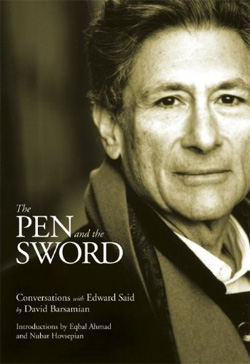
The Pen and the Sword

This review was originally published at the indispensable Electronic Intifada.

Edward Said was one of the great public intellectuals of the twentieth century – prolific, polymathic, principled, and always concerned to link theory to practice. Perhaps by virtue of his Palestinian identity, he was never an ivory tower intellectual. He never feared dirtying his hands in the messy, unwritten history of the present moment. Neither was he ever a committed member of a particular camp. Rather he offered a discomfiting, provocative, constantly critical voice. And against the postmodern grain of contemporary academia, his perspective was consistently moral, consistently worried about justice.

Said was primarily a historian of ideas. More precisely, he was interested in ‘discourse’, the stories a society tells itself and by which it (mis)understands itself and others. His landmark book “Orientalism” examined the Western narrative of empire in the Islamic Middle East, as constructed by Flaubert and Renan, Bernard Lewis and CNN. Said’s multi-disciplinary approach, his treatment of poetry, news coverage and colonial administration documents as aspects of one cultural continuum, was hugely influential in academia, helping to spawn a host of ‘postcolonial’ studies. Said’s “Culture and Imperialism” expanded the focus to include Western depictions of India, Africa, the Caribbean and Latin America, and the literary and political ‘replies’ of the colonised.

Continue reading “The Pen and the Sword”