What Used To Be Home

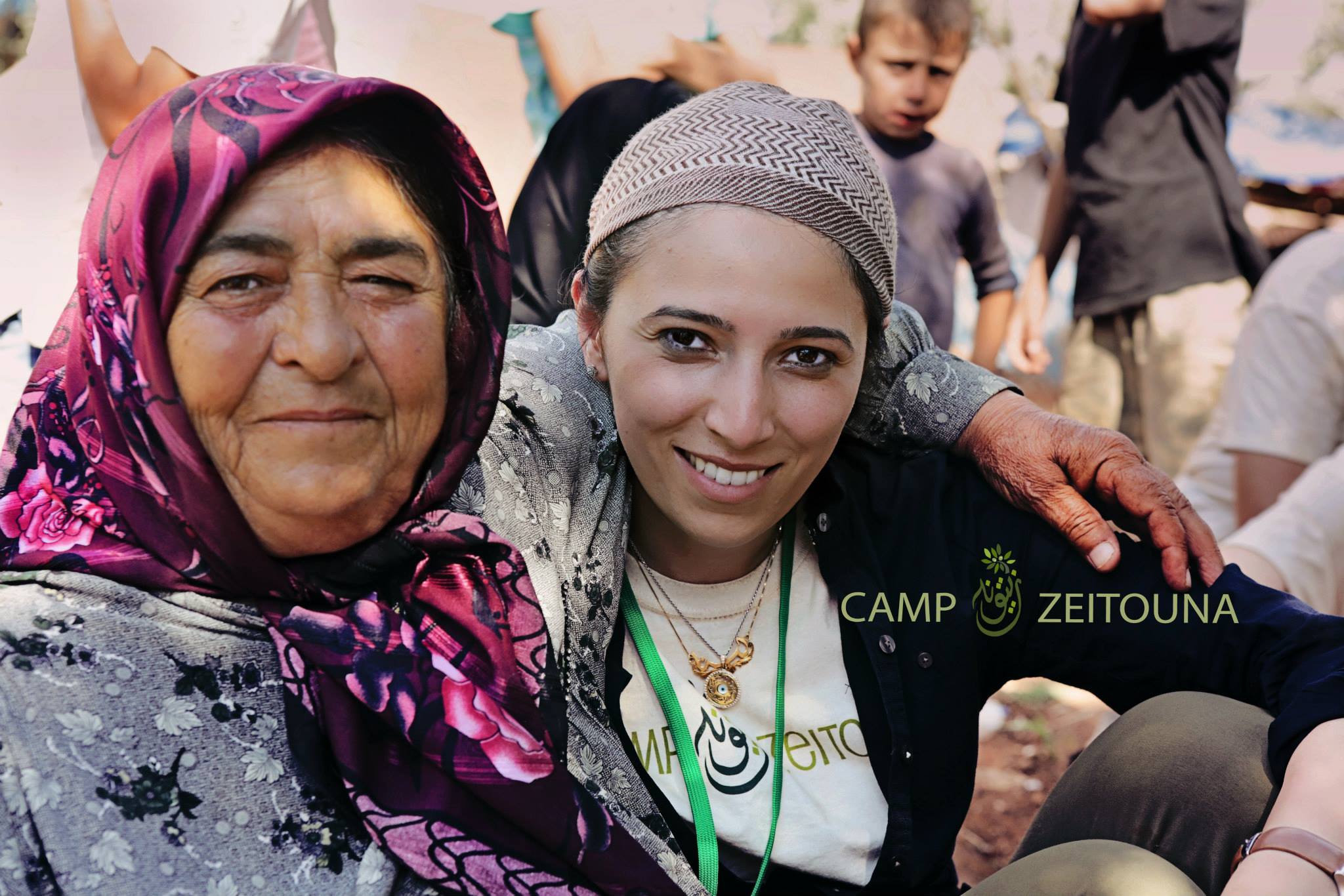
Lina Sergie Attar with a woman from rural Idlib, Atmeh camp, Syria. photo by Mohamed Ojjeh

Syrian-American architect Lina Sergie Attar is the founder of the Karam Foundation and its Zeitouna project which brings hope to Syrian displaced and refugee children, many of whom are traumatised, all of whom have lost great chunks of their schooling. Pulse co-editor Robin Yassin-Kassab participated in June’s Camp Zeitouna in the Atmeh camp on the Syrian side of the Turkish border. In this moving piece, originally published at the New York Times, Lina describes the workshop she led with the children in their hot and dusty tented school – mapping a floor plan of their abandoned homes – and what it meant to them. Please donate to the project and Karam’s other work inside Syria here.

by Lina Sergie Attar

“We comfort ourselves by reliving memories of protection.”

Gaston Bachelard, The Poetics of Space

Standing in a stuffy tent while facing over forty children crowded onto small benches, their dusty faces propped up by weathered, lean arms, I feel a bit nervous. They study me curiously. I tell them that I’m Syrian, from Aleppo, and that I’m an architect. I turn towards the cracked whiteboard and begin to draw with the streaky, half dried-up marker. “I haven’t been to my family’s home for over two years. When I miss it, I remember it like this.” Without turning around, I say, “Let me tell you a story about my home.”

***

After enduring two and a half years of the grueling brutality that defines Syria, the fall of Assad’s regime is no longer the most pressing concern of most Syrians. Rather, “When will we return home?” is the question that haunts the over seven million displaced Syrians. Of course, the fact that the first concern is the reason the second one exists adds to the country’s mass despair.

Last winter in Atmeh, the largest of Syria’s border camps for the internally displaced, the longing to return home was repeated to me over and over — sometimes in anger, other times in sorrow. I could not answer their inquiry, “Will we ever return home?” except with the traditional, “God  willing.” A response that should have been comforting if my wavering voice hadn’t betrayed my uncertainty.

When I returned to Atmeh last June, the camp had doubled in size from 12,000 to over 24,000 people who had fled their villages and towns to seek refuge in rows of tents between the olive trees — literally in no man’s land. They were as I had left them, still surviving without running water, electricity, and adequate sanitary services. The biting cold of December had been exchanged with the suffocating summer heat. The snow-white tents were now permanently coated with brown dirt streaks. The camp which had been still in formation a few months before, now felt unsettlingly settled.

I did not return alone. I returned with a team of Syrian expatriates to hold an educational mentorship program for displaced children called Zeitouna. The idea behind Zeitouna was to inspire and engross Syrian children with creative and athletic workshops that would engage their young minds. We returned to show them that they mattered. And that they had not been forgotten.

Continue reading “What Used To Be Home”

Tariq Ali on the Arab Revolutions

Over at Not George Sabra, Malik Little criticises Tariq Ali’s orientalist take on the Arab revolutions.

“What is a revolution?” asks Marxist Tariq Ali in a recent article. He answers, “a transfer of power from one social class (or even a layer) to another that leads to fundamental change.”

Ali never gets around to defining what exactly constitutes “fundamental change,” but he knows for sure that whatever “fundamental change” is, there has been none of it in the Arab world since 2011.

Does the end of the Ben Ali dictatorship in Tunisia and the destruction of its secret police count as “fundamental change? For Ali, no. After decades of a life of comfort and privilege in West, it seems Ali has forgotten what it is like to live under the thumb of a police state and murderous military rule. He has forgotten what a “fundamental change it is to be ruled by elected institutions and politicians rather than tyrants and generalissimos.

Since Ben Ali was ousted, there have been two general strikes called by the main union federation.

For Ali, this is no big deal. How do we know? He never mentions Tunisia or its people even once in his half-assed self-serving overview of the Arab Spring’s non-revolutionaryness, a double oversight since Tunisia is why the Arab Spring happened in the first place.

Instead, Ali goes on to ‘analyze’ events in Egypt where the counter-revolution has triumphed. He uses this triumph to deny that a revolution ever happened. Woe to V.I. Lenin who continued to write about the Russian revolution of 1905 even after it was smashed by the Tsar and Karl Marx who continually referred to the lessons he learned in the abortive German revolution of 1848-1849 for failing to match the insightful wisdom of Tariq Ali, a man who knows a revolution is only a revolution when it succeeds!

The next stop on Ali’s “nothing to see here” tour is Libya:

“In Libya, the old state was destroyed by NATO after a six-month bombing spree and armed tribal gangs of one sort or another still roam the country, demanding their share of the loot. Hardly a revolution according to any criteria.”

No mention of course of the General National Congress election of 2012 that went off without a hitch to the immense jubilation of the long-suffering Libyan people. Mentioning inconvenient facts like this might make Westerners sympathetic to the their difficult struggle to build institutions out of the ashes of 42 years of one-man rule by a deranged tyrant. No discussion of what class rules Libya today is necessary. Better to talk up “armed tribal gangs” in true Orientalist fashion. Who better than a brown man to play on the fears peddled by the white man to convince Westerners that there’s no revolution in Libya for them to solidarize with? Ali knows that if there’s anything Westerners love to hate, it’s Muslims.

In tribes.

With guns.

Throwing up gang signs.

Continue reading “Tariq Ali on the Arab Revolutions”

Amal Hanano on Kafranbel

kafranbel1First published at Foreign Policy, the great Syrian journalist Amal Hanano describes her visit to Kafranbel last June (I was honoured to accompany her), and the revolutionary town’s changing strategy in the face of global indifference to (or orientalist misrepresentation of) the Syrian people’s struggle. “Many activists inside and outside Syria,” she writes, “realize that there is no longer a reason to convince the world to action. No one is coming to save Syria.”

KAFRANBEL, Syria — The Syrian revolution’s heart — not yet ravished by the regime or Islamist extremists — beats on in the northern town of Kafranbel, where a group of dedicated activists has captured the world’s attention through witty posters and banners that reflect the state of the revolt since spring 2011. And even as the Syrian narrative has increasingly focused on the extremists or an international plan to dismantle the Assad regime’s chemical stockpiles, the artists of Kafranbel have been engaged in their own struggle — to win back the support of residents of their own town.

The 40-year-old Raed Faris and his partner, 33-year-old Ahmad Jalal, are the creative duo behind the banners. Faris — a tall man with a booming laugh — writes the banners, while Jalal, quiet and shy, draws the cartoons. Together, they spend their time brainstorming, researching, and connecting with others on how to display Syria’s tragedy to the world.

The banners express sophisticated geopolitical analysis in the simplest of forms. They are often inspired by iconic pop culture references: Faris and Jalal have used a Pink Floyd album cover, the Titanic movie poster, and even The Lord of the Rings to describe what is happening in Syria. No side in the crisis was spared — not the Syrian regime and its allies, not the Western powers and the United Nations, not the exiled Syrian opposition, and not even the radical jihadists who eventually came to live among the activists.

Kafranbel’s messages traveled the world. A large collection of the posters and banners was smuggled out of Syria to protect them from being destroyed, and they were displayed as exhibitions across the United States and Europe. One poignant banner — carried in front of the White House last spring on the second anniversary of the revolution — adapted and adopted Martin Luther King Jr.’s timeless words: “I have a dream, let freedom ring from Kafranbel.”

Banners like this one — along with the famous response to the Boston Marathon bombing — drove home the universal and historic nature of the Syrian struggle. Kafranbel’s artists consistently made these connections to show that Syria’s war was not an event isolated by time or geography.

What made Kafranbel’s messages unique was their relentless insistence to reach out to the world. The banners expressed empathy and solidarity: “You are not alone; we suffer with you.” But another message was always embedded: “Do not leave us alone. Do not forget about us.”

But the world read the banners, and did nothing. Eventually, Kafranbel — and by extension, Syria — were disappointed by their global audience.

Continue reading “Amal Hanano on Kafranbel”

The West is Wrong on Syria

by Razan Zaitouneh

Human rights lawyer Razan Zaitouneh bemoans the West’s indifference to Assad’s crimes, its focus on chemical weapons but not on the starving children in the areas besieged by Assadist forces, and its failure to arm the Free Army. This was first published at The Damascus Bureau.

Why does the West insist on dealing with our dead and injured as if they were less valuable than a Westerner – and as if our casualties don’t even deserve respect or compassion?

After the chemical massacre in Syria’s two Ghoutas, we believed that the world would, at last, take our interests into account in one way or another. We did not believe that, upon seeing hundreds of dead children, the international community would act only in favour of its narrow interests.

The chemical massacre was a milestone, not only in the Syrian revolution, but also in the Syrians’ consciousness and minds.

I witnessed the massacre myself. I saw the bodies of men, women and children in the streets. I heard the mothers screaming when they found the bodies of their children among the dead

As a human rights activist who has always believed in the humanitarian principles of the United Nations, I can talk for hours about the psychological breakdown and the amount of humiliation I felt after the adoption of UN Security Council resolution 2118. This resolution implies that Bashar al-Assad will continue to rule Syria for at least one more year, with the international community’s acquiescence. The resolution also reveals the lie we have all been living regarding the human rights principles that have not been applied, not even in form, in Syria.  If this is how I have been affected, how does the ordinary Syrian citizen, who has never believed our misleading slogans about human unity and equality, feel after suffering such discrimination and injustice?

The world goes further in disrespecting the sufferings of the Syrians by awarding the Nobel Peace Prize this year to the Organization for the Prohibition of Chemical Weapons. This award shows the West has exchanged its moral ethical obligations for the legal ones.

Meanwhile Assad, the real criminal, is free because no one cares.

Continue reading “The West is Wrong on Syria”

Revolutionary Gardening

the radishes are at ground level

For a long time it’s been too late for a happy ending in Syria. The longer this process continues, the less we can hope for.

How do you fight a monster without becoming a monster? How, particularly when the monster’s chief strategy is to make a monster of you? How, when the world’s most powerful storytellers depict you as a monster? How, when monsters hiding behind human facades walk by blindly as you are tortured, raped, humiliated, maimed, murdered?

I don’t really know. I’d welcome a reading list, if anyone has one.

I know this monster must be fought, even if we become monsters while fighting it. I know we must fight both internally and externally. I know the greater and lesser jihads must be fought simultaneously.

At some point, somehow, this stage will be replaced by another. Most probably that stage like this one will be bumbled through blindly. Human beings seldom or never achieve control over their larger social movements. Still, it’s pleasant to imagine that Syrians will be able to defuse the sectarian tensions which have existed at least since ibn Taymiyyeh, which were immeasurably exacerbated by Sykes-Picot and the French occupation’s construction of an ‘army of minorities’, and then set afire by Assad’s gang and its allies. It’s good to hope too that a new constitution will guard against any party, clique or ideological police imposing its straitjacket on the plural people.

Beyond religion and politics, environmental factors should also be taken into account.

It’s interesting to note that Jared Diamond’s three factors of civilisational collapse (deforestation, soil erosion, water management problems) have been present in Syria since late Ottoman times, and rampant in the last couple of decades. People my age who grew up in Damascus remember that in their childhoods the Ghouta still consisted of orchards and streams, that summer temperatures almost never climbed above the mid to high thirties. You don’t have to be my age to remember the Barada as an actual river, rather than a layer of concrete and a few stinking pools. Wasn’t Damascus the city the Prophet refused to enter, fearing to sin by imagining himself prematurely in paradise? The dicatorship’s corruption (anyone with connections or money could build in the green zone) put paid to that. Stupidly grand development schemes repeated the pattern all over the country (Lake Assad, like Lake Nasser, was an environmental and social disaster – see Omar Amiralay’s film A Flood in Ba‘ath Land – a wonderful exercise in quiet irony). People’s lack of control over the public space meant they were alienated from it, and threw black plastic bags all over it (this explains the discrepancy between people’s spotlessly clean homes and the filth in the streets outside). Over the decade before the revolution erupted, a million climate change refugees, according to the UN, left the desertifying north east for the impoverished outskirts of Dera’a, Homs, Damascus and Aleppo. This, combined with the effects of Bashaar’s crony capitalism, provides the backdrop to the uprising. The revolutions to the west, and the monster’s extreme violence, provided the spark.

Continue reading “Revolutionary Gardening”

A Slaughter of Alawi Innocents

For the first time there is proof of a large-scale massacre of Alawis – the heterodox Shia offshoot sect to which Bashaar al-Assad belongs – by Islamist extremists among Syrian opposition forces. In its context, this disaster is hardly surprising. It follows a string of sectarian massacres of Sunni civilians (in Houla, Tremseh, Bayda and Banyas, and elsewhere), the sectarian ethnic cleansing of Sunnis from areas of Homs province, and an assault on Sunni sacred sites such as the Khaled ibn al-Waleed mosque in Homs, the Umawi mosque in Aleppo, and the Omari mosque in Dera’a. It follows two and a half years of rape, torture and murder carried out on an enormous scale by a ‘Syrian’ army commanded by Alawi officers and backed by sectarian Shia militias from Iraq, Iran and Lebanon, and by Alawi irregular militias. Assad and his backers have deliberately instrumentalised sectarian hatred more effectively than the Americans did in Iraq, and they must bear the lion’s share of responsibility for the dissolution of Syria’s social mosaic. Next, the counter-revolutionary forces in the West (chief among them the United States) must be blamed for obstructing the flow of arms to the Free Syrian Army, a policy which has inevitably strengthened the most extreme and sectarian jihadist groups (some of whom, such as the foreign-commanded Islamic State of Iraq and Syria, are actively fighting the Free Army). Human Rights Watch’s important report on the massacre of Alawi villagers is summed up in the video below. Sadly, HRW fails to adequately distinguish between Syrian and foreign, and moderate and extremist anti-Assad militias. The excellent EAWorldview critiques the report here. Its conclusion:

The HRW report illustrates the dangers of conflating the various factions of the insurgency under the heading “armed opposition groups”.

Coincidentally, that conflation is a tactic of the regime who seeks to portray the insurgency as extremist-led, largely foreign fighters rather than an extension of the indigenous protest movement that took up arms after Assad’s forces used violence to quash it from March 2011.

By this conflation, HRW (a fine organisation which has done great work in uncovering the truth of the Syrian conflict) veers dangerously close to the orientalist/racist stereotyping of the Syrian people’s struggle now dominant in both the rightist and liberal/leftist Western media.

It goes without saying that the crimes committed against Alawi civilians in northern Lattakia province are grotesque and idiotic, and constitute another strategic blow against the revolution and the survival of the Syrian state.

Khaled Khalifa: Silence is Disgraceful Too

The following is an interview with the renowned Syrian writer Khaled Khalifa, which was released on the 2nd Sept 2013. Pulse editor Robin Yassin-Kassab was honoured to be asked to write the introduction to the English translation of Khaled Khalifa‘s third novel, In Praise of Hatred. Some of that introduction is available here.

Continue reading “Khaled Khalifa: Silence is Disgraceful Too”

Gilbert Achcar on the Syrian Revolution

In this interview published at Socialist Resistance, the clear-sighted leftist Gilbert Achcar explains the importance of standing in solidarity with Syria’s popular revolution and the need to resist the propaganda of Western, Russian, and Gulf counter-revolutionary forces. Achcar is interviewed by Terry Conway.

TC: Could you assess the present state of the Arab uprising in general before we focus more specifically on Syria?

GA: What is happening now is a confirmation of what could be said from the start; the fact that what began in December 2010 in Tunisia, was not a ‘Spring’ as the media called it, a brief period of political change during which one despot or another is overthrown, opening the way for a nice parliamentary democracy, and that’s it. The uprisings were portrayed as a ‘Facebook revolution’, another one of these ‘colour revolutions’.  I, for one, insisted from the beginning that this was a misrepresentation of reality. What started unfolding in 2011 was a long-term revolutionary process, which would develop over many, many years if not decades, especially if we take into account its geographic extension.

From that perspective, what we have had so far is just the opening phase of the process. In some countries they have managed to go beyond the initial stage of overthrowing existing governments; this was the case in Egypt, Tunisia and Libya – the three countries where the regimes were overthrown by the uprising. And you can see that these countries are still in a state of turmoil, instability, which is usual in revolutionary periods.

Those eager to believe that the Arab uprising has ended or was stillborn focused on the initial victory of Islamic forces in elections in Tunisia and Egypt. Against such doomsayers, I stressed the fact that this was actually unavoidable since elections held shortly after the overthrow of the despotic regime could only reflect the balance of organised forces that existed in these countries. I argued that the Islamic fundamentalists’ period in power would not last long, if we consider the real roots of the revolutionary process.

This long-term revolutionary process is rooted in the social reality of the region, characterised by many decades of stalled development – a higher rate of unemployment, especially youth unemployment, than in any other region in the world over several decades.  These were the real basic causes of the explosion, and as long as these causes are not addressed, the process will continue. Any new government which has no solutions to these root problems will fail. It was predictable that the Muslim Brotherhood would fail: in my book The People Want, which was of course written before Morsi’s overthrow in Egypt, I argued that the Muslim Brotherhood would fail inevitably. I wrote the same about Ennahda in Tunisia, which is now faced with a very strong protest movement that puts the future of the government in question.

So there is an ongoing process throughout the region, which, like any revolutionary process in history, has ups and downs, periods of advances and periods of setbacks – and sometimes ambiguous periods. The most ambiguous event in the whole process until now has been the recent experience in Egypt where we saw this huge mass mobilisation against Morsi on 30 June, which was a very advanced experience in democracy by a mass movement asking for the recall of an elected president who had betrayed the promises he made to the people. But at the same time, and here lies the ambiguity of course, you had the military coup and widespread illusions that the army could play a progressive role, including amongst dominant sections of the broad left as well as amongst liberals.

Continue reading “Gilbert Achcar on the Syrian Revolution”

Streets of Freedom

This excellent documentary on the early days of Syria’s popular revolution was the last work of the martyred film-maker Bassel Shehadeh.