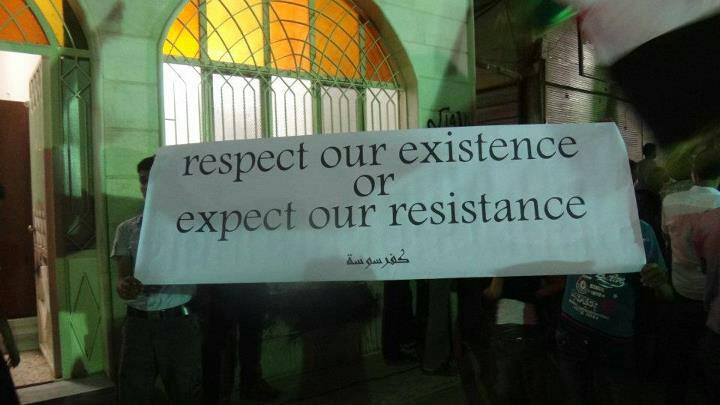
The Left, Imperialism, and the Syrian Revolution

by Corey Oakley

This was first published at Socialist Alternative.

Of the millions of people who have risen up in revolt across the Arab world these past 19 months, few have suffered as much for their courage as the revolutionaries fighting the Assad dictatorship in Syria.

The decision of Bashar al-Assad’s regime to use the full force of his security forces against what was a largely peaceful protest movement has transformed the uprising into a full blown civil war, in which up to 20,000 people have died.

Yet the Syrian revolution – in the eyes of some on the left – lacks legitimacy. The uprising is denounced as a Western plot, a CIA- or Israeli-backed conspiracy to overthrow a regime that defends the Palestinians. Those fighting Assad’s troops on the ground are condemned as stooges of outside forces – variously Saudi Arabia, the US, Israel and Al Qaeda, among others.

In the West, open support for Assad has been mostly confined to hardline Stalinists or a minority of Assad loyalists among the Palestinian movement. Most on the left initially took a version of what has been called the “third way” – support for the revolution, combined with opposition to imperialist intervention from the West.

But over the last few months, this “third way” has begun to crack apart.

Prominent British leftists Tariq Ali and George Galloway have come out stridently in opposition to the insurrectionary aims of the uprising, claiming that the revolution has been taken over by reactionaries and arguing that a negotiated settlement with the regime is the only answer. Ali, in an interview with Russia Today, said the choice was between a “Western imposed regime, composed of sundry Syrians who work for the Western intelligence agencies…or the Assad regime.” Galloway, the left populist MP best known as a campaigner against the Iraq war, goes even further, denouncing the Syrian resistance for not accepting the peace plan advanced by the UN.

Much of this left-agonising about the Syrian revolt reflects the legacy of Stalinism, which led many to identify leftism with various despotic but “anti-imperialist” regimes that opposed the West and oppressed their own people in equal measure. But others on the left not weighed down by the legacy of Stalinism echo Galloway’s attitude over Syria. John Rees, until a few years ago a leading member of the Socialist Workers’ Party, wrote last month that he was in “broad agreement” with Galloway and Ali.

Continue reading “The Left, Imperialism, and the Syrian Revolution”

Palestinians on the Road to Damascus

by Ahmad Diab

A Temporary People

One hot summer day in 2011, the residents of the beleaguered Homs neighborhood of Al-Khaldyeh were struggling to identify the bodies of two men. There was something unusual about the bodies even by the now morbidly gory Syrian standards. They were merely skeletons with worn-out fatigues, and a few personal belongings. The unearthing of their bodies was collateral damage to a stray bomb. They had been blown out of their unmarked shallow makeshift grave by the shells of the Syrian army against the rebellious neighborhood. The residents decided the belongings were clearly from the 1980s, the military fatigues were Palestinian. The story of Syrian Palestinians – like that of most Syrians – is one of many tucked-away skeletons that are thrown into the open, unannounced yet badly needing to be addressed.

Syria is home to some half a million Palestinian refugees, the great majority of whom were born into a dictatorship that oppresses them and its own people in the name of Arab unity and steadfastness in the face of Zionism and imperialism. Their imagined and lived geographies could not be farther apart. They know the streets of Homs, Aleppo, Deraa, and Damascus like the palms of their hands. Their schools, named after their villages and towns in Palestine, hoist the flag of the United Nations.

Continue reading “Palestinians on the Road to Damascus”

To Kill, and to Walk in the Funeral Procession

photo by Razan Ghazzawi

Updated with a postscript noting Robert Fisk’s obscene pro-regime propaganda while embedded with the regime army in Darayya, and the response of the LCCs to Fisk’s nonsense.

The Syrian regime is now perpetrating crimes against humanity at a pace to match its crimes in Hama in 1982 and at the Tel Za’atar Palestinian camp in 1976. All of Syria is a burning hell. Savage aerial bombardment (such as that causing the apocalypse here in Kafranbel, which held such beautifully creative demonstrations) and continuous massacres have raised the average daily death toll to well above two hundred, most of them in Damascus and its suburbs. The other day 440 people were murdered in twenty four hours.

The worst hit area has been the working class suburb of Darayya. I visited people in Darayya some years ago, and once bought a bedroom set for a friend’s wedding in the town. I remember it as a lively, friendly, youthful place. Last year Darayya became a cultural centre of the revolution. Ghiath Matar and others developed wonderful methods of non-violent protest there. When security forces arrived to repress demonstrations, Darayya’s residents handed the soldiers flowers and glasses of water. But Matar was murdered, and Darayya has been repeatedly raided, its young men detained and tortured, its women and children shot and bombed. Nevertheless, for some months the regime was kept out of Darayya. The town ruled itself in a civilised manner, successfully keeping a lid on crime and sectarianism.

The recent pattern is already well established (remember the massacre at Houla), but this time has played out on a larger scale. The regime bombed Darayya for days, mainly from artillery stationed on the mountains overlooking Damascus. Once any armed resistance had retreated, soldiers and shabeeha militia moved in, with knives and guns. This stage reminds one of Sabra and Shatila. It seems there was a list of suspected activists and resistance sympathisers, but the field executions included old men, women and children. About three hundred bodies have been counted so far, found in the street or in basements or in family homes.

Continue reading “To Kill, and to Walk in the Funeral Procession”

Dead journalists and Sister Agnes-Mariam

The Committee for the Protection of Journalists has an important report up by Dahlia El Zein. The attacks on media personnel affiliated with the Syrian regime has been rightly condemned. But not enough is said about the regime’s more systematic policy to co-opt and in some cases deliberately trap journalists for propaganda purposes. Most shocking however is the role of Sister Agnes-Mariam, the regime-affiliated nun who has been feted both by the far left and the Christian right. The nun has already been condemned by Father Paolo Dell’Oglio, who was expelled by the regime for his criticisms after spending 30 years of his life in the country. The following story is further indictment.

Evidence of government targeting in the deaths of the international journalists is circumstantial, although the journalists on the ground perceived that they were under attack. CPJ spoke with Sid Ahmed Hammouche, a reporter with the Swiss daily La Liberté who participated in the government-sponsored trip that ended in Jacquier’s death. He said he believes the government laid a trap for the reporters.

Gilles Jacquier (AFP)

Hammouche and Jacquier were among a group of 15 journalists allowed into Syria on government-issued visas facilitated bySister Agnes-Mariam de la Croix, a Lebanese nun of Palestinian origin with close relations to the Assad regime. Sister Agnes had helped arrange a reporting trip to Homs on January 11, although she declined to accompany the group, saying her absence would help them move freely. Jacquier resisted the Homs trip, believing it unsafe, but Sister Agnes urged him to go or risk losing the opportunity to renew his visa beyond the initial four-day period, Hammouche told CPJ in an account consistent with news reports.

Once they arrived in Homs, the journalists divided into two groups, one with journalists from CNN, CBS, and BBC who were led by the Ministry of Information to visit a local hospital. The other contingent included Hammouche, three French journalists, including Jacquier, his wife, Caroline Poiron, Jacquier’s cameraman, Christophe Kenck; and Swiss and Belgian journalists. That group was escorted by 20 Syrian soldiers dressed in military fatigues and in plainclothes. This group was also supposed to visit the hospital but they were detoured without explanation to a pro-Assad neighborhood, Hammouche said, where they interviewed residents. As they left the area, the group encountered a pro-Assad march and heard an explosion.

To his surprise, Hammouche said, the soldiers took no evident action to protect the journalists or respond to the explosion; instead, most of the soldiers dispersed without explanation, leaving four escorts who appeared relaxed and dismissed the noise as a “sound explosion.” Hammouche said the soldiers urged the journalists to go toward the explosions to investigate. Hammouche said he and a Swiss colleague refused, remaining in one of two government vehicles, but Jacquier and the others traveled toward the source of the initial explosion.

More explosions followed, Hammouche recounted: “There were four explosions total in a 10-minute period. And that’s it. We didn’t hear a sound after that.”

Continue reading “Dead journalists and Sister Agnes-Mariam”

Why Social Inequality Persists

Leading social commentators Danny Dorling and Kate Pickett discuss the persistence of injustice and the unacknowledged beliefs that propagate it.

History will not be kind to the Syrian regime…

The great Palestinian philosopher and former MK Azmi Bishara on the Syrian revolution.

1) Let’s suppose that impoverishment of the people and the suppression of their freedoms are marginal when placed in the context of a grander goal, such as defending the homeland. That would only make sense, however, during limited periods of time, such as during wars. Anyway, such claims do not justify the way in which the people have to share out the misery between them, while the rulers enjoy the riches. Nor does such sloganeering justify the institutionalized, systematic denial of the rights of their people. There is no justification for the tyranny and corruption of the rulers, and their appropriation of the fruits of the masses’ labour. Trying to exploit a cause held dearly by both the people and the regime to achieve this is the beginning of demagoguery, and it is a tool used solely to preserve the existence of the corrupt, tyrannical regime. None of this, of course, takes away from the righteousness of the cause being exploited, but it does serve to bestow legitimacy on an illegitimate regime. Rebellion against this tyranny will necessarily place the removal of that regime as its first target, but the sanctity of the just causes which the regime exploits must also be preserved. This applies when the question comes to US plans to dominate our region, seeking to design the policies of Arab states with Israeli interests at heart, as well as the question of Palestine and the duty to resist the occupation at every turn.

2) No people, anywhere in the world, would accept torture, false imprisonment, financial corruption and the muzzling of the media for generation after generation, regardless of the justification. Nor does anybody to have the right that those being persecuted remain quiet for the sake of grander concerns, without hopes for a change, all to placate commentators who seem to think that the suffering of the people is secondary to the “Central Question”, especially as all the evidence that no progress on that same “Central Question” in the first place.

Continue reading “History will not be kind to the Syrian regime…”

What happened in Houla?

On May 25, when regime militias entered the town of Houla and carried out a gruesome massacre killing 108, including 49 children, something very strange happened. Despite the fact that Channel 4 had entered the town the very next day and collected on-camera testimonies from survivors, reactionary outfits like MediaLens, media watchdogs like FAIR, and some left luminaries, including our friend Tariq Ali, started blaming the victims. There is no reason why official stories shouldn’t be doubted, but given the heinous nature of the crime, one would expect greater care with regard to evidence. As it happened, all of them were relying on a single article appearing in a German publication, written by an author who never visited Houla or met a survivor. This was no innocent mistake: it was pointed out to both Medialens and FAIR that their source was dubious and its claim highly questionable. The source was discredited soon afterwards, and Der Spiegel and the UN have since both confirmed the original reports. Neither Medialens nor FAIR has apologized. Here meanwhile is Al Jazeera’s investigation into the massacre.

On May 25, 2012, the once serene region of Houla in Syria became the scene of events that shocked the world – the massacre of around 100 civilians, almost half of them children. The Syrian regime blamed the massacre “terrorist” groups, but this investigation paints a different picture.

World Have Your Say: Syria

From the BBC World Service’s World Have Your Say. Robin Yassin-Kassab of PULSE joins other commentators to bring you the latest developments.

All Things Considered

Me on BBC Radio Wales discussing Syria’s Christian minority with Harry Hagopian, the lovely Nadim Nassar, and the strange English priest and admirer of the tyrant Christopher Gilham.