Yaara Bou Melhem of Dateline Australia manages to sneak in to Syria from Turkey to speak to members of the rebel opposition, including a rare interview with Colonel Riad al-Asaad, a leader of the Free Syrian Army.
1) After a legendary show of resistance in the face of an unprecedented onslaught of savagery, the Syrian revolutionaries can now almost touch their main aim: a change of regime. As I have said elsewhere, a lack of wisdom at this stage could lead to a complete destruction of the very country of Syria.
2) This progress would not have been made without the sacrifices of millions of Syrians, and tens of thousands of the armed rebels. Yet it must be said that some of the members of these armed groups used the opportunity to carry out personal vendettas, and others are clearly infiltrators into the Syrian cause. It is patently clear that foreign operatives have exploited the revolutionaries’ needs for financial and logistical support, not to mention their understandable grievances against the regime, to try and effect the course of events. In this regard, the assassinations of six Syrian scientists (including a missile expert) is a threatening development. The same can be said of the attempts of Iraqi Kurdish leader Masoud Barzani to try and control some of the Kurdish-populated areas of Syria; bear in mind that the Syrian Kurds’ National Council is now well armed, whilst not having taken part in the revolution itself. We cannot assume that the Israelis and the CIA will stand backk and just watch. (Put another way: was the removal of the former head of the Saudi Arabian intelligence service a mere coincidence?) The recent statements made by Israeli and American statesmen on the question of Syria’s chemical weapons is to be taken seriously: their efforts are already underway. Anybody who doesn’t understand this point, clearly does not understand the way in which world powers and their regional counterparts attempt to achieve their aims, and does not understand the reality of the enmity [between the Israelis and the other countries in the region], nor does that person understand the strategic significance of Syria.
A message from the Syrian opposition: “We just want to thank our sponsors in the CIA, MI6, Mossad, al-Qaeda, Qatar and the House of Saud for their generous financial support and high tech communications equipment.”
The Syrian resistance has struck a major blow. In a targeted attack, it has killed Defence Minister General Daoud Rajha and his deputy, Assad’s brother-in-law Assef Shawkat. The blast also killed Hafez Makhlouf the head of interrogation in the general security services and Hasan Turkmani, the head of the crisis committee set up to crush the revolution. Robert Fisk comments:
While the capital’s inhabitants are viewed with contempt by people from Homs and Hama for not joining the revolution with gusto, many Damascenes are working behind the scenes. Businessmen fund food for displaced Syrians. Others open their doors to them, often cramming several families into a single flat. Traders have held strikes. Activists work to keep dialogue going between different sects.
According to friends and contacts in Damascus, the clash between the Syrian resistance and the regime has intensified. The regime is using artillery and gunships, and, according to latest video reports, bombers too. The brave Razzan Ghazzawi, who is reporting from Damascus, has gone offline. The regime has cut electricity to the city and her batteries have died. Assad’s jets are bombing the oldest capital in the world. Simon Assaf gives this overview:
Armed rebels took control over key neighbourhoods and are now surrounded. Yesterday regime troops failed to overrun these neighbourhoods and are attempting to put them under siege. But the fighting is now very mobile, and has spread to many areas of the city. Meanwhile every major front across the country is now in battle with orders to hit all regime positions and call for the surrender of troops. The FSA are attempting to cut off the reinforcements to the capital, and stretch regime forces.
Meanwhile, here is the story of survivors from the regime’s earlier assault on Homs.
One of my infantile leftist ex-friends recently referred to the Free Syrian Army as a ‘sectarian gang’. The phrase may well come from Asa’ad Abu Khalil, who seems to have a depressingly large audience, but it could come from any of a large number of blanket thinkers in the ranks of the Western left. I admit that I sometimes indulged in such blanket thinking in the past. For instance, I used to refer to Qatar and Saudi Arabia as ‘US client states’, as if this was all to be said about them. I did so in angry response to the mainstream Western media which referred to pro-Western Arab tyrannies as ‘moderate’; but of course Qatar and Saudi Arabia have their own, competing agendas, and do not always behave as the Americans want them to. This is more true now, in a multipolar world and in the midst of a crippling economic crisis in the West, than it was ten years ago. Chinese workers undertaking oil and engineering projects in the Gulf are one visible sign of this shifting order.
(My talk of ‘infantile leftists’ does not include the entire left of course. Simon Assaf of the Socialist Workers, for instance, understands what’s happening. So does Max Blumenthal. And many others.)
The problem with blanket thinkers is that they are unable to adapt to a rapidly shifting reality. Instead of evidence, principles and analytical tools, they are armed only with ideological blinkers. Many of the current crop became politicised by Palestine and the invasion of Iraq, two cases in which the imperialist baddy is very obviously American. As a result, they read every other situation through the US-imperialist lens.
I’ve just come back from the Hay Literature Festival in Beirut. Literature Across Frontiers asked me to write three posts on the experience. Here’s the third.
At this year’s Karachi Lit Fest, Hanif Qureishi asserted that the purpose of such festivals was “to give writers a social life.” I concur wholeheartedly, but still I admit I was a little scared to go to Beirut and socialise there. This is because several Syrians had advised me to avoid speaking about the revolution while in the city, and to watch my back in areas controlled by Syrian regime allies. “They know who you are,” they muttered darkly.
But I was fine. At no point did I feel under any threat. I presume the warnings tell us more about the fear so successfully planted in Syrian hearts than they do about the capacity of the flailing regime to hunt down obscure writers. True, one Syrian slit another Syrian’s throat outside the Yunes Cafe just a couple of minutes’ walk from my hotel one night. Reports varied as to whether the killing was personally or politically motivated. And true, writer Khaled Khalifa’s arm was still in a sling after being broken by regime goons during the funeral of murdered musician Rabee Ghazzy back in May. Khaled, whose most famous novel ‘In Praise of Hatred’ is about to be published in English by Doubleday (I’m writing the introduction), is a warm and gentle man who smiles irrepressibly despite it all. He spoke fearlessly during his event at the Hay Festival. He’ll be back in Syria now. In Beirut I asked him why he didn’t stay outside, in safety. He said he can’t, he becomes scared for his friends and family when he’s outside.
A new massacre in Tremseh, Hama. The actual footage is too gruesome, so we are posting an Al Jazeera report.
Syrian government troops using tanks and helicopters have killed more than 150 people in the central region of Hama, the Syrian Observatory for Human Rights has told the AFP news agency.
Maher Arar on the Syrian Intifada and the left’s confused response.
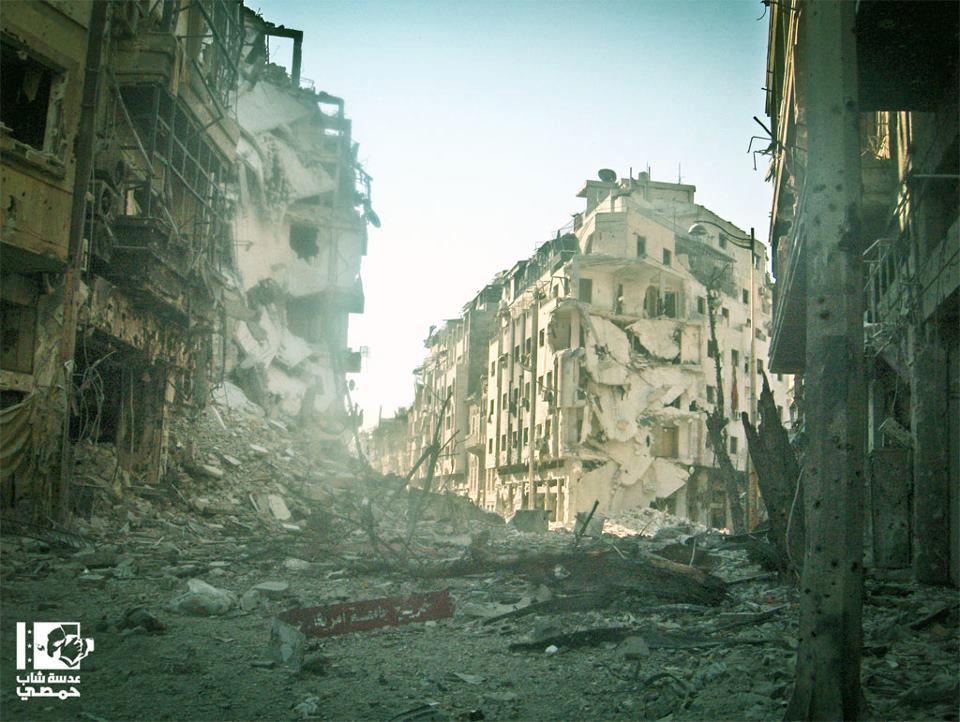
Homs after 37 days of a brutal siege
Deciding whether or not to oppose Syria’s rulers has been the recent dominant preoccupation of many anti-imperialist and left-leaning movements. This hesitant attitude towards the Syrian struggle for freedom is nurtured by many anti-regime actions that were recently taken by many Western and Middle-Eastern countries, whose main interest lies in isolating Syria from Iran. However, I believe a better question to ask with respect to Syria is whether the leftist movement should support, or not support, the struggle of the Syrian people.
What I find lacking in many of the analyses relating to the Syrian crisis, which I find oftentimes biased and politically motivated, is how well the interests of the Syrian people who are living inside are taken into account. Dry and unnecessarily sophisticated in nature, these analyses ignore simple facts about why the Syrian people rebelled against the regime in the first place.
A brief historical context is probably the best way to bring about some insight with respect to the events that are unfolding in front of our eyes today. Before doing so, it is important to highlight that, unlike many other Arab countries, Syria is not a religiously homogenous Middle-Eastern country. I am mentioning this because it is through religion that the majority of Arabs identified themselves for centuries. As it stands today, Syria’s population is composed 74 per cent of Sunnis (including Kurds and others), 12 per cent Alawites (including Arab Shia), ten per cent Christians (including Armenians) and three per cent Druze.



 P U L S E