The Image and the Imagined: On Why We’re not Allowed to see Detainee Abuse

By Aisha Ghani

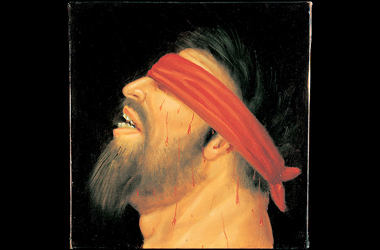
Abu Ghraib painting by Fernando BoteroBy Aisha Ghani


On Monday, November 30th the Supreme Court overturned a Second Circuit Court of Appeals order to release photographs of U.S. soldier abuse of prisoners in Afghanistan and Iraq. According to a statement by Solicitor General Elena Kagan, disclosing these photographs “would pose a clear and grave risk of inciting violence and riots against American troops and coalition forces.”

The contestation over the release of these photographs began four years ago, when a trials court judge claimed that the Bush administration was evading obligations imposed on it by the Freedom of Information Act in withholding the images. Although earlier this year the Obama administration argued in favor of releasing the photographs in an effort to encourage ‘transparency’, the decision was later reversed. While the Supreme Court has historically challenged the state’s assertions in cases concerning the rights of detainees, this time they sided with the  Obama Administration, permitting the Pentagon to block the release of these photographs and others like them.

Are we to believe that concern for the safety of U.S. soldiers and civilians lies at the heart of this decision, or can we sense a certain disingenuity when we think about how the state endangers both soldiers and civilians everyday by subjecting them to war?  Insincerity, as George Orwell tells us, is “the gap between one’s real and declared aims.”

What is it about the nature of the image in general and, more specifically, about the ‘possible’ content of these images in particular that is creating a palpable gap between the state and judiciary’s real and declared aims?

Continue reading “The Image and the Imagined: On Why We’re not Allowed to see Detainee Abuse”

Views on Torture

Torture

So there is higher public support for torture in the US than in Iran, China or Russia. But not nearly as much as the support it has among Indians. (from The Economist, via Carlos)

Busted, Pentagon

Abu Ghraib (Fernando Botero)

Why The Photos Probably Do Show Detainees Sodomized and Raped. Naomi Wolf explains:

(MIA: I am not quite sure why this is being treated as new information when Seymour Hersh had reported on the videos of Iraqi children being sodomized soldiers five years back, and again three years later in his profile on Gen. Antony Taguba Hersh revealed that there were cases of rape, and that Taguba had seen ‘a video of a male American soldier in uniform sodomizing a female detainee’. It was likewise revealed in an earlier investigation that an investigator from the mercenary firm Titan Corp., named Adil Nakhla was charged with sodomizing an Iraqi boy).

The Telegraph of London broke the news – because the US press is in a drugged stupor — that the photos Obama is refusing to release of detainee abuse depict, among other sexual tortures, an American soldier raping a female detainee and a male translator raping a male prisoner. The paper claims the photos also show anal rape of prisoners with foreign objects such as wires and lightsticks. Major General Antonio Taguba calls the images `horrific’ and `indecent’ (but absurdly agrees that Obama should not release them – proving once again that the definition of hypocrisy is the assertion that the truth is in poor taste).

Predictably, a few hours later the Pentagon issues a formal denial.

Continue reading “Busted, Pentagon”

‘These colours don’t run’

From Colombian painter Francisco Boteros series depicting US abuse of Iraqi detainees.
From Colombian painter Fernando Botero's series depicting US abuse of Iraqi detainees.

Guantanamo, Abu Ghraib, and Bagram are well known. Less so the police detention centers where the innocents caught in the ‘war on terror’ dragnet were subjected to similar abuses. Inigo Thomas reveals:

In his remarks to the American Enterprise Institute last week, Dick Cheney said that inmates at Guantánamo should remain imprisoned on Cuba because they are too dangerous to be incarcerated in American jails. What about the Americans arrested and jailed under the terms of the war on terror? Should they be incarcerated on Cuba, or does Cheney suppose that Americans are, regardless of what they have done, inherently less dangerous than other people and therefore don’t need to be jailed at Guantánamo?

Nor – surely – can Cheney have forgotten that immediately after 9/11, hundreds of men were rounded up by the FBI and other police forces in the US and imprisoned in high security American jails: 760 in total, 184 of whom were considered especially interesting by the authorities. Just over half of them were interred at the Metropolitan Detention Center in Brooklyn, a former warehouse on the waterfront overlooking the harbour and the Statue of Liberty. The story was covered by the New York Times, but it was treated, mostly, as local news and carried in the ‘New York Region’ section of the paper.

Continue reading “‘These colours don’t run’”

The Torture Memos

guantanmoNoam Chomsky examines the recently released torture memos and puts them in a historical context.

“Bush, of course, went beyond his predecessors in authorizing prima facie violations of international law, and several of his extremist innovations were struck down by the Courts. While Obama, like Bush, eloquently affirms our unwavering commitment to international law, he seems intent on substantially reinstating the extremist Bush measures.”

Continue reading “The Torture Memos”

Torture Continues at Guantánamo Bay

Steve Bell on Military Commissions

An important piece of investigative journalism by Jeremy Scahill exposing the brutal practices of the ‘Immediate Reaction Force’ better known to the prisoners as the ‘Extreme Repression Force’ – at Guantanamo. Based on new evidence obtained by the Spanish court which initiated criminal proceedings against John Yoo, Jay Bybee, David Addington, Alberto Gonzales, William Haynes and Douglas Feith several weeks ago, prisoners speak of routine terror which include breaking bones, gouging eyes, squeezing testicles, and “dousing” them with chemicals. The repression is said to have only intensified since Obama got into office, who reinstated the use of  ‘military commissions‘ last week, deemed unconstitutional by the US Supreme Court.

As the Obama administration continues to fight the release of some 2,000 photos that graphically document U.S. military abuse of prisoners in Iraq and Afghanistan, an ongoing Spanish investigation is adding harrowing details to the ever-emerging portrait of the torture inside and outside Guantánamo. Among them: “blows to [the] testicles;” “detention underground in total darkness for three weeks with deprivation of food and sleep;” being “inoculated … through injection with ‘a disease for dog cysts;'” the smearing of feces on prisoners; and waterboarding. The torture, according to the Spanish investigation, all occurred “under the authority of American military personnel” and was sometimes conducted in the presence of medical professionals.

More significantly, however, the investigation could for the first time place an intense focus on a notorious, but seldom discussed, thug squad deployed by the U.S. military to retaliate with excessive violence to the slightest resistance by prisoners at Guantánamo.

Continue reading “Torture Continues at Guantánamo Bay”

UAE “torture” scandal and cover-up sparks outrage in the U.S.

Glenn Greenwald’s delightfully ironic take on the UAE torture scandal. A must read.

As more videotapes emerge documenting the torture inflicted on numerous victims by Sheikh Issa bin Zayed al-Nahyan, a prince of the United Arab Emirates, the controversy is beginning to jeopardize the UAE’s relationship with the United States, a country that absolutely loathes torture and demands real accountability for those who do it:

“I have more than two hours of video footage showing Sheikh Issa’s involvement in the torture of more than 25 people,” wrote Texas-based lawyer Anthony Buzbee in a letter obtained by the Observer.

The news of more torture videos involving Issa is another huge blow to the international image of the UAE . . . . The fresh revelations about Issa’s actions will add further doubt to a pending nuclear energy deal between the UAE and the US.  The deal, signed in the final days of George W Bush, is seen as vital for the UAE.  It will see the US share nuclear energy expertise, fuel and technology in return for a promise to abide by non-proliferation agreements. But the deal needs to be recertified by the Obama administration and there is growing outrage in America over the tapes. Congressman James McGovern, a senior Democrat, has demanded that Hillary Clinton, the US secretary of state, investigate the matter and find out why US officials initially appeared to play down its significance.

The U.S. is a very tolerant nation, but the one thing we simply cannot abide is when a government fails adequately to investigate allegations of torture on the part of key officials and fails to hold them accountable.  That’s where we draw the line.

Continue reading “UAE “torture” scandal and cover-up sparks outrage in the U.S.”

If Obama won’t prosecute, Spain will

Michael Ratner: Obama has a duty to prosecute while a Spanish judge moves ahead on his own.

Continue reading “If Obama won’t prosecute, Spain will”

Sheikhs, lives and videotape

‘A member of the UAE royal family is accused of torture – but is there any chance of justice when the country’s rulers are the law?’ asks Brian Whitaker.

The atrocities of Abu Ghraib caused much rightful indignation – and nowhere more so than in Arab countries where the sadistic torture of prisoners at the hands of their American jailers was viewed as symbolising the rape of Iraq by a foreign power.

I remember discussing this at the time with Hisham Kassem, a newspaper editor in Cairo who – contrary to the prevailing Arab view – described the coverage of Abu Ghraib by the Egyptian press as “shameless”.

“They talk about American monstrosities as if their own governments have never practised anything similar,” he said. “It’s nothing in comparison to what’s happening in Arab prisons.”

Continue reading “Sheikhs, lives and videotape”

Torture? It probably killed more Americans than 9/11

A US major reveals the inside story of military interrogation in Iraq in this report by Patrick Cockburn, winner of the 2009 Orwell Prize for journalism

The use of torture by the US has proved so counter-productive that it may have led to the death of as many US soldiers as civilians killed in 9/11, says the leader of a crack US interrogation team in Iraq.

“The reason why foreign fighters joined al-Qa’ida in Iraq was overwhelmingly because of abuses at Guantanamo and Abu Ghraib and not Islamic ideology,” says Major Matthew Alexander, who personally conducted 300 interrogations of prisoners in Iraq. It was the team led by Major Alexander [a named assumed for security reasons] that obtained the information that led to the US military being able to locate Abu Musab al-Zarqawi, the head of al-Qa’ida in Iraq. Zarqawi was then killed by bombs dropped by two US aircraft on the farm where he was hiding outside Baghdad on 7 June 2006. Major Alexander said that he learnt where Zarqawi was during a six-hour interrogation of a prisoner with whom he established relations of trust.

Continue reading “Torture? It probably killed more Americans than 9/11”